
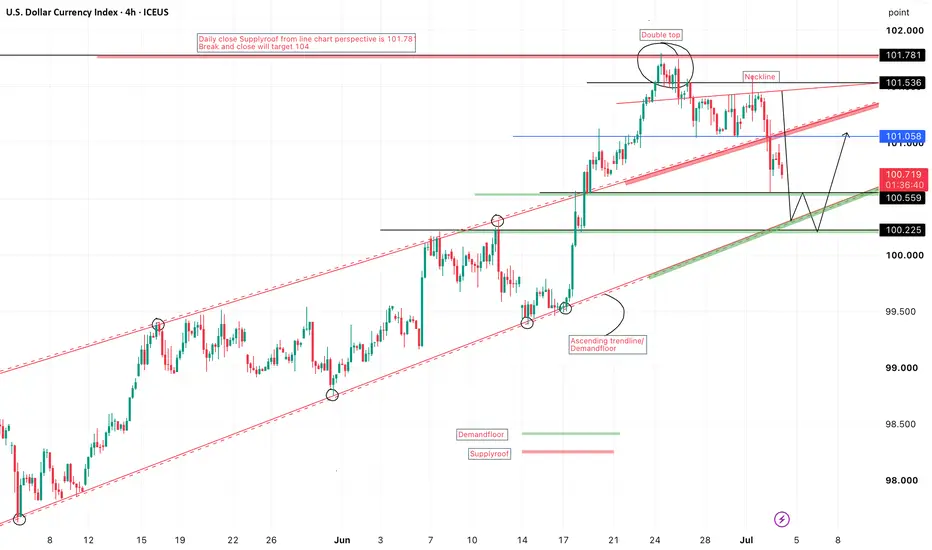
Dollar What is DXY?
The DXY (or USDX) measures the value of the US Dollar (USD) against a weighted basket of six major currencies:
• Euro (EUR) ~57.6%
• Japanese Yen (JPY) ~13.6%
• British Pound (GBP) ~11.9%
• Canadian Dollar (CAD) ~9.1%
• Swedish Krona (SEK) ~4.2%
• Swiss Franc (CHF) ~3.6%
A rising DXY = stronger USD. A falling DXY = weaker USD. Current levels are around 100.8–101 (as of early July 2026). 
How DXY Affects Gold (XAU/USD)
Gold and DXY have a strong negative (inverse) correlation — typically between -0.5 and -0.8 historically. 
• Stronger USD (↑ DXY) → Lower gold prices: Gold is priced in USD. A stronger dollar makes gold more expensive for buyers using other currencies, reducing demand and pressuring prices down.
• Weaker USD (↓ DXY) → Higher gold prices: Gold becomes cheaper for international buyers, boosting demand. Gold also acts as a hedge against dollar weakness.
Exceptions: During extreme crises (e.g., major geopolitical events or simultaneous safe-haven flows), both can sometimes rise together temporarily. 
How DXY Affects Other Currency Pairs (“Other Pairs”)
Since DXY tracks the USD’s strength, it has a direct impact on most USD-based forex pairs:
• Negative correlation pairs (DXY up → pair down):
• EUR/USD: Heavily weighted in DXY — strong inverse link.
• GBP/USD, AUD/USD, NZD/USD, etc. (commodity currencies often move with risk sentiment too).
• Positive correlation pairs (DXY up → pair up):
• USD/JPY, USD/CHF, USD/CAD (these strengthen when USD does).
Practical trading tip: If DXY is breaking higher, expect downward pressure on EUR/USD, GBP/USD, and gold.
#DXY

คำจำกัดสิทธิ์ความรับผิดชอบ
ข้อมูลและบทความไม่ได้มีวัตถุประสงค์เพื่อก่อให้เกิดกิจกรรมทางการเงิน, การลงทุน, การซื้อขาย, ข้อเสนอแนะ หรือคำแนะนำประเภทอื่น ๆ ที่ให้หรือรับรองโดย TradingView อ่านเพิ่มเติมใน ข้อกำหนดการใช้งาน
คำจำกัดสิทธิ์ความรับผิดชอบ
ข้อมูลและบทความไม่ได้มีวัตถุประสงค์เพื่อก่อให้เกิดกิจกรรมทางการเงิน, การลงทุน, การซื้อขาย, ข้อเสนอแนะ หรือคำแนะนำประเภทอื่น ๆ ที่ให้หรือรับรองโดย TradingView อ่านเพิ่มเติมใน ข้อกำหนดการใช้งาน