
Underlying Support Remains, but Sell-Off Risk Is Rising (2026 Outlook, Ep. 2: US Dollar)
This series consists of 12 research notes covering 12 instruments. Each episode blends fundamental and technical analysis to frame a structured set of investment themes for 2026.
This is the Episode 2 which focuses on the US Dollar Index (DXY) and the key forces that could meaningfully influence USD performance throughout 2026.
________________________________________
1) Fed stance: the market may price in cuts early–mid year, but the Fed could move late → hawkish surprise risk
Because the Fed is arguably the world’s most important liquidity provider, any USD outlook should begin with the Fed’s policy function and reaction framework.
• Early to mid-year: incoming inflation and labor data may keep markets debating whether the Fed will cut sooner or later. This “pricing and repricing” process often leaves DXY range-bound, as expectations swing with each major data release.
• Late-year: if the Fed chooses to wait for clearer confirmation and delivers easing later than markets anticipated, the result can be a hawkish surprise, supporting the dollar via sentiment and rate expectations.
• Tail risk: investors should not dismiss the possibility that the Fed turns more hawkish than priced if inflation or price risks remain sticky. This aligns with the Fed’s long-standing emphasis on being data-dependent, adjusting policy as inflation and inflation expectations evolve.
Implication for DXY: the dollar may not rally immediately, but the USD floor could be reinforced by rate expectations that repeatedly reset hawkishly.
________________________________________
2) Tariffs: even if IEEPA is constrained, the tariff risk does not disappear—it simply shifts to a different legal channel. By signaling a viable route via Section 122, the administration keeps trade policy active and market-relevant.
Market and USD implications:
• This reinforces the message that a Trump-led administration is unlikely to retreat from its trade agenda.
• In narrative terms, tariffs can be viewed as a mechanism to reduce the trade deficit and potentially improve the current-account path, which can be USD-supportive, at least initially, through expectations and positioning.
• More broadly, the direction of policy also signals an intent to re-shore investment and shift domestic production incentives—another channel that can influence medium-term USD sentiment.
________________________________________
3) Japan FX intervention logic: if Japan buys JPY, it may need to sell USD assets → a USD headwind
The mechanism is straightforward:
• Supporting the yen via JPY buying can be associated with reducing USD-asset holdings at the margin, given Japan’s large external asset base.
• This is not a mechanical 1:1 relationship every time, but it is a closely watched risk channel because Japan holds a substantial amount of US Treasuries.
• As a result, FX intervention episodes can become a downside pressure point for the dollar.
________________________________________
4) Japan: top foreign holder of UST + BoJ hiking while the Fed eases → carry trade fades → unwind risk rises
The key is flow, not headlines.
• Japan is the largest foreign holder of US Treasuries, making its portfolio actions highly relevant to global rates and FX flows.
• The BoJ is hiking while the Fed is cutting, the rate differential narrows.
• As spreads compress, the incentive for JPY carry trades declines, increasing the probability of an unwind—more buy JPY / sell USD behavior, or at least reduced intensity of buy USD / sell JPY flows.
• This dynamic can weigh on USD through a gradual but meaningful positioning adjustment.
________________________________________
5) Relative growth and competitiveness with Eurozone: if Europe remains less competitive, EUR weakens → DXY gains structural support
Because DXY has a large EUR weight, the euro’s trajectory matters materially.
Europe’s structural constraints—growth challenges, competitiveness issues, demographic headwinds, and public-debt burdens—can keep EUR under pressure over the long run. Even if US economiy is not “excellent” in absolute terms, it can still look relatively stronger, helping DXY hold up structurally.
(We will explore Europe’s structural challenges in more detail in the next episode of this series.)
________________________________________
6) War / geopolitics: risk-off boosts safe-haven demand → USD benefits as the global liquidity currency
During wars or sharp geopolitical escalations, markets typically shift toward capital preservation and liquidity.
• The USD often benefits from its role as the world’s central funding and settlement currency, especially during sudden panic phases when investors prioritize immediate liquidity.
• A large-scale war can also introduce two additional USD-supportive channels:
War funding
A major conflict requires large-scale funding. Historically, governments have financed wars through issuance—famously including “War Bonds” during World War II. In a modern context, if the US needs to mobilize capital, policymakers may need to maintain attractive yields or a tighter policy stance to support funding demand—potentially USD-supportive.
War inflation
Wars often trigger energy and commodity shocks, feeding inflation pressures. If inflation risks rise meaningfully, the Fed may need to remain more hawkish than the market expects, supporting USD via yields and policy expectations.
________________________________________
7) If geopolitics persists but does not escalate into a large war: USD’s support may be episodic, while precious metals may benefit
If geopolitical risks stay elevated but don’t escalate into a major war, USD support is likely to be episodic rather than trending—with hedging demand tilting more toward precious metals, which can cap USD upside or mildly pressure the dollar, depending on yields and positioning.
________________________________________
8) Debt risks and Ray Dalio’s sequence: in a credit crunch, USD often strengthens first
US debt dynamics cannot be ignored. If the world faces a credit crunch from any source, FX moves can become nonlinear and complex. Ray Dalio’s framework helps illustrate the sequence:
• In a credit crunch / deleveraging, markets urgently demand cash and liquidity, forcing asset sales.
• Because USD sits at the center of global funding markets, demand for USD tends to surge—so USD often strengthens in the first phase of stress.
• If the policy response later shifts toward heavy liquidity injections or monetization, then currency debasement concerns can become more prominent in the next phase—consistent with Dalio’s “debt-cycle” playbook.
________________________________________
9) US yields are “hard to fall” → a stabilizer for USD even without an immediate USD rally
Consistent with the prior episode’s rate framework: if Treasury yields prove resistant to falling, USD may not surge, but it often becomes difficult for USD to weaken aggressively.
• The dollar may not “rip higher” immediately.
• But the yield advantage, together with carry/relative-return dynamics, can provide a durable support layer.
________________________________________
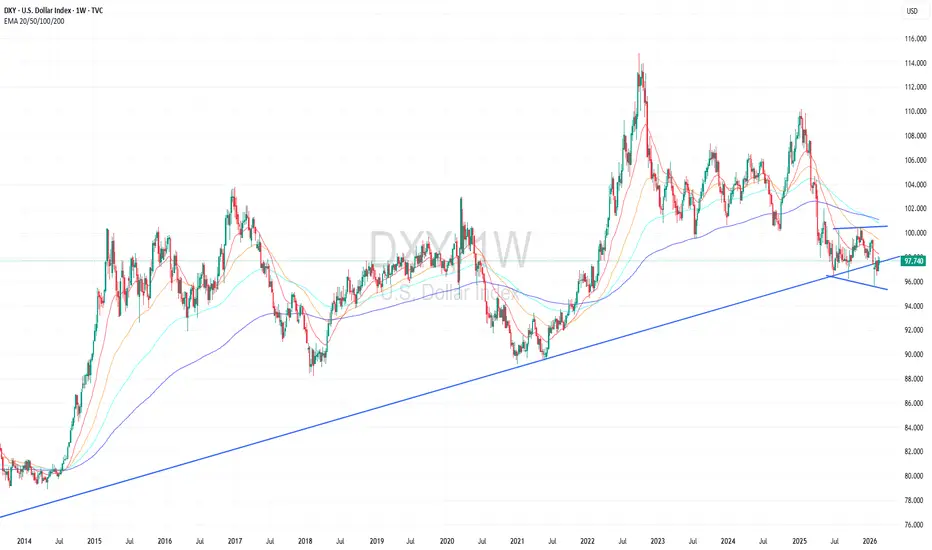
Technical View: Neutral (with an upward bias)
Technically, DXY has broken below an ascending trendline and is now consolidating around the breakout area, which suggests the break is not yet fully decisive. Meanwhile, the EMA structure is beginning to stack bearish, signaling a rising probability of a broader trend shift.
• A clean break below the sideways channel, especially under 96.00, would be a bearish continuation signal and could confirm a larger-scale bearish reversal.
• However, DXY may also remain range-bound within roughly 96.00–101.00, waiting for a decisive breakout. For now, the broader bias remains neutral-to-up, unless clearer downside confirmation appears.
________________________________________
Summary and Outlook
Key pillars that can keep DXY supported in 2026 include:
• A Fed stance that may repeatedly reset market pricing in a hawkish direction
• Treasury yields that are difficult to decline, reinforcing USD support through relative return
• A risk environment where risk-off episodes continue to deliver sporadic safe-haven demand
• Ongoing relative weakness in other regions, particularly Europe, sustaining a relative-value tailwind for USD
Watch US Treasury yields—especially the 10-year, a key gauge of bond-market health. A sustained break above 5% could signal rising stress and trigger a sharper move higher.
Given the mix of supportive and offsetting drivers, the USD outlook is adjusted from long-term bullish to Neutral with an upward bias, until the market delivers clearer evidence of a structural shift.
This series consists of 12 research notes covering 12 instruments. Each episode blends fundamental and technical analysis to frame a structured set of investment themes for 2026.
This is the Episode 2 which focuses on the US Dollar Index (DXY) and the key forces that could meaningfully influence USD performance throughout 2026.
________________________________________
1) Fed stance: the market may price in cuts early–mid year, but the Fed could move late → hawkish surprise risk
Because the Fed is arguably the world’s most important liquidity provider, any USD outlook should begin with the Fed’s policy function and reaction framework.
• Early to mid-year: incoming inflation and labor data may keep markets debating whether the Fed will cut sooner or later. This “pricing and repricing” process often leaves DXY range-bound, as expectations swing with each major data release.
• Late-year: if the Fed chooses to wait for clearer confirmation and delivers easing later than markets anticipated, the result can be a hawkish surprise, supporting the dollar via sentiment and rate expectations.
• Tail risk: investors should not dismiss the possibility that the Fed turns more hawkish than priced if inflation or price risks remain sticky. This aligns with the Fed’s long-standing emphasis on being data-dependent, adjusting policy as inflation and inflation expectations evolve.
Implication for DXY: the dollar may not rally immediately, but the USD floor could be reinforced by rate expectations that repeatedly reset hawkishly.
________________________________________
2) Tariffs: even if IEEPA is constrained, the tariff risk does not disappear—it simply shifts to a different legal channel. By signaling a viable route via Section 122, the administration keeps trade policy active and market-relevant.
Market and USD implications:
• This reinforces the message that a Trump-led administration is unlikely to retreat from its trade agenda.
• In narrative terms, tariffs can be viewed as a mechanism to reduce the trade deficit and potentially improve the current-account path, which can be USD-supportive, at least initially, through expectations and positioning.
• More broadly, the direction of policy also signals an intent to re-shore investment and shift domestic production incentives—another channel that can influence medium-term USD sentiment.
________________________________________
3) Japan FX intervention logic: if Japan buys JPY, it may need to sell USD assets → a USD headwind
The mechanism is straightforward:
• Supporting the yen via JPY buying can be associated with reducing USD-asset holdings at the margin, given Japan’s large external asset base.
• This is not a mechanical 1:1 relationship every time, but it is a closely watched risk channel because Japan holds a substantial amount of US Treasuries.
• As a result, FX intervention episodes can become a downside pressure point for the dollar.
________________________________________
4) Japan: top foreign holder of UST + BoJ hiking while the Fed eases → carry trade fades → unwind risk rises
The key is flow, not headlines.
• Japan is the largest foreign holder of US Treasuries, making its portfolio actions highly relevant to global rates and FX flows.
• The BoJ is hiking while the Fed is cutting, the rate differential narrows.
• As spreads compress, the incentive for JPY carry trades declines, increasing the probability of an unwind—more buy JPY / sell USD behavior, or at least reduced intensity of buy USD / sell JPY flows.
• This dynamic can weigh on USD through a gradual but meaningful positioning adjustment.
________________________________________
5) Relative growth and competitiveness with Eurozone: if Europe remains less competitive, EUR weakens → DXY gains structural support
Because DXY has a large EUR weight, the euro’s trajectory matters materially.
Europe’s structural constraints—growth challenges, competitiveness issues, demographic headwinds, and public-debt burdens—can keep EUR under pressure over the long run. Even if US economiy is not “excellent” in absolute terms, it can still look relatively stronger, helping DXY hold up structurally.
(We will explore Europe’s structural challenges in more detail in the next episode of this series.)
________________________________________
6) War / geopolitics: risk-off boosts safe-haven demand → USD benefits as the global liquidity currency
During wars or sharp geopolitical escalations, markets typically shift toward capital preservation and liquidity.
• The USD often benefits from its role as the world’s central funding and settlement currency, especially during sudden panic phases when investors prioritize immediate liquidity.
• A large-scale war can also introduce two additional USD-supportive channels:
War funding
A major conflict requires large-scale funding. Historically, governments have financed wars through issuance—famously including “War Bonds” during World War II. In a modern context, if the US needs to mobilize capital, policymakers may need to maintain attractive yields or a tighter policy stance to support funding demand—potentially USD-supportive.
War inflation
Wars often trigger energy and commodity shocks, feeding inflation pressures. If inflation risks rise meaningfully, the Fed may need to remain more hawkish than the market expects, supporting USD via yields and policy expectations.
________________________________________
7) If geopolitics persists but does not escalate into a large war: USD’s support may be episodic, while precious metals may benefit
If geopolitical risks stay elevated but don’t escalate into a major war, USD support is likely to be episodic rather than trending—with hedging demand tilting more toward precious metals, which can cap USD upside or mildly pressure the dollar, depending on yields and positioning.
________________________________________
8) Debt risks and Ray Dalio’s sequence: in a credit crunch, USD often strengthens first
US debt dynamics cannot be ignored. If the world faces a credit crunch from any source, FX moves can become nonlinear and complex. Ray Dalio’s framework helps illustrate the sequence:
• In a credit crunch / deleveraging, markets urgently demand cash and liquidity, forcing asset sales.
• Because USD sits at the center of global funding markets, demand for USD tends to surge—so USD often strengthens in the first phase of stress.
• If the policy response later shifts toward heavy liquidity injections or monetization, then currency debasement concerns can become more prominent in the next phase—consistent with Dalio’s “debt-cycle” playbook.
________________________________________
9) US yields are “hard to fall” → a stabilizer for USD even without an immediate USD rally
Consistent with the prior episode’s rate framework: if Treasury yields prove resistant to falling, USD may not surge, but it often becomes difficult for USD to weaken aggressively.
• The dollar may not “rip higher” immediately.
• But the yield advantage, together with carry/relative-return dynamics, can provide a durable support layer.
________________________________________
Technical View: Neutral (with an upward bias)
Technically, DXY has broken below an ascending trendline and is now consolidating around the breakout area, which suggests the break is not yet fully decisive. Meanwhile, the EMA structure is beginning to stack bearish, signaling a rising probability of a broader trend shift.
• A clean break below the sideways channel, especially under 96.00, would be a bearish continuation signal and could confirm a larger-scale bearish reversal.
• However, DXY may also remain range-bound within roughly 96.00–101.00, waiting for a decisive breakout. For now, the broader bias remains neutral-to-up, unless clearer downside confirmation appears.
________________________________________
Summary and Outlook
Key pillars that can keep DXY supported in 2026 include:
• A Fed stance that may repeatedly reset market pricing in a hawkish direction
• Treasury yields that are difficult to decline, reinforcing USD support through relative return
• A risk environment where risk-off episodes continue to deliver sporadic safe-haven demand
• Ongoing relative weakness in other regions, particularly Europe, sustaining a relative-value tailwind for USD
Watch US Treasury yields—especially the 10-year, a key gauge of bond-market health. A sustained break above 5% could signal rising stress and trigger a sharper move higher.
Given the mix of supportive and offsetting drivers, the USD outlook is adjusted from long-term bullish to Neutral with an upward bias, until the market delivers clearer evidence of a structural shift.

คำจำกัดสิทธิ์ความรับผิดชอบ
ข้อมูลและบทความไม่ได้มีวัตถุประสงค์เพื่อก่อให้เกิดกิจกรรมทางการเงิน, การลงทุน, การซื้อขาย, ข้อเสนอแนะ หรือคำแนะนำประเภทอื่น ๆ ที่ให้หรือรับรองโดย TradingView อ่านเพิ่มเติมใน ข้อกำหนดการใช้งาน
คำจำกัดสิทธิ์ความรับผิดชอบ
ข้อมูลและบทความไม่ได้มีวัตถุประสงค์เพื่อก่อให้เกิดกิจกรรมทางการเงิน, การลงทุน, การซื้อขาย, ข้อเสนอแนะ หรือคำแนะนำประเภทอื่น ๆ ที่ให้หรือรับรองโดย TradingView อ่านเพิ่มเติมใน ข้อกำหนดการใช้งาน