

The Macroeconomic Catalyst
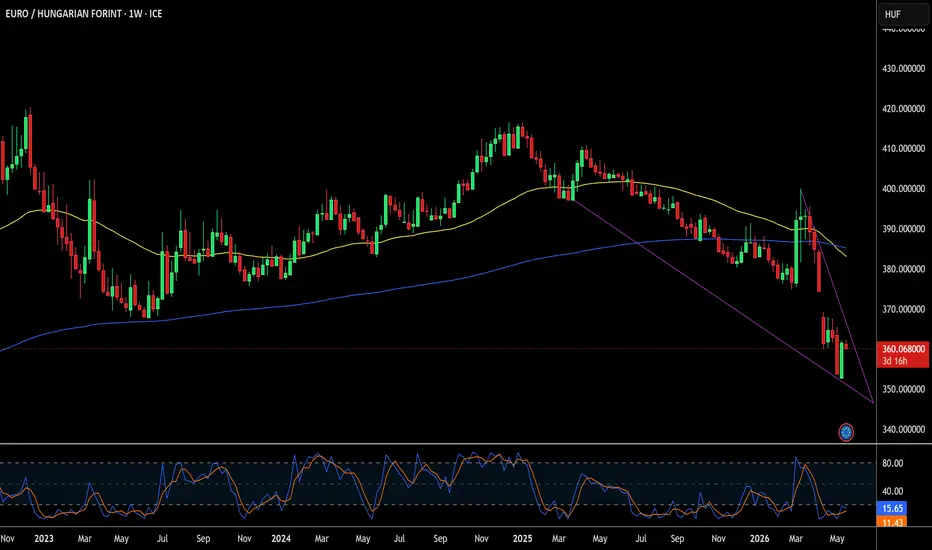
In April 2026, Hungary experienced a genuine political earthquake. Peter Magyar’s Tisza Party secured a landslide victory in the April 12 general elections, winning 138 of 199 parliamentary seats, a two-thirds supermajority that ended Viktor Orban’s 16-year rule. Currency markets reacted decisively. EUR/HUF dropped from above 380 in pre-election trading to 363.84 the day after the result, the forint’s strongest level since 2022. The pair extended gains in subsequent weeks and traded around 358 to 360 as of mid-May, near the lower end of its 52-week range of 353 to 405.
The macroeconomic picture supporting that move is mixed, not the unambiguous bull case some commentary suggests. Hungarian Q1 2026 GDP grew 0.8%, the strongest quarterly rate in recent years, and consumer confidence has improved. But headline inflation rose to 2.1% in April from 1.8% in March, and the National Bank of Hungary forecasts 2026 average inflation at 3.8% (revised up from 3.2%), with CPI expected to exceed the 3% target band from Q3 2026. The deficit ran around 4.6% of GDP in 2025 and is projected at 4.1% for 2026, with debt-to-GDP at 73.6%. Markets have repriced Hungarian assets aggressively on political expectations. The underlying macro will need to confirm that pricing.
Geopolitics and EU Realignment
The electoral outcome materially shifts Hungary’s geopolitical positioning. Under Fidesz, Hungary repeatedly clashed with Brussels over rule-of-law disputes, which led the European Commission to freeze approximately €17 billion in EU cohesion funds at the end of 2022. The Magyar government has pledged to secure these funds with a deadline of August 2026. Markets are pricing meaningful inflows, but the timeline and conditionality remain uncertain. Magyar explicitly stated it is in Hungary’s interest to join the euro area, marking a sharp departure from Fidesz’s monetary policy. Tisza’s economic adviser, Andras Karman, has suggested groundwork for euro adoption could be laid by 2030, but Hungary currently fails every Maastricht criterion (deficit, debt-to-GDP, inflation, and exchange rate stability), so the realistic timeline is later this decade at the earliest. Multinational corporations are reassessing Hungary’s positioning following the geopolitical shift, but the actual investment response will take quarters to verify, not days.
High-Tech Manufacturing and the Battery Cluster
Hungary’s battery and automotive cluster is real but more nuanced than the bull case suggests. CATL is investing €7.34 billion in Debrecen for a 100 GWh lithium-ion battery plant near existing Mercedes-Benz, BMW, Stellantis, and Volkswagen vehicle facilities, with production starting in early 2026. BYD has placed its European headquarters, R&D center, and vehicle plant in Szeged. Samsung SDI operates in Goed (40 GWh capacity), SK On in Komarom, and EVE Energy is also building in the country. Hungary holds the third-largest battery production capacity globally behind China and the US.
The technology base is dominated by NMC and LFP lithium-ion chemistries, not solid-state batteries (which do not yet exist commercially at a meaningful scale anywhere in the world). The cluster also faces real headwinds. CATL suspended the second phase of its Debrecen gigafactory amid weaker-than-expected EV demand. SK On began significant layoffs in February 2025 and is considering consolidating Hungarian operations. The automotive sector accounts for roughly 5% of Hungarian GDP and around a third of total exports (not 15% as sometimes reported), making the economy highly sensitive to European demand trends.
Industry Trends and Business Models
Hungarian export structure remains heavily concentrated, with exports accounting for roughly 58% of GDP and the automotive sector representing close to a third of that total. Exports are heavily oriented toward Germany and the rest of the eurozone, making Hungary’s economy sensitive to weak European demand and supply chain disruptions. The Tisza government has signaled it will gradually remove state-imposed price caps on food and household goods, although the transition will be managed carefully to avoid a household burden. Foreign investors continue to use Hungary’s competitive corporate tax structure (9%, the lowest in the EU) to anchor regional operations. The longer-term thesis is integration into EU clean tech and EV supply chains, but the near-term EV demand picture is softer than expected, which limits how quickly the battery cluster contributes to growth.
Cybersecurity and Industrial Infrastructure
Like all major manufacturing centers, Hungary’s industrial hubs face cyber risk targeting battery IP, manufacturing data, and supply chain controls. Investment in zero-trust architectures and secure manufacturing has grown. Cyber incidents have not, however, been a meaningful historical driver of EUR/HUF volatility. The actual risks to the forint over the next 12 months are conventional: the speed and conditions of EU fund disbursement, the new government’s relationship with the MNB (Economy Minister Marton Nagy has publicly criticized strong forint levels as “artificially high” and pushed for rate cuts), the U.S.-Israel war on Iran’s impact on energy and inflation, Hungary’s elevated debt and deficit, and execution risk on Magyar’s reform agenda.
Management, Leadership, and the New Political Economy
The new political configuration has not yet produced corporate or institutional results, since the Tisza government was formed only at the end of May 2026. The market is pricing the expectation of more predictable governance, reduced political patronage in state-linked firms, and faster EU policy alignment. Whether that pricing proves correct depends on whether Tisza respects MNB independence, delivers the August 2026 EU fund unlock, and avoids the temptation to use loose fiscal policy to consolidate political support. Citigroup has already recommended taking profits on long forint positions, which suggests the rally may consolidate before the next leg. The forint is in its strongest position in years, but the easy money on the political shift has likely already been made. From here, the trade depends on execution rather than narrative.
In April 2026, Hungary experienced a genuine political earthquake. Peter Magyar’s Tisza Party secured a landslide victory in the April 12 general elections, winning 138 of 199 parliamentary seats, a two-thirds supermajority that ended Viktor Orban’s 16-year rule. Currency markets reacted decisively. EUR/HUF dropped from above 380 in pre-election trading to 363.84 the day after the result, the forint’s strongest level since 2022. The pair extended gains in subsequent weeks and traded around 358 to 360 as of mid-May, near the lower end of its 52-week range of 353 to 405.
The macroeconomic picture supporting that move is mixed, not the unambiguous bull case some commentary suggests. Hungarian Q1 2026 GDP grew 0.8%, the strongest quarterly rate in recent years, and consumer confidence has improved. But headline inflation rose to 2.1% in April from 1.8% in March, and the National Bank of Hungary forecasts 2026 average inflation at 3.8% (revised up from 3.2%), with CPI expected to exceed the 3% target band from Q3 2026. The deficit ran around 4.6% of GDP in 2025 and is projected at 4.1% for 2026, with debt-to-GDP at 73.6%. Markets have repriced Hungarian assets aggressively on political expectations. The underlying macro will need to confirm that pricing.
Geopolitics and EU Realignment
The electoral outcome materially shifts Hungary’s geopolitical positioning. Under Fidesz, Hungary repeatedly clashed with Brussels over rule-of-law disputes, which led the European Commission to freeze approximately €17 billion in EU cohesion funds at the end of 2022. The Magyar government has pledged to secure these funds with a deadline of August 2026. Markets are pricing meaningful inflows, but the timeline and conditionality remain uncertain. Magyar explicitly stated it is in Hungary’s interest to join the euro area, marking a sharp departure from Fidesz’s monetary policy. Tisza’s economic adviser, Andras Karman, has suggested groundwork for euro adoption could be laid by 2030, but Hungary currently fails every Maastricht criterion (deficit, debt-to-GDP, inflation, and exchange rate stability), so the realistic timeline is later this decade at the earliest. Multinational corporations are reassessing Hungary’s positioning following the geopolitical shift, but the actual investment response will take quarters to verify, not days.
High-Tech Manufacturing and the Battery Cluster
Hungary’s battery and automotive cluster is real but more nuanced than the bull case suggests. CATL is investing €7.34 billion in Debrecen for a 100 GWh lithium-ion battery plant near existing Mercedes-Benz, BMW, Stellantis, and Volkswagen vehicle facilities, with production starting in early 2026. BYD has placed its European headquarters, R&D center, and vehicle plant in Szeged. Samsung SDI operates in Goed (40 GWh capacity), SK On in Komarom, and EVE Energy is also building in the country. Hungary holds the third-largest battery production capacity globally behind China and the US.
The technology base is dominated by NMC and LFP lithium-ion chemistries, not solid-state batteries (which do not yet exist commercially at a meaningful scale anywhere in the world). The cluster also faces real headwinds. CATL suspended the second phase of its Debrecen gigafactory amid weaker-than-expected EV demand. SK On began significant layoffs in February 2025 and is considering consolidating Hungarian operations. The automotive sector accounts for roughly 5% of Hungarian GDP and around a third of total exports (not 15% as sometimes reported), making the economy highly sensitive to European demand trends.
Industry Trends and Business Models
Hungarian export structure remains heavily concentrated, with exports accounting for roughly 58% of GDP and the automotive sector representing close to a third of that total. Exports are heavily oriented toward Germany and the rest of the eurozone, making Hungary’s economy sensitive to weak European demand and supply chain disruptions. The Tisza government has signaled it will gradually remove state-imposed price caps on food and household goods, although the transition will be managed carefully to avoid a household burden. Foreign investors continue to use Hungary’s competitive corporate tax structure (9%, the lowest in the EU) to anchor regional operations. The longer-term thesis is integration into EU clean tech and EV supply chains, but the near-term EV demand picture is softer than expected, which limits how quickly the battery cluster contributes to growth.
Cybersecurity and Industrial Infrastructure
Like all major manufacturing centers, Hungary’s industrial hubs face cyber risk targeting battery IP, manufacturing data, and supply chain controls. Investment in zero-trust architectures and secure manufacturing has grown. Cyber incidents have not, however, been a meaningful historical driver of EUR/HUF volatility. The actual risks to the forint over the next 12 months are conventional: the speed and conditions of EU fund disbursement, the new government’s relationship with the MNB (Economy Minister Marton Nagy has publicly criticized strong forint levels as “artificially high” and pushed for rate cuts), the U.S.-Israel war on Iran’s impact on energy and inflation, Hungary’s elevated debt and deficit, and execution risk on Magyar’s reform agenda.
Management, Leadership, and the New Political Economy
The new political configuration has not yet produced corporate or institutional results, since the Tisza government was formed only at the end of May 2026. The market is pricing the expectation of more predictable governance, reduced political patronage in state-linked firms, and faster EU policy alignment. Whether that pricing proves correct depends on whether Tisza respects MNB independence, delivers the August 2026 EU fund unlock, and avoids the temptation to use loose fiscal policy to consolidate political support. Citigroup has already recommended taking profits on long forint positions, which suggests the rally may consolidate before the next leg. The forint is in its strongest position in years, but the easy money on the political shift has likely already been made. From here, the trade depends on execution rather than narrative.

The5ers Funding Forex Traders & Growth Program. Get Funded with up to $2.56M
We Trade Forex - Come Join Us!
the5ers.com
We Trade Forex - Come Join Us!
the5ers.com
คำจำกัดสิทธิ์ความรับผิดชอบ
ข้อมูลและบทความไม่ได้มีวัตถุประสงค์เพื่อก่อให้เกิดกิจกรรมทางการเงิน, การลงทุน, การซื้อขาย, ข้อเสนอแนะ หรือคำแนะนำประเภทอื่น ๆ ที่ให้หรือรับรองโดย TradingView อ่านเพิ่มเติมใน ข้อกำหนดการใช้งาน
The5ers Funding Forex Traders & Growth Program. Get Funded with up to $2.56M
We Trade Forex - Come Join Us!
the5ers.com
We Trade Forex - Come Join Us!
the5ers.com
คำจำกัดสิทธิ์ความรับผิดชอบ
ข้อมูลและบทความไม่ได้มีวัตถุประสงค์เพื่อก่อให้เกิดกิจกรรมทางการเงิน, การลงทุน, การซื้อขาย, ข้อเสนอแนะ หรือคำแนะนำประเภทอื่น ๆ ที่ให้หรือรับรองโดย TradingView อ่านเพิ่มเติมใน ข้อกำหนดการใช้งาน