
So it is done: Kevin Warsh’s Fed has raised the federal funds rate from 3.75% to 4%, unveiled its new monetary policy outlook and updated its macroeconomic projections. The Fed Chair once again reminded us that the central bank would remain “data dependent” and that it was still committed to supporting the proper functioning of the interbank market.
Are the Fed’s new monetary policy projections a source of pressure or relative relief for financial markets, which have been under pressure from the sharp rise in bond yields and oil and natural gas prices?
Let’s review 4 major dimensions that have been updated and assess what they tell us.
1) DOT PLOTS and the balance of power among the 12 voting members of the FOMC
Since Kevin Warsh took over as Fed Chair, the balance of power within the FOMC has been one of the most important aspects to monitor. Will there be further rate hikes? Could a status quo quickly regain the upper hand? There are 12 members on the FOMC, and a majority is required to make a monetary policy decision. In the event of a tie (6 VS 6), Kevin Warsh has the deciding vote.
On Wednesday, September 16, all 12 out of 12 voted in favor of a rate hike, so there was complete convergence among the FOMC voting members.
The updated DOT PLOTS show that the median FOMC projection now stands at an interest rate of 4.1%, meaning that one final rate hike remains possible by the end of the year or in 2027.

2) The Fed’s inflation and employment projections
The Fed faces the same uncertainty as the rest of the world: when will the Strait of Hormuz reopen, and when will oil and gas prices cease to be a source of upward pressure on headline inflation?
The Fed has expressed confidence that core inflation will return to the 2% target by the end of 2027/2028, but this requires avoiding a prolonged geopolitical shock. Core inflation remains broadly under control, and the rise in oil prices has not yet affected underlying inflation. This is, in itself, a source of optimism for the Fed.

3) How the market (high finance) is positioning itself on the Fed’s rate outlook, through futures contracts on the federal funds rate
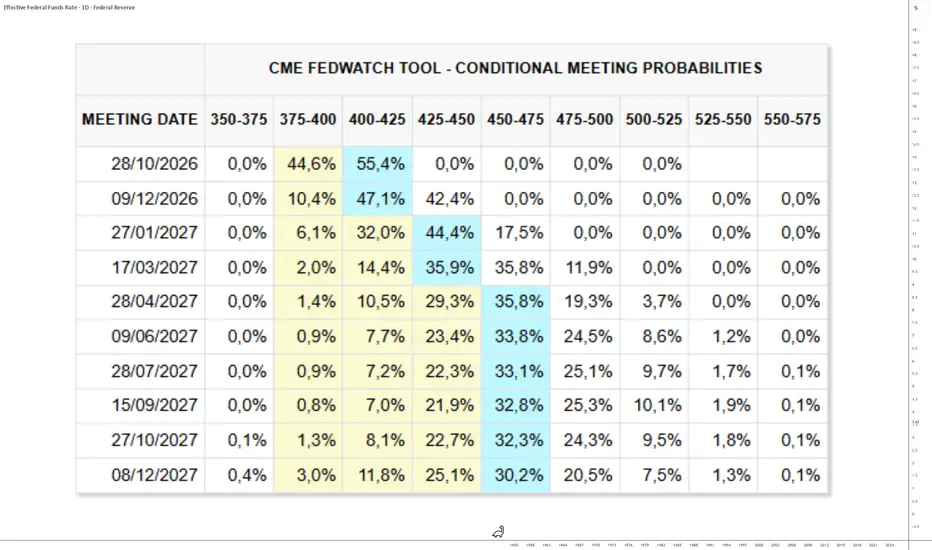
The price of federal funds rate futures traded on the Chicago Mercantile Exchange (CME) helps us understand how institutional investors anticipate the future path of the Fed’s interest rate. Following the Fed’s monetary policy decision, the market estimates that one final rate hike could take place by the end of the year, but the status quo could regain the upper hand depending on the evolution of oil prices and core inflation.

4) The technical signals from the 2-year US Treasury yield
The 2-year US Treasury yield is the one that best anticipates the future path of the US federal funds rate. If it is above the Fed’s policy rate, it means that the market is pricing in a rate hike, and vice versa.
The Fed’s policy rate is now 4%, while the US 2-year yield stands at 4.70% following the Fed’s monetary policy decision. The market therefore considers it likely that the Fed will raise its policy rate again by the end of the year.

DISCLAIMER:
This content is intended for individuals who are familiar with financial markets and instruments and is for information purposes only. The presented idea (including market commentary, market data and observations) is not a work product of any research department of Swissquote or its affiliates. This material is intended to highlight market action and does not constitute investment, legal or tax advice. If you are a retail investor or lack experience in trading complex financial products, it is advisable to seek professional advice from licensed advisor before making any financial decisions.
This content is not intended to manipulate the market or encourage any specific financial behavior.
Swissquote makes no representation or warranty as to the quality, completeness, accuracy, comprehensiveness or non-infringement of such content. The views expressed are those of the consultant and are provided for educational purposes only. Any information provided relating to a product or market should not be construed as recommending an investment strategy or transaction. Past performance is not a guarantee of future results.
Swissquote and its employees and representatives shall in no event be held liable for any damages or losses arising directly or indirectly from decisions made on the basis of this content.
The use of any third-party brands or trademarks is for information only and does not imply endorsement by Swissquote, or that the trademark owner has authorised Swissquote to promote its products or services.
Swissquote is the marketing brand for the activities of Swissquote Bank Ltd (Switzerland) regulated by FINMA, Swissquote Capital Markets Limited regulated by CySEC (Cyprus), Swissquote Bank Europe SA (Luxembourg) regulated by the CSSF, Swissquote Ltd (UK) regulated by the FCA, Swissquote Financial Services (Malta) Ltd regulated by the Malta Financial Services Authority, Swissquote MEA Ltd. (UAE) regulated by the Dubai Financial Services Authority, Swissquote Pte Ltd (Singapore) regulated by the Monetary Authority of Singapore, Swissquote Asia Limited (Hong Kong) licensed by the Hong Kong Securities and Futures Commission (SFC) and Swissquote South Africa (Pty) Ltd supervised by the FSCA.
Products and services of Swissquote are only intended for those permitted to receive them under local law.
All investments carry a degree of risk. The risk of loss in trading or holding financial instruments can be substantial. The value of financial instruments, including but not limited to stocks, bonds, cryptocurrencies, and other assets, can fluctuate both upwards and downwards. There is a significant risk of financial loss when buying, selling, holding, staking, or investing in these instruments. SQBE makes no recommendations regarding any specific investment, transaction, or the use of any particular investment strategy.
CFDs are complex instruments and come with a high risk of losing money rapidly due to leverage. The vast majority of retail client accounts suffer capital losses when trading in CFDs. You should consider whether you understand how CFDs work and whether you can afford to take the high risk of losing your money.
Digital Assets are unregulated in most countries and consumer protection rules may not apply. As highly volatile speculative investments, Digital Assets are not suitable for investors without a high-risk tolerance. Make sure you understand each Digital Asset before you trade.
Cryptocurrencies are not considered legal tender in some jurisdictions and are subject to regulatory uncertainties.
The use of Internet-based systems can involve high risks, including, but not limited to, fraud, cyber-attacks, network and communication failures, as well as identity theft and phishing attacks related to crypto-assets.
Are the Fed’s new monetary policy projections a source of pressure or relative relief for financial markets, which have been under pressure from the sharp rise in bond yields and oil and natural gas prices?
Let’s review 4 major dimensions that have been updated and assess what they tell us.
1) DOT PLOTS and the balance of power among the 12 voting members of the FOMC
Since Kevin Warsh took over as Fed Chair, the balance of power within the FOMC has been one of the most important aspects to monitor. Will there be further rate hikes? Could a status quo quickly regain the upper hand? There are 12 members on the FOMC, and a majority is required to make a monetary policy decision. In the event of a tie (6 VS 6), Kevin Warsh has the deciding vote.
On Wednesday, September 16, all 12 out of 12 voted in favor of a rate hike, so there was complete convergence among the FOMC voting members.
The updated DOT PLOTS show that the median FOMC projection now stands at an interest rate of 4.1%, meaning that one final rate hike remains possible by the end of the year or in 2027.
2) The Fed’s inflation and employment projections
The Fed faces the same uncertainty as the rest of the world: when will the Strait of Hormuz reopen, and when will oil and gas prices cease to be a source of upward pressure on headline inflation?
The Fed has expressed confidence that core inflation will return to the 2% target by the end of 2027/2028, but this requires avoiding a prolonged geopolitical shock. Core inflation remains broadly under control, and the rise in oil prices has not yet affected underlying inflation. This is, in itself, a source of optimism for the Fed.
3) How the market (high finance) is positioning itself on the Fed’s rate outlook, through futures contracts on the federal funds rate
The price of federal funds rate futures traded on the Chicago Mercantile Exchange (CME) helps us understand how institutional investors anticipate the future path of the Fed’s interest rate. Following the Fed’s monetary policy decision, the market estimates that one final rate hike could take place by the end of the year, but the status quo could regain the upper hand depending on the evolution of oil prices and core inflation.
4) The technical signals from the 2-year US Treasury yield
The 2-year US Treasury yield is the one that best anticipates the future path of the US federal funds rate. If it is above the Fed’s policy rate, it means that the market is pricing in a rate hike, and vice versa.
The Fed’s policy rate is now 4%, while the US 2-year yield stands at 4.70% following the Fed’s monetary policy decision. The market therefore considers it likely that the Fed will raise its policy rate again by the end of the year.
DISCLAIMER:
This content is intended for individuals who are familiar with financial markets and instruments and is for information purposes only. The presented idea (including market commentary, market data and observations) is not a work product of any research department of Swissquote or its affiliates. This material is intended to highlight market action and does not constitute investment, legal or tax advice. If you are a retail investor or lack experience in trading complex financial products, it is advisable to seek professional advice from licensed advisor before making any financial decisions.
This content is not intended to manipulate the market or encourage any specific financial behavior.
Swissquote makes no representation or warranty as to the quality, completeness, accuracy, comprehensiveness or non-infringement of such content. The views expressed are those of the consultant and are provided for educational purposes only. Any information provided relating to a product or market should not be construed as recommending an investment strategy or transaction. Past performance is not a guarantee of future results.
Swissquote and its employees and representatives shall in no event be held liable for any damages or losses arising directly or indirectly from decisions made on the basis of this content.
The use of any third-party brands or trademarks is for information only and does not imply endorsement by Swissquote, or that the trademark owner has authorised Swissquote to promote its products or services.
Swissquote is the marketing brand for the activities of Swissquote Bank Ltd (Switzerland) regulated by FINMA, Swissquote Capital Markets Limited regulated by CySEC (Cyprus), Swissquote Bank Europe SA (Luxembourg) regulated by the CSSF, Swissquote Ltd (UK) regulated by the FCA, Swissquote Financial Services (Malta) Ltd regulated by the Malta Financial Services Authority, Swissquote MEA Ltd. (UAE) regulated by the Dubai Financial Services Authority, Swissquote Pte Ltd (Singapore) regulated by the Monetary Authority of Singapore, Swissquote Asia Limited (Hong Kong) licensed by the Hong Kong Securities and Futures Commission (SFC) and Swissquote South Africa (Pty) Ltd supervised by the FSCA.
Products and services of Swissquote are only intended for those permitted to receive them under local law.
All investments carry a degree of risk. The risk of loss in trading or holding financial instruments can be substantial. The value of financial instruments, including but not limited to stocks, bonds, cryptocurrencies, and other assets, can fluctuate both upwards and downwards. There is a significant risk of financial loss when buying, selling, holding, staking, or investing in these instruments. SQBE makes no recommendations regarding any specific investment, transaction, or the use of any particular investment strategy.
CFDs are complex instruments and come with a high risk of losing money rapidly due to leverage. The vast majority of retail client accounts suffer capital losses when trading in CFDs. You should consider whether you understand how CFDs work and whether you can afford to take the high risk of losing your money.
Digital Assets are unregulated in most countries and consumer protection rules may not apply. As highly volatile speculative investments, Digital Assets are not suitable for investors without a high-risk tolerance. Make sure you understand each Digital Asset before you trade.
Cryptocurrencies are not considered legal tender in some jurisdictions and are subject to regulatory uncertainties.
The use of Internet-based systems can involve high risks, including, but not limited to, fraud, cyber-attacks, network and communication failures, as well as identity theft and phishing attacks related to crypto-assets.

This content is written by Vincent Ganne for Swissquote.
This content is intended for individuals who are familiar with financial markets and instruments and is for information purposes only and does not constitute investment, legal or tax advice.
This content is intended for individuals who are familiar with financial markets and instruments and is for information purposes only and does not constitute investment, legal or tax advice.
คำจำกัดสิทธิ์ความรับผิดชอบ
ข้อมูลและบทความไม่ได้มีวัตถุประสงค์เพื่อก่อให้เกิดกิจกรรมทางการเงิน, การลงทุน, การซื้อขาย, ข้อเสนอแนะ หรือคำแนะนำประเภทอื่น ๆ ที่ให้หรือรับรองโดย TradingView อ่านเพิ่มเติมใน ข้อกำหนดการใช้งาน
This content is written by Vincent Ganne for Swissquote.
This content is intended for individuals who are familiar with financial markets and instruments and is for information purposes only and does not constitute investment, legal or tax advice.
This content is intended for individuals who are familiar with financial markets and instruments and is for information purposes only and does not constitute investment, legal or tax advice.
คำจำกัดสิทธิ์ความรับผิดชอบ
ข้อมูลและบทความไม่ได้มีวัตถุประสงค์เพื่อก่อให้เกิดกิจกรรมทางการเงิน, การลงทุน, การซื้อขาย, ข้อเสนอแนะ หรือคำแนะนำประเภทอื่น ๆ ที่ให้หรือรับรองโดย TradingView อ่านเพิ่มเติมใน ข้อกำหนดการใช้งาน