
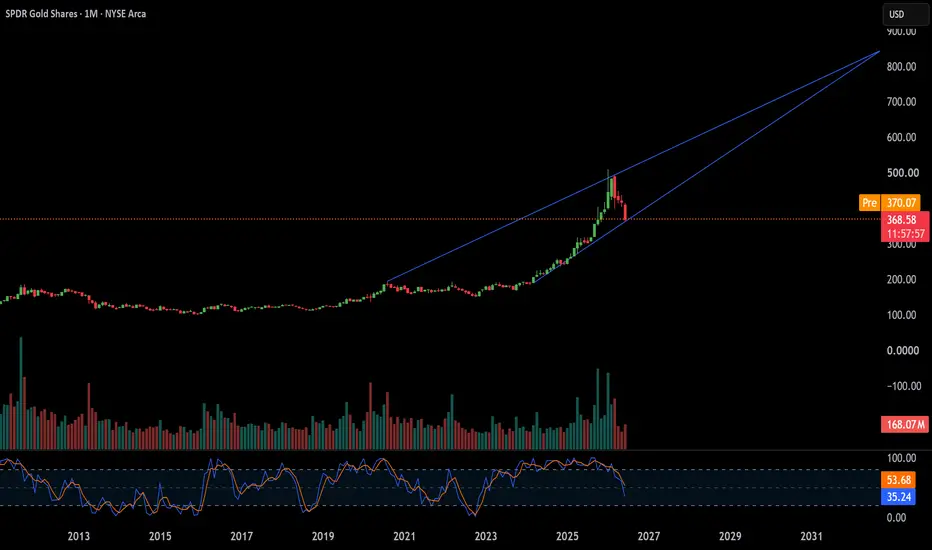
Gold's rally is not dead, but it has cooled sharply. After peaking near $5,589 in late January 2026, the metal corrected about 25% and now trades around $4,200 to $4,500, a slide that included its worst month since 2013. The cause is cyclical rather than structural. A hawkish Federal Reserve has signaled no rate cuts in 2026, and possibly hikes if energy-driven inflation persists, while elevated real yields raise the opportunity cost of holding a non-yielding asset. A firmer dollar and a retreat in ETF and speculative demand have added to the pressure.
Yet the floor under gold has rarely been firmer, which is why this looks like consolidation rather than collapse. Central banks have become the dominant, price-insensitive buyers, purchasing more than 1,000 tonnes a year from 2022 through 2024 and 863 tonnes in 2025, roughly double the pre-2022 norm. They buy as policy, not as a trade, and they do not sell on weak days. Combined with accelerating de-dollarization, with BRICS nations now holding 17.4% of global reserves and gold overtaking the euro as the second-largest reserve asset, plus US debt above $36 trillion, that demand has turned the $4,300 to $4,500 zone into structural support rather than a ceiling.
That tension defines the price debate. The mainstream base case for end-2026 clusters between roughly $4,900 and $6,300, with Goldman Sachs near $4,900, UBS at $5,500, and J.P. Morgan and Wells Fargo around $6,000 to $6,300. The $7,000 headline is a real forecast, but a conditional one. UBS sees $7,200 only if geopolitical risks escalate materially, and Bank of America's $8,000 is a 2027 bull case. Reaching $7,000 requires a fresh catalyst, renewed Fed easing, a geopolitical shock, or a return of ETF inflows, not merely the structural bid already in place.
The honest read is that the rally is neither dead nor charging to $7,000 today. It is consolidating, pinned between a cyclical ceiling and a structural floor, waiting for a catalyst to break the deadlock. The asymmetry is what matters for investors. The downside looks limited because price-insensitive central banks keep absorbing dips, while the upside to $7,000 depends on the Fed pivoting or geopolitics re-escalating. The signals to watch are real yields, the Fed's path, ETF flows, and the resolution of the Iran conflict. Until one of those turns, gold grinds sideways on a firm floor, a coiled spring rather than a dead rally.
Yet the floor under gold has rarely been firmer, which is why this looks like consolidation rather than collapse. Central banks have become the dominant, price-insensitive buyers, purchasing more than 1,000 tonnes a year from 2022 through 2024 and 863 tonnes in 2025, roughly double the pre-2022 norm. They buy as policy, not as a trade, and they do not sell on weak days. Combined with accelerating de-dollarization, with BRICS nations now holding 17.4% of global reserves and gold overtaking the euro as the second-largest reserve asset, plus US debt above $36 trillion, that demand has turned the $4,300 to $4,500 zone into structural support rather than a ceiling.
That tension defines the price debate. The mainstream base case for end-2026 clusters between roughly $4,900 and $6,300, with Goldman Sachs near $4,900, UBS at $5,500, and J.P. Morgan and Wells Fargo around $6,000 to $6,300. The $7,000 headline is a real forecast, but a conditional one. UBS sees $7,200 only if geopolitical risks escalate materially, and Bank of America's $8,000 is a 2027 bull case. Reaching $7,000 requires a fresh catalyst, renewed Fed easing, a geopolitical shock, or a return of ETF inflows, not merely the structural bid already in place.
The honest read is that the rally is neither dead nor charging to $7,000 today. It is consolidating, pinned between a cyclical ceiling and a structural floor, waiting for a catalyst to break the deadlock. The asymmetry is what matters for investors. The downside looks limited because price-insensitive central banks keep absorbing dips, while the upside to $7,000 depends on the Fed pivoting or geopolitics re-escalating. The signals to watch are real yields, the Fed's path, ETF flows, and the resolution of the Iran conflict. Until one of those turns, gold grinds sideways on a firm floor, a coiled spring rather than a dead rally.

คำจำกัดสิทธิ์ความรับผิดชอบ
ข้อมูลและบทความไม่ได้มีวัตถุประสงค์เพื่อก่อให้เกิดกิจกรรมทางการเงิน, การลงทุน, การซื้อขาย, ข้อเสนอแนะ หรือคำแนะนำประเภทอื่น ๆ ที่ให้หรือรับรองโดย TradingView อ่านเพิ่มเติมใน ข้อกำหนดการใช้งาน
คำจำกัดสิทธิ์ความรับผิดชอบ
ข้อมูลและบทความไม่ได้มีวัตถุประสงค์เพื่อก่อให้เกิดกิจกรรมทางการเงิน, การลงทุน, การซื้อขาย, ข้อเสนอแนะ หรือคำแนะนำประเภทอื่น ๆ ที่ให้หรือรับรองโดย TradingView อ่านเพิ่มเติมใน ข้อกำหนดการใช้งาน