Kimberly-Clark ( KMB)—the company behind Huggies, Kleenex, Cottonelle, Kotex, Depend and Scott—is trading almost 30% below its recent highs.
The market appears deeply skeptical about its enormous pending acquisition of Kenvue. But after a capitulation below $100 and a sharp rebound, my Master Buy Scanner V2 has identified an early long-term opportunity.
THE SIGNAL
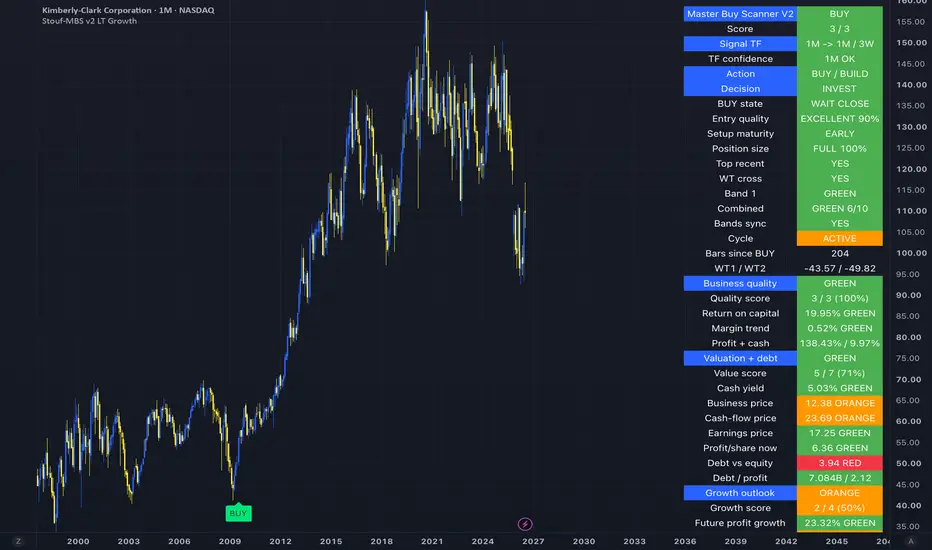
The monthly scanner currently shows:
• Overall signal: BUY — 3/3
• Action: BUY / BUILD
• Decision: INVEST
• Entry quality: EXCELLENT — 90%
• Setup maturity: EARLY
• Buy state: WAIT FOR MONTHLY CLOSE
• Technical cycle: ACTIVE
• Business quality: GREEN — 3/3
• Valuation and debt: GREEN — 5/7
• Growth outlook: ORANGE — 2/4
This is exactly the type of situation the scanner was designed to uncover: improving technical conditions combined with strong business quality and a significantly reset valuation.
However, WAIT CLOSE matters. The setup is attractive, but the monthly reversal has not yet been fully confirmed.
WHY KIMBERLY-CLARK IS INTERESTING
1. Exceptional business quality
The scanner gives Kimberly-Clark a perfect 3/3 quality score:
• Return on capital: 19.95%
• Margin trend: Positive
• Profitability: GREEN
• Cash generation: Positive
This is supported by a portfolio of globally recognized consumer brands with leading market positions across essential categories.
Kimberly-Clark’s products are sold in more than 175 countries and territories, while its brands hold the No. 1 or No. 2 market position in approximately 70 countries.
Demand for diapers, tissues, feminine care and adult-care products is not dependent on the latest technology cycle. That makes the underlying business relatively defensive—even when market sentiment is not.
2. The latest operating results remain solid
First-quarter 2026 results included:
• Net sales: $4.2 billion, up 2.7%
• Organic sales growth: 2.5%
• Operating profit: $753 million
• Adjusted operating profit: $732 million, up 3.7%
• GAAP EPS: $2.00, up from $1.70
Management continues to expect approximately $2 billion of adjusted free cash flow in 2026, despite increasing capital investment to roughly $1.3 billion.
This is not a broken business. It is a profitable consumer-staples company undergoing a major strategic transformation.
3. The dividend is difficult to ignore
Kimberly-Clark recently declared a quarterly dividend of $1.28 per share.
At approximately $110, that represents an indicated annual dividend yield of roughly 4.7%.
More importantly:
• Dividends have been paid for 92 consecutive years
• The dividend has increased for 54 consecutive years
That does not eliminate risk, but it makes KMB particularly relevant for long-term income investors searching for quality after a major drawdown.
THE $48.7 BILLION QUESTION
The pending acquisition of Kenvue is the central issue.
Kenvue owns brands such as:
• Tylenol
• Neutrogena
• Listerine
• Band-Aid
• Aveeno
• Zyrtec
• Johnson’s
If completed, the transaction would create a global health-and-wellness company with approximately $32 billion in annual revenue and 10 billion-dollar brands.
Management expects:
• $2.1 billion of annual run-rate synergies
• Approximately $1.9 billion of cost synergies
• EPS accretion beginning in the second year after closing
• Current KMB shareholders to own approximately 54% of the combined company
The potential is substantial—but so is the execution risk.
Kimberly-Clark is effectively using a transformational acquisition to move beyond traditional consumer staples and build a broader personal-care and consumer-health platform.
That could be a brilliant long-term pivot—or an expensive empire-building exercise.
VALUATION AFTER THE SELLOFF
The scanner gives KMB a 5/7 valuation score:
• Cash yield: 5.03%
• Business-price multiple: 12.38x
• Cash-flow multiple: 23.69x
• Earnings multiple: 17.25x
• Current profit per share: $6.36
The valuation is no longer excessive, but it is not uniformly cheap. The cash-flow multiple remains elevated, while the balance sheet deserves close attention.
The scanner flags:
• Debt-to-equity: 3.94 — RED
• Debt: approximately $7.08 billion
• Debt-to-profit ratio: 2.12
The Kenvue transaction will involve cash, additional debt and newly issued shares. Investors must therefore consider leverage, integration costs and dilution—not just the headline synergies.
THE TECHNICAL SETUP
The monthly chart shows a violent breakdown from approximately $145, followed by capitulation below $100 and an equally sharp rebound.
Key areas I am watching:
• $105–110: immediate support and current decision zone
• $95–100: major structural support
• $115–118: first confirmation level
• $125–130: important resistance and potential recovery target
• $138–145: major long-term supply zone
A monthly close above $115–118 would strengthen the reversal thesis.
A sustained move below $95 would suggest that the bottoming process has failed and that the market remains concerned about the combined company’s leverage and execution risks.
THE BEAR CASE
The setup is not without serious risks:
• The $48.7 billion Kenvue acquisition is exceptionally large
• Expected synergies may take years to materialize
• Integration costs are estimated at several billion dollars
• Additional debt and share issuance could pressure shareholders
• Kenvue carries litigation and regulatory exposure
• Higher oil and energy prices could increase input costs
• Management identified a potential $150–170 million input-cost headwind if oil prices remain elevated
• A distribution-center fire is expected to affect second-quarter sales and profit
• The scanner’s growth score remains only 2/4
• Second-quarter results on August 4 could create significant volatility
MY CURRENT PLAN
The scanner displays a full-position model signal, but I would still build exposure progressively due to the upcoming earnings release and transaction risk.
My framework would be:
• Consider an initial position while $105–110 remains supported
• Add after a confirmed monthly close above $115–118
• Increase conviction if price recovers $125–130
• Reassess the setup below $100
• Treat a sustained loss of $95 as a major technical warning
This is a long-term quality-and-income setup—not a short-term momentum trade.
SCAN YOUR OWN STOCKS
This opportunity was identified using Master Buy Scanner V2, which combines:
• Multi-timeframe technical timing
• Business-quality analysis
• Valuation and debt filters
• Growth scoring
• Entry-quality assessment
• Position-sizing guidance
You can add the indicator to your own TradingView charts here:

Run it on your watchlist and comment with the next ticker you want me to analyze.
THE DEBATE
At $110, which interpretation is closer to the truth?
A — Rare entry into a 54-year dividend grower
B — Wait for confirmation above $118
C — Avoid until the Kenvue integration risk becomes clearer
Comment A, B or C—and explain your thesis.
This is not financial advice. Always conduct your own research and manage risk according to your investment horizon.
KMB)—the company behind Huggies, Kleenex, Cottonelle, Kotex, Depend and Scott—is trading almost 30% below its recent highs.The market appears deeply skeptical about its enormous pending acquisition of Kenvue. But after a capitulation below $100 and a sharp rebound, my Master Buy Scanner V2 has identified an early long-term opportunity.
THE SIGNAL
The monthly scanner currently shows:
• Overall signal: BUY — 3/3
• Action: BUY / BUILD
• Decision: INVEST
• Entry quality: EXCELLENT — 90%
• Setup maturity: EARLY
• Buy state: WAIT FOR MONTHLY CLOSE
• Technical cycle: ACTIVE
• Business quality: GREEN — 3/3
• Valuation and debt: GREEN — 5/7
• Growth outlook: ORANGE — 2/4
This is exactly the type of situation the scanner was designed to uncover: improving technical conditions combined with strong business quality and a significantly reset valuation.
However, WAIT CLOSE matters. The setup is attractive, but the monthly reversal has not yet been fully confirmed.
WHY KIMBERLY-CLARK IS INTERESTING
1. Exceptional business quality
The scanner gives Kimberly-Clark a perfect 3/3 quality score:
• Return on capital: 19.95%
• Margin trend: Positive
• Profitability: GREEN
• Cash generation: Positive
This is supported by a portfolio of globally recognized consumer brands with leading market positions across essential categories.
Kimberly-Clark’s products are sold in more than 175 countries and territories, while its brands hold the No. 1 or No. 2 market position in approximately 70 countries.
Demand for diapers, tissues, feminine care and adult-care products is not dependent on the latest technology cycle. That makes the underlying business relatively defensive—even when market sentiment is not.
2. The latest operating results remain solid
First-quarter 2026 results included:
• Net sales: $4.2 billion, up 2.7%
• Organic sales growth: 2.5%
• Operating profit: $753 million
• Adjusted operating profit: $732 million, up 3.7%
• GAAP EPS: $2.00, up from $1.70
Management continues to expect approximately $2 billion of adjusted free cash flow in 2026, despite increasing capital investment to roughly $1.3 billion.
This is not a broken business. It is a profitable consumer-staples company undergoing a major strategic transformation.
3. The dividend is difficult to ignore
Kimberly-Clark recently declared a quarterly dividend of $1.28 per share.
At approximately $110, that represents an indicated annual dividend yield of roughly 4.7%.
More importantly:
• Dividends have been paid for 92 consecutive years
• The dividend has increased for 54 consecutive years
That does not eliminate risk, but it makes KMB particularly relevant for long-term income investors searching for quality after a major drawdown.
THE $48.7 BILLION QUESTION
The pending acquisition of Kenvue is the central issue.
Kenvue owns brands such as:
• Tylenol
• Neutrogena
• Listerine
• Band-Aid
• Aveeno
• Zyrtec
• Johnson’s
If completed, the transaction would create a global health-and-wellness company with approximately $32 billion in annual revenue and 10 billion-dollar brands.
Management expects:
• $2.1 billion of annual run-rate synergies
• Approximately $1.9 billion of cost synergies
• EPS accretion beginning in the second year after closing
• Current KMB shareholders to own approximately 54% of the combined company
The potential is substantial—but so is the execution risk.
Kimberly-Clark is effectively using a transformational acquisition to move beyond traditional consumer staples and build a broader personal-care and consumer-health platform.
That could be a brilliant long-term pivot—or an expensive empire-building exercise.
VALUATION AFTER THE SELLOFF
The scanner gives KMB a 5/7 valuation score:
• Cash yield: 5.03%
• Business-price multiple: 12.38x
• Cash-flow multiple: 23.69x
• Earnings multiple: 17.25x
• Current profit per share: $6.36
The valuation is no longer excessive, but it is not uniformly cheap. The cash-flow multiple remains elevated, while the balance sheet deserves close attention.
The scanner flags:
• Debt-to-equity: 3.94 — RED
• Debt: approximately $7.08 billion
• Debt-to-profit ratio: 2.12
The Kenvue transaction will involve cash, additional debt and newly issued shares. Investors must therefore consider leverage, integration costs and dilution—not just the headline synergies.
THE TECHNICAL SETUP
The monthly chart shows a violent breakdown from approximately $145, followed by capitulation below $100 and an equally sharp rebound.
Key areas I am watching:
• $105–110: immediate support and current decision zone
• $95–100: major structural support
• $115–118: first confirmation level
• $125–130: important resistance and potential recovery target
• $138–145: major long-term supply zone
A monthly close above $115–118 would strengthen the reversal thesis.
A sustained move below $95 would suggest that the bottoming process has failed and that the market remains concerned about the combined company’s leverage and execution risks.
THE BEAR CASE
The setup is not without serious risks:
• The $48.7 billion Kenvue acquisition is exceptionally large
• Expected synergies may take years to materialize
• Integration costs are estimated at several billion dollars
• Additional debt and share issuance could pressure shareholders
• Kenvue carries litigation and regulatory exposure
• Higher oil and energy prices could increase input costs
• Management identified a potential $150–170 million input-cost headwind if oil prices remain elevated
• A distribution-center fire is expected to affect second-quarter sales and profit
• The scanner’s growth score remains only 2/4
• Second-quarter results on August 4 could create significant volatility
MY CURRENT PLAN
The scanner displays a full-position model signal, but I would still build exposure progressively due to the upcoming earnings release and transaction risk.
My framework would be:
• Consider an initial position while $105–110 remains supported
• Add after a confirmed monthly close above $115–118
• Increase conviction if price recovers $125–130
• Reassess the setup below $100
• Treat a sustained loss of $95 as a major technical warning
This is a long-term quality-and-income setup—not a short-term momentum trade.
SCAN YOUR OWN STOCKS
This opportunity was identified using Master Buy Scanner V2, which combines:
• Multi-timeframe technical timing
• Business-quality analysis
• Valuation and debt filters
• Growth scoring
• Entry-quality assessment
• Position-sizing guidance
You can add the indicator to your own TradingView charts here:
Run it on your watchlist and comment with the next ticker you want me to analyze.
THE DEBATE
At $110, which interpretation is closer to the truth?
A — Rare entry into a 54-year dividend grower
B — Wait for confirmation above $118
C — Avoid until the Kenvue integration risk becomes clearer
Comment A, B or C—and explain your thesis.
This is not financial advice. Always conduct your own research and manage risk according to your investment horizon.

คำจำกัดสิทธิ์ความรับผิดชอบ
ข้อมูลและบทความไม่ได้มีวัตถุประสงค์เพื่อก่อให้เกิดกิจกรรมทางการเงิน, การลงทุน, การซื้อขาย, ข้อเสนอแนะ หรือคำแนะนำประเภทอื่น ๆ ที่ให้หรือรับรองโดย TradingView อ่านเพิ่มเติมใน ข้อกำหนดการใช้งาน
คำจำกัดสิทธิ์ความรับผิดชอบ
ข้อมูลและบทความไม่ได้มีวัตถุประสงค์เพื่อก่อให้เกิดกิจกรรมทางการเงิน, การลงทุน, การซื้อขาย, ข้อเสนอแนะ หรือคำแนะนำประเภทอื่น ๆ ที่ให้หรือรับรองโดย TradingView อ่านเพิ่มเติมใน ข้อกำหนดการใช้งาน