
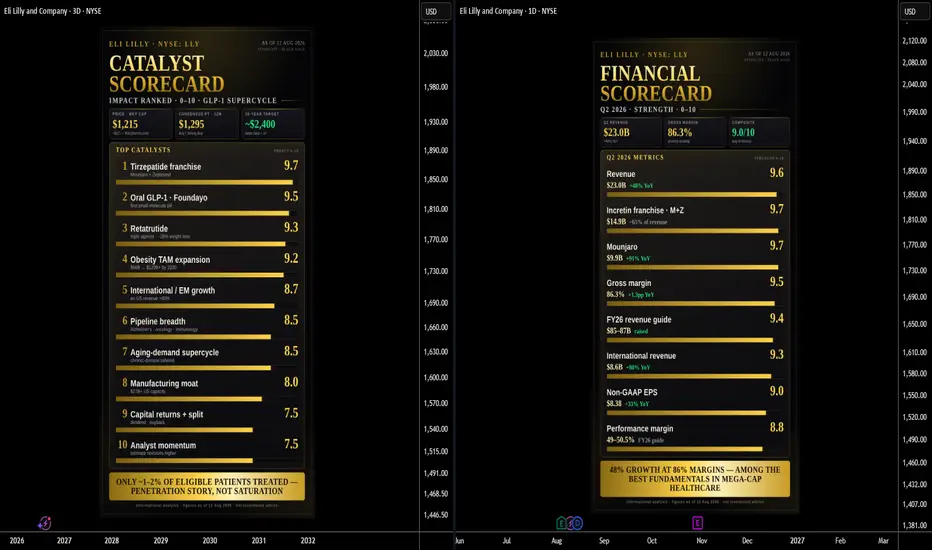
As of August 12, 2026. Stock ~$1,215. First pharmaceutical company ever to cross a $1 trillion market cap (~$1.05–1.1T). An ~12-bagger since 2018 (~$100 → ~$1,215, roughly +1,100–1,200%) — a quiet, low-profile secular compounder that has outperformed most of the AI mega-caps over the cycle. Consensus rating Buy / Strong Buy (~22 covering analysts, ~20 buy / 2 hold); average 12-month price target ~$1,290–$1,300 (~+6–7% upside); range $850 (low) → $1,600 (high). Post-Q2 Street targets cluster higher: Morgan Stanley $1,419, BMO $1,400, one desk $1,385, Truist $1,376, Wells Fargo $1,330. Latest reported quarter: Q2 2026 (ended Jun 30, 2026) — revenue $23.0B (+48% YoY), Mounjaro $9.9B (+91% YoY). Next earnings ~late Oct/early Nov 2026 (Q3); Investment Community Meeting Dec 7, 2026.
🧬 Key Catalysts Driving LLY (2026+)
💊 The Incretin Franchise — Tirzepatide (Mounjaro + Zepbound), the core engine
Combined Mounjaro + Zepbound revenue reached $14.9B in Q2 (~65% of total revenue), contributing $6.3B of the quarter's growth. Mounjaro alone grew 91% to $9.9B; Zepbound $4.9B (+44% U.S.). Lilly holds ~60% U.S. GLP-1 share and accounts for 6 of 10 total U.S. obesity prescriptions and 7 of 10 injectable scripts. Tirzepatide has shown superiority vs. semaglutide in head-to-head diabetes and obesity data, and management guides patent protection into the back half of the 2030s in major markets. Impact Score: 9.7/10
🧪 Foundayo (Orforglipron) — The First Small-Molecule Oral GLP-1
FDA-approved April 1, 2026 as the first once-daily oral small-molecule GLP-1 for chronic weight management (no food/water restrictions). The oral form factor is the real story: pills are radically cheaper and easier to manufacture and ship than weekly injections, unlocking a far larger global and emerging-market TAM. First full quarter contributed $98M with prescriptions doubling month-over-month and ~1 in 4 new patient starts; already filed in ~40 countries. Efficacy (~11–12% weight loss) sits below top injectables but the convenience/scale trade is a category expander, not a cannibalizer. Impact Score: 9.5/10
🧬 Retatrutide — Best-in-Class Next-Gen Triple Agonist
Investigational GIP/GLP-1/glucagon triple receptor agonist; TRIUMPH-1 delivered ~28.3% weight loss (~70 lbs) at 80 weeks — approaching bariatric-surgery magnitude and the deepest of any GLP-1 to date. NDA filing guided to late 2026 / early 2027. Retatrutide gives Lilly a built-in upgrade cycle above tirzepatide and extends the efficacy frontier competitors are still chasing. Impact Score: 9.3/10
⬛ Obesity / GLP-1 TAM Expansion
The global obesity-drug market was ~$66B in 2025 and is guided to $120B+ by 2030 (Bloomberg Intelligence), with Lilly positioned as the primary beneficiary. Crucially, only ~1–2% of the eligible global population is currently treated — this is a penetration story, not a saturation story. Diabetes, cardiovascular, sleep apnea and other tirzepatide label expansions widen the runway further. Impact Score: 9.2/10
🌍 International & Emerging-Market Expansion
Ex-U.S. revenue jumped 80% to $8.6B; Mounjaro outside the U.S. surged 172% (China NRDL inclusion plus strong cash-pay demand in Brazil, India, China). Management notes most international patients pay out of pocket, signaling durable, price-insensitive demand as oral supply scales. This diversifies the franchise beyond a U.S. market that is beginning to mature. Impact Score: 8.7/10
🔬 Pipeline Breadth Beyond Obesity
Kisunla (donanemab) in Alzheimer's, Jaypirca in oncology (CLL/SLL), Taltz/Ebglyss in immunology & dermatology, and a growing cardiometabolic pipeline (Lp(a) and lipid programs) reduce single-franchise dependence. Aggressive business development (Orna, Centessa, Kelonia, Ajax, plus vaccines/psychiatry) is refilling the long-dated pipeline. This is the optionality layer most "GLP-1 only" bulls under-model. Impact Score: 8.5/10
👥 Aging Demographics + Chronic-Disease Supercycle
The structural tailwind: global populations are aging rapidly and the prevalence of obesity, type-2 diabetes, Alzheimer's and cardiovascular disease is rising in lockstep — precisely the therapeutic areas where Lilly leads. Demand for metabolic, neuro and chronic-care drugs compounds for decades, not quarters, giving Lilly one of the most durable secular demand curves in large-cap healthcare. This is the slow, unglamorous engine behind the "stealth bull market." Impact Score: 8.5/10
🏭 Manufacturing Scale-Up as a Moat
$27B+ committed to U.S. manufacturing (plus a fresh $4.5B for Indiana capacity for oral/retatrutide supply). In a demand-constrained category, capacity is competitive advantage — and the build-out secured a 3-year tariff reprieve under the administration's pricing deal. Supply, not demand, has been the binding constraint; closing it directly converts to revenue. Impact Score: 8.0/10
🖤 Capital Returns + Potential Stock Split
Quarterly dividend $1.73 (~$6.92/yr, ~0.57% yield) with a low ~26% payout ratio — ample room to grow. Post-Q2, split speculation intensified (last split 1997); a split wouldn't change fundamentals but would broaden retail access and tends to add a near-term bid. Impact Score: 7.5/10
⬛ Analyst Momentum & Estimate Revisions
Buy/Strong Buy consensus with a wave of post-Q2 target raises into the $1,330–$1,420 range. 2026 EPS estimates have been revised up steadily (Zacks ~$33.9, Street ~$35.50–$36.50 guided); positive revision momentum tends to pull in institutional flows. Impact Score: 7.5/10
⬛ Key Risks & Negative Drivers
⬛ Drug-Pricing Policy — MFN, IRA & Net-Price Erosion (the loudest bear case)
The dominant overhang. Lilly signed a "Most-Favored-Nation" deal committing future launches to MFN-referenced pricing across commercial, Medicare, Medicaid and cash (via the TrumpRx portal), and the administration is pushing to codify elements into law (Lilly opposes). Separately, IRA Medicare negotiation is expanding (15 more drugs in 2027, scaling thereafter). U.S. realized price already fell ~9–13% in Q2; management guides continued low-to-mid-teens U.S. price drag in 2026. Risk Severity: 8.0/10
⬛ Valuation & Franchise Concentration
A >$1T cap on a forward P/E of ~32x (TTM ~40x) prices in sustained hypergrowth, and ~65% of revenue rides one molecule class (tirzepatide/incretins). Any GLP-1 stumble — efficacy scare, supply miss, pricing shock — risks a sharp multiple de-rating. The stock has repeatedly shown two-way volatility around policy headlines. Risk Severity: 7.5/10
⬛ Competition — Novo Nordisk, Generics & Next-Gen Entrants
Novo (Wegovy/Ozempic, oral Wegovy, CagriSema, amycretin) remains a well-capitalized #2 and pre-announced steep 2027 price cuts (~50% Wegovy / ~35% Ozempic) that pressure the whole category. Generic semaglutide is emerging in markets like India and Brazil, and Viking, Amgen (MariTide) and Roche are advancing credible assets. Second-sourcing and price competition are structural features of a maturing category. Risk Severity: 7.0/10
⬛ Margin & Net-Price Erosion (rebates, formulary, mix)
Rising rebates/discounts, CVS formulary dynamics for Zepbound, declining medical-exception usage, and a shift toward lower-priced oral and international volume all pressure realized price and gross-to-net. Volume growth (+60% in Q2) is offsetting it today, but the margin math tightens if volume ever decelerates. Risk Severity: 6.5/10
⬛ Pipeline, Regulatory & Legal Risk
Reliance on the pipeline delivering: retatrutide faces litigation over its FDA regulatory pathway, Foundayo's ramp has been slower than some expected, and oral efficacy trails injectables. Add an ongoing Novo lawsuit over Mounjaro advertising and periodic compounding disputes. Binary clinical/regulatory events can move the stock hard. Risk Severity: 6.0/10
⬛ Tariffs & M&A / IPR&D Drag
Pharma import tariffs (floated at ~25%) remain a policy risk despite the temporary reprieve. Aggressive dealmaking carries integration risk and lumpy acquired-IPR&D charges — Q2 reported EPS absorbed $3.03 of IPR&D, muting the headline print even as underlying guidance rose. Risk Severity: 5.5/10
⬛ Long-Dated Patent Cliff
Tirzepatide is protected into the back half of the 2030s in major markets — comfortably distant, but a real eventual loss-of-exclusivity that the next-gen pipeline (orforglipron, retatrutide) must be positioned to absorb. Low near-term severity, non-trivial long-term. Risk Severity: 4.5/10
🩺 Financial Scorecard (Q2 2026, ended Jun 30, 2026)
Each metric scored 0–10 on strength/quality relative to expectations and trajectory.
# Metric Latest Value Trend Financial Strength
F1 Revenue $23.0B +48% YoY, ~+16% QoQ; volume +60%, price −13% 9.6
F2 Incretin franchise (M+Z) $14.9B ~65% of revenue; +$6.3B of growth YoY 9.7
F3 Mounjaro $9.9B +91% YoY; ex-U.S. +172% 9.7
F4 Gross Margin 86.3% +1.3pp YoY; pharma-leading 9.5
F5 Non-GAAP EPS $8.38 +33% YoY (reported $7.94, incl. $3.03 IPR&D) 9.0
F6 FY2026 Revenue Guidance $85–87B Raised from $82–85B 9.4
F7 Performance Margin (FY guide) 49–50.5% Strong operating leverage 8.8
F8 Cash Generation / Reinvestment Strong OCF Heavy $27B+ capex build-out compresses near-term FCF 7.5
F9 International Revenue $8.6B +80% YoY; volume +113% 9.3
F10 Pipeline / R&D Productivity Orforglipron approved; retatrutide filing; donanemab Deep, front-loaded catalyst slate 9.5
F11 Pricing Headwind / IPR&D Drag U.S. price −9 to −13%; $3.03 IPR&D Net-price erosion + lumpy charges = quality watch-item 6.5
Financial composite (avg of F1–F11): ~9.0/10 — exceptional top-line, best-in-class gross margins and a uniquely deep catalyst pipeline; the soft spots are U.S. net-price erosion, IPR&D lumpiness, and heavy reinvestment that holds down near-term free cash flow.
🏆 Master Ranking — Catalysts & Financial Strengths Combined
Positive drivers ranked by score. Risks listed separately as deductions.
Rank Driver Type Score (0–10)
1 Mounjaro $9.9B (+91% YoY) Financial 9.7
1 Incretin franchise $14.9B (~65% of revenue) Financial 9.7
1 Tirzepatide franchise dominance Catalyst 9.7
4 Revenue $23.0B (+48% YoY) Financial 9.6
5 Gross margin 86.3% Financial 9.5
5 Orforglipron / Foundayo (oral GLP-1) Catalyst 9.5
5 Pipeline / R&D productivity Financial 9.5
8 FY2026 guidance raised to $85–87B Financial 9.4
9 Retatrutide (triple agonist) Catalyst 9.3
9 International revenue $8.6B (+80%) Financial 9.3
11 Obesity / GLP-1 TAM ($66B → $120B+ by 2030) Catalyst 9.2
12 Non-GAAP EPS $8.38 (+33%) Financial 9.0
13 Performance margin 49–50.5% Financial 8.8
14 International / emerging-market expansion Catalyst 8.7
15 Pipeline breadth beyond obesity Catalyst 8.5
15 Aging demographics / chronic-disease supercycle Catalyst 8.5
17 Manufacturing scale-up as moat Catalyst 8.0
18 Capital returns + potential split Catalyst 7.5
18 Analyst momentum & revisions Catalyst 7.5
⬛ Risk Ledger (severity-ranked)
Rank Risk Severity (0–10)
1 Drug-pricing policy (MFN / IRA / net price) 8.0
2 Valuation & franchise concentration 7.5
3 Competition (Novo, generics, next-gen) 7.0
4 Margin & net-price erosion 6.5
5 Pipeline, regulatory & legal 6.0
6 Tariffs & M&A / IPR&D drag 5.5
7 Long-dated patent cliff 4.5
🖤 Long-Term Price Target Framework (BUY / HOLD)
12-Month (analyst consensus): ~$1,290–$1,300 average, range $850 → $1,600; post-Q2 Street raises cluster $1,330–$1,420. Rating: Buy / Strong Buy.
10-Year BUY / HOLD target: roughly 2x from current levels → ~$2,400–$2,500 base case.
The math is undemanding relative to the growth: with revenue compounding at a moderating mid-teens+ CAGR off an $85–87B 2026 base, EPS can plausibly build from ~$36 (2026) toward ~$70–90+ by the mid-2030s. Even assuming meaningful multiple normalization (from ~32x forward today toward a high-20s/low-30s "mature compounder" multiple), a double over a decade implies only ~7% annual price appreciation — a conservative outcome for a franchise leader in an under-penetrated, secularly expanding market. Some Street voices are more aggressive (a widely-cited call sees a $2T market cap by ~2031). Aging demographics and rising chronic-disease prevalence are the ballast under this thesis: the demand curve compounds regardless of the quarterly tape.
Scenario band (10-yr, directional):
• Bear (~$1,300–$1,600): MFN codified + aggressive price cuts + share loss compress both growth and multiple.
• Base (~$2,400–$2,500): steady incretin leadership, successful oral/retatrutide scale-up, TAM expansion as modeled.
• Bull ($3,000+): retatrutide best-in-class, oral unlocks emerging markets, pipeline (Alzheimer's/cardiometabolic) delivers a second engine.
Posture: a long-term BUY / core HOLD — accumulate on policy-driven drawdowns, size for the two-way volatility around pricing headlines and quarterly prints.
📝 Summary Outlook (August 2026)
Eli Lilly is the quiet heavyweight of the market — the first pharma to cross $1 trillion, an ~12-bagger since 2018, and a franchise growing revenue 48% at 86% gross margins while most investors are watching the AI names. The engine is tirzepatide (Mounjaro + Zepbound, ~65% of revenue), now flanked by the first oral small-molecule GLP-1 (Foundayo) and a best-in-class triple agonist (retatrutide) filing into 2026/27. With only ~1–2% of the eligible global population treated, a $66B market heading to $120B+ by 2030, and an aging, chronically-sicker world underneath it all, the demand runway is measured in decades.
The bear case is not about demand — it's about price and policy. MFN referencing, IRA negotiation and the TrumpRx framework are eroding U.S. net price (−9 to −13% and counting), a >$1T cap on ~32x forward earnings prices in continued excellence, and Novo plus generics plus next-gen entrants keep the category competitive. Volume growth is currently swamping the price drag; the risk is what happens to the margin math if that ever reverses.
Bottom line: fundamentals are among the best in mega-cap healthcare (financial composite ~9.0/10), the pipeline is uniquely deep, and the secular demographic tailwind is real and durable. The debate isn't whether Lilly grows — it's how much of that growth policy and pricing extract along the way. For a 10-year horizon, a conservative "roughly double" (~$2,400–$2,500) is a reasonable base case, with genuine upside if oral GLP-1 and retatrutide scale as the data suggests.
Sources: Lilly Q2 2026 & Q1 2026 press releases and CFO commentary (SEC 8-K, investor.lilly.com, PRNewswire); CNBC, Yahoo Finance, Quartz, GuruFocus, FXLeaders (earnings); StockAnalysis, WallStreetZen, Public.com, TipRanks, CNN, TradingView (targets/ratings); PharmExec, AJMC, PhysiciansWeekly, Lilly IR (orforglipron/retatrutide); CNBC, BioPharma Dive, Bloomberg, Axios, Barchart, DrugDiscoveryTrends (MFN/IRA/tariffs); The Motley Fool, The Corner, Zacks, TIKR (competition/TAM/valuation).
🧬 Key Catalysts Driving LLY (2026+)
💊 The Incretin Franchise — Tirzepatide (Mounjaro + Zepbound), the core engine
Combined Mounjaro + Zepbound revenue reached $14.9B in Q2 (~65% of total revenue), contributing $6.3B of the quarter's growth. Mounjaro alone grew 91% to $9.9B; Zepbound $4.9B (+44% U.S.). Lilly holds ~60% U.S. GLP-1 share and accounts for 6 of 10 total U.S. obesity prescriptions and 7 of 10 injectable scripts. Tirzepatide has shown superiority vs. semaglutide in head-to-head diabetes and obesity data, and management guides patent protection into the back half of the 2030s in major markets. Impact Score: 9.7/10
🧪 Foundayo (Orforglipron) — The First Small-Molecule Oral GLP-1
FDA-approved April 1, 2026 as the first once-daily oral small-molecule GLP-1 for chronic weight management (no food/water restrictions). The oral form factor is the real story: pills are radically cheaper and easier to manufacture and ship than weekly injections, unlocking a far larger global and emerging-market TAM. First full quarter contributed $98M with prescriptions doubling month-over-month and ~1 in 4 new patient starts; already filed in ~40 countries. Efficacy (~11–12% weight loss) sits below top injectables but the convenience/scale trade is a category expander, not a cannibalizer. Impact Score: 9.5/10
🧬 Retatrutide — Best-in-Class Next-Gen Triple Agonist
Investigational GIP/GLP-1/glucagon triple receptor agonist; TRIUMPH-1 delivered ~28.3% weight loss (~70 lbs) at 80 weeks — approaching bariatric-surgery magnitude and the deepest of any GLP-1 to date. NDA filing guided to late 2026 / early 2027. Retatrutide gives Lilly a built-in upgrade cycle above tirzepatide and extends the efficacy frontier competitors are still chasing. Impact Score: 9.3/10
⬛ Obesity / GLP-1 TAM Expansion
The global obesity-drug market was ~$66B in 2025 and is guided to $120B+ by 2030 (Bloomberg Intelligence), with Lilly positioned as the primary beneficiary. Crucially, only ~1–2% of the eligible global population is currently treated — this is a penetration story, not a saturation story. Diabetes, cardiovascular, sleep apnea and other tirzepatide label expansions widen the runway further. Impact Score: 9.2/10
🌍 International & Emerging-Market Expansion
Ex-U.S. revenue jumped 80% to $8.6B; Mounjaro outside the U.S. surged 172% (China NRDL inclusion plus strong cash-pay demand in Brazil, India, China). Management notes most international patients pay out of pocket, signaling durable, price-insensitive demand as oral supply scales. This diversifies the franchise beyond a U.S. market that is beginning to mature. Impact Score: 8.7/10
🔬 Pipeline Breadth Beyond Obesity
Kisunla (donanemab) in Alzheimer's, Jaypirca in oncology (CLL/SLL), Taltz/Ebglyss in immunology & dermatology, and a growing cardiometabolic pipeline (Lp(a) and lipid programs) reduce single-franchise dependence. Aggressive business development (Orna, Centessa, Kelonia, Ajax, plus vaccines/psychiatry) is refilling the long-dated pipeline. This is the optionality layer most "GLP-1 only" bulls under-model. Impact Score: 8.5/10
👥 Aging Demographics + Chronic-Disease Supercycle
The structural tailwind: global populations are aging rapidly and the prevalence of obesity, type-2 diabetes, Alzheimer's and cardiovascular disease is rising in lockstep — precisely the therapeutic areas where Lilly leads. Demand for metabolic, neuro and chronic-care drugs compounds for decades, not quarters, giving Lilly one of the most durable secular demand curves in large-cap healthcare. This is the slow, unglamorous engine behind the "stealth bull market." Impact Score: 8.5/10
🏭 Manufacturing Scale-Up as a Moat
$27B+ committed to U.S. manufacturing (plus a fresh $4.5B for Indiana capacity for oral/retatrutide supply). In a demand-constrained category, capacity is competitive advantage — and the build-out secured a 3-year tariff reprieve under the administration's pricing deal. Supply, not demand, has been the binding constraint; closing it directly converts to revenue. Impact Score: 8.0/10
🖤 Capital Returns + Potential Stock Split
Quarterly dividend $1.73 (~$6.92/yr, ~0.57% yield) with a low ~26% payout ratio — ample room to grow. Post-Q2, split speculation intensified (last split 1997); a split wouldn't change fundamentals but would broaden retail access and tends to add a near-term bid. Impact Score: 7.5/10
⬛ Analyst Momentum & Estimate Revisions
Buy/Strong Buy consensus with a wave of post-Q2 target raises into the $1,330–$1,420 range. 2026 EPS estimates have been revised up steadily (Zacks ~$33.9, Street ~$35.50–$36.50 guided); positive revision momentum tends to pull in institutional flows. Impact Score: 7.5/10
⬛ Key Risks & Negative Drivers
⬛ Drug-Pricing Policy — MFN, IRA & Net-Price Erosion (the loudest bear case)
The dominant overhang. Lilly signed a "Most-Favored-Nation" deal committing future launches to MFN-referenced pricing across commercial, Medicare, Medicaid and cash (via the TrumpRx portal), and the administration is pushing to codify elements into law (Lilly opposes). Separately, IRA Medicare negotiation is expanding (15 more drugs in 2027, scaling thereafter). U.S. realized price already fell ~9–13% in Q2; management guides continued low-to-mid-teens U.S. price drag in 2026. Risk Severity: 8.0/10
⬛ Valuation & Franchise Concentration
A >$1T cap on a forward P/E of ~32x (TTM ~40x) prices in sustained hypergrowth, and ~65% of revenue rides one molecule class (tirzepatide/incretins). Any GLP-1 stumble — efficacy scare, supply miss, pricing shock — risks a sharp multiple de-rating. The stock has repeatedly shown two-way volatility around policy headlines. Risk Severity: 7.5/10
⬛ Competition — Novo Nordisk, Generics & Next-Gen Entrants
Novo (Wegovy/Ozempic, oral Wegovy, CagriSema, amycretin) remains a well-capitalized #2 and pre-announced steep 2027 price cuts (~50% Wegovy / ~35% Ozempic) that pressure the whole category. Generic semaglutide is emerging in markets like India and Brazil, and Viking, Amgen (MariTide) and Roche are advancing credible assets. Second-sourcing and price competition are structural features of a maturing category. Risk Severity: 7.0/10
⬛ Margin & Net-Price Erosion (rebates, formulary, mix)
Rising rebates/discounts, CVS formulary dynamics for Zepbound, declining medical-exception usage, and a shift toward lower-priced oral and international volume all pressure realized price and gross-to-net. Volume growth (+60% in Q2) is offsetting it today, but the margin math tightens if volume ever decelerates. Risk Severity: 6.5/10
⬛ Pipeline, Regulatory & Legal Risk
Reliance on the pipeline delivering: retatrutide faces litigation over its FDA regulatory pathway, Foundayo's ramp has been slower than some expected, and oral efficacy trails injectables. Add an ongoing Novo lawsuit over Mounjaro advertising and periodic compounding disputes. Binary clinical/regulatory events can move the stock hard. Risk Severity: 6.0/10
⬛ Tariffs & M&A / IPR&D Drag
Pharma import tariffs (floated at ~25%) remain a policy risk despite the temporary reprieve. Aggressive dealmaking carries integration risk and lumpy acquired-IPR&D charges — Q2 reported EPS absorbed $3.03 of IPR&D, muting the headline print even as underlying guidance rose. Risk Severity: 5.5/10
⬛ Long-Dated Patent Cliff
Tirzepatide is protected into the back half of the 2030s in major markets — comfortably distant, but a real eventual loss-of-exclusivity that the next-gen pipeline (orforglipron, retatrutide) must be positioned to absorb. Low near-term severity, non-trivial long-term. Risk Severity: 4.5/10
🩺 Financial Scorecard (Q2 2026, ended Jun 30, 2026)
Each metric scored 0–10 on strength/quality relative to expectations and trajectory.
# Metric Latest Value Trend Financial Strength
F1 Revenue $23.0B +48% YoY, ~+16% QoQ; volume +60%, price −13% 9.6
F2 Incretin franchise (M+Z) $14.9B ~65% of revenue; +$6.3B of growth YoY 9.7
F3 Mounjaro $9.9B +91% YoY; ex-U.S. +172% 9.7
F4 Gross Margin 86.3% +1.3pp YoY; pharma-leading 9.5
F5 Non-GAAP EPS $8.38 +33% YoY (reported $7.94, incl. $3.03 IPR&D) 9.0
F6 FY2026 Revenue Guidance $85–87B Raised from $82–85B 9.4
F7 Performance Margin (FY guide) 49–50.5% Strong operating leverage 8.8
F8 Cash Generation / Reinvestment Strong OCF Heavy $27B+ capex build-out compresses near-term FCF 7.5
F9 International Revenue $8.6B +80% YoY; volume +113% 9.3
F10 Pipeline / R&D Productivity Orforglipron approved; retatrutide filing; donanemab Deep, front-loaded catalyst slate 9.5
F11 Pricing Headwind / IPR&D Drag U.S. price −9 to −13%; $3.03 IPR&D Net-price erosion + lumpy charges = quality watch-item 6.5
Financial composite (avg of F1–F11): ~9.0/10 — exceptional top-line, best-in-class gross margins and a uniquely deep catalyst pipeline; the soft spots are U.S. net-price erosion, IPR&D lumpiness, and heavy reinvestment that holds down near-term free cash flow.
🏆 Master Ranking — Catalysts & Financial Strengths Combined
Positive drivers ranked by score. Risks listed separately as deductions.
Rank Driver Type Score (0–10)
1 Mounjaro $9.9B (+91% YoY) Financial 9.7
1 Incretin franchise $14.9B (~65% of revenue) Financial 9.7
1 Tirzepatide franchise dominance Catalyst 9.7
4 Revenue $23.0B (+48% YoY) Financial 9.6
5 Gross margin 86.3% Financial 9.5
5 Orforglipron / Foundayo (oral GLP-1) Catalyst 9.5
5 Pipeline / R&D productivity Financial 9.5
8 FY2026 guidance raised to $85–87B Financial 9.4
9 Retatrutide (triple agonist) Catalyst 9.3
9 International revenue $8.6B (+80%) Financial 9.3
11 Obesity / GLP-1 TAM ($66B → $120B+ by 2030) Catalyst 9.2
12 Non-GAAP EPS $8.38 (+33%) Financial 9.0
13 Performance margin 49–50.5% Financial 8.8
14 International / emerging-market expansion Catalyst 8.7
15 Pipeline breadth beyond obesity Catalyst 8.5
15 Aging demographics / chronic-disease supercycle Catalyst 8.5
17 Manufacturing scale-up as moat Catalyst 8.0
18 Capital returns + potential split Catalyst 7.5
18 Analyst momentum & revisions Catalyst 7.5
⬛ Risk Ledger (severity-ranked)
Rank Risk Severity (0–10)
1 Drug-pricing policy (MFN / IRA / net price) 8.0
2 Valuation & franchise concentration 7.5
3 Competition (Novo, generics, next-gen) 7.0
4 Margin & net-price erosion 6.5
5 Pipeline, regulatory & legal 6.0
6 Tariffs & M&A / IPR&D drag 5.5
7 Long-dated patent cliff 4.5
🖤 Long-Term Price Target Framework (BUY / HOLD)
12-Month (analyst consensus): ~$1,290–$1,300 average, range $850 → $1,600; post-Q2 Street raises cluster $1,330–$1,420. Rating: Buy / Strong Buy.
10-Year BUY / HOLD target: roughly 2x from current levels → ~$2,400–$2,500 base case.
The math is undemanding relative to the growth: with revenue compounding at a moderating mid-teens+ CAGR off an $85–87B 2026 base, EPS can plausibly build from ~$36 (2026) toward ~$70–90+ by the mid-2030s. Even assuming meaningful multiple normalization (from ~32x forward today toward a high-20s/low-30s "mature compounder" multiple), a double over a decade implies only ~7% annual price appreciation — a conservative outcome for a franchise leader in an under-penetrated, secularly expanding market. Some Street voices are more aggressive (a widely-cited call sees a $2T market cap by ~2031). Aging demographics and rising chronic-disease prevalence are the ballast under this thesis: the demand curve compounds regardless of the quarterly tape.
Scenario band (10-yr, directional):
• Bear (~$1,300–$1,600): MFN codified + aggressive price cuts + share loss compress both growth and multiple.
• Base (~$2,400–$2,500): steady incretin leadership, successful oral/retatrutide scale-up, TAM expansion as modeled.
• Bull ($3,000+): retatrutide best-in-class, oral unlocks emerging markets, pipeline (Alzheimer's/cardiometabolic) delivers a second engine.
Posture: a long-term BUY / core HOLD — accumulate on policy-driven drawdowns, size for the two-way volatility around pricing headlines and quarterly prints.
📝 Summary Outlook (August 2026)
Eli Lilly is the quiet heavyweight of the market — the first pharma to cross $1 trillion, an ~12-bagger since 2018, and a franchise growing revenue 48% at 86% gross margins while most investors are watching the AI names. The engine is tirzepatide (Mounjaro + Zepbound, ~65% of revenue), now flanked by the first oral small-molecule GLP-1 (Foundayo) and a best-in-class triple agonist (retatrutide) filing into 2026/27. With only ~1–2% of the eligible global population treated, a $66B market heading to $120B+ by 2030, and an aging, chronically-sicker world underneath it all, the demand runway is measured in decades.
The bear case is not about demand — it's about price and policy. MFN referencing, IRA negotiation and the TrumpRx framework are eroding U.S. net price (−9 to −13% and counting), a >$1T cap on ~32x forward earnings prices in continued excellence, and Novo plus generics plus next-gen entrants keep the category competitive. Volume growth is currently swamping the price drag; the risk is what happens to the margin math if that ever reverses.
Bottom line: fundamentals are among the best in mega-cap healthcare (financial composite ~9.0/10), the pipeline is uniquely deep, and the secular demographic tailwind is real and durable. The debate isn't whether Lilly grows — it's how much of that growth policy and pricing extract along the way. For a 10-year horizon, a conservative "roughly double" (~$2,400–$2,500) is a reasonable base case, with genuine upside if oral GLP-1 and retatrutide scale as the data suggests.
Sources: Lilly Q2 2026 & Q1 2026 press releases and CFO commentary (SEC 8-K, investor.lilly.com, PRNewswire); CNBC, Yahoo Finance, Quartz, GuruFocus, FXLeaders (earnings); StockAnalysis, WallStreetZen, Public.com, TipRanks, CNN, TradingView (targets/ratings); PharmExec, AJMC, PhysiciansWeekly, Lilly IR (orforglipron/retatrutide); CNBC, BioPharma Dive, Bloomberg, Axios, Barchart, DrugDiscoveryTrends (MFN/IRA/tariffs); The Motley Fool, The Corner, Zacks, TIKR (competition/TAM/valuation).
บันทึก
Strong Reclaim Zones | ProjectSyndicate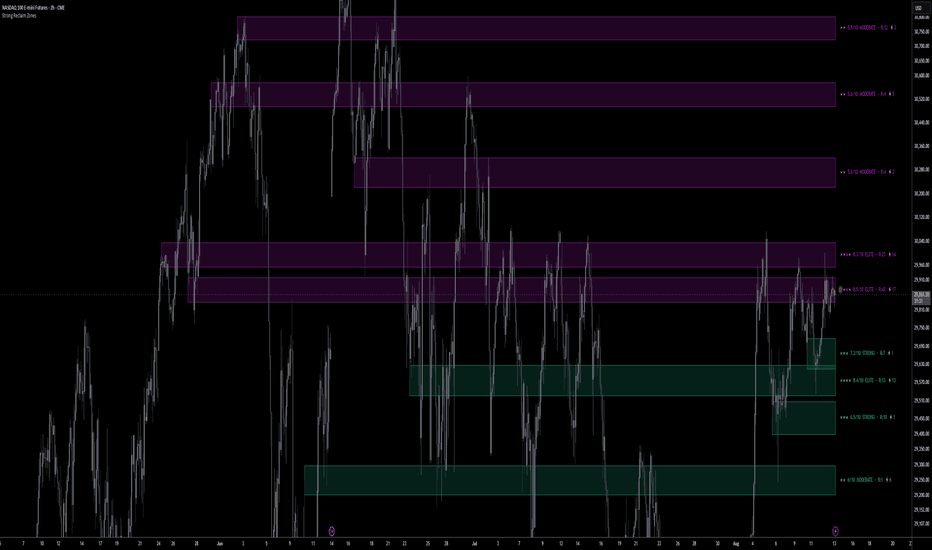
บันทึก
ES H4 Institutional Liquidity Levels Bulls/Bears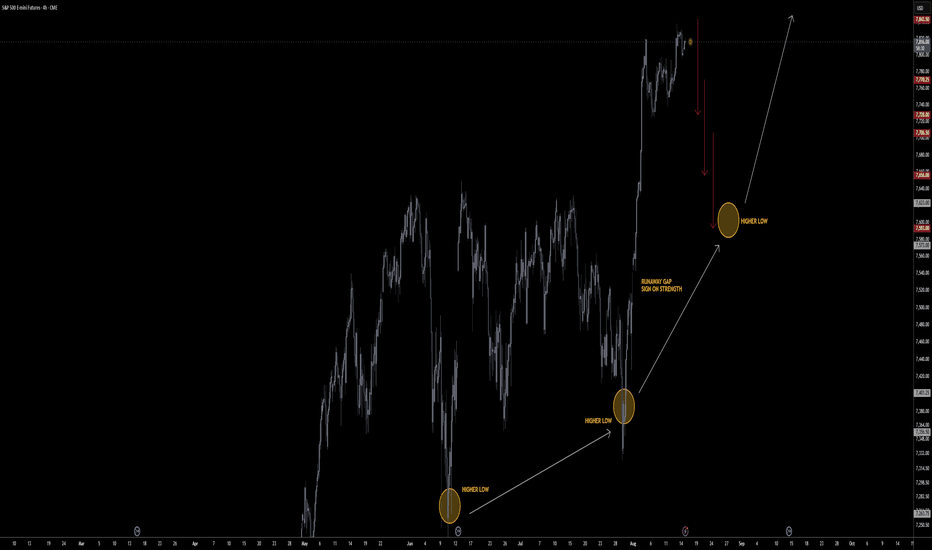
บันทึก
SpaceX (SPCX) 2026+ Catalysts & Risks Institutional Overview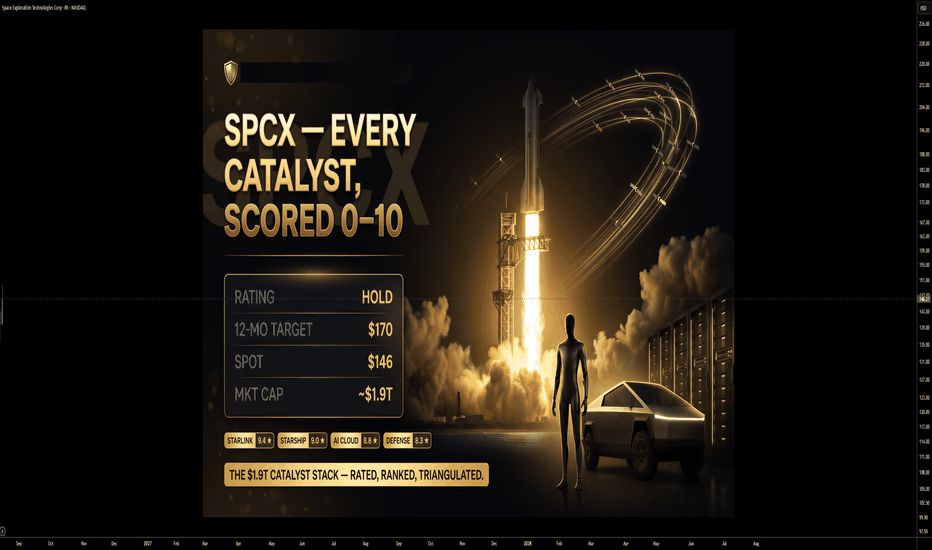

Gold Algo Trading · +1100% YTD · max DD <5%
Syndicate Ultimate · 5 algo systems · 1 bundle
1 payment · lifetime access · no monthly fees
+ FX · NQ/ES · 10+ yr institutional desk
syndicate001.com
Join on Telegram
t.me/aisyndicate001
Syndicate Ultimate · 5 algo systems · 1 bundle
1 payment · lifetime access · no monthly fees
+ FX · NQ/ES · 10+ yr institutional desk
syndicate001.com
Join on Telegram
t.me/aisyndicate001
คำจำกัดสิทธิ์ความรับผิดชอบ
ข้อมูลและบทความไม่ได้มีวัตถุประสงค์เพื่อก่อให้เกิดกิจกรรมทางการเงิน, การลงทุน, การซื้อขาย, ข้อเสนอแนะ หรือคำแนะนำประเภทอื่น ๆ ที่ให้หรือรับรองโดย TradingView อ่านเพิ่มเติมใน ข้อกำหนดการใช้งาน
Gold Algo Trading · +1100% YTD · max DD <5%
Syndicate Ultimate · 5 algo systems · 1 bundle
1 payment · lifetime access · no monthly fees
+ FX · NQ/ES · 10+ yr institutional desk
syndicate001.com
Join on Telegram
t.me/aisyndicate001
Syndicate Ultimate · 5 algo systems · 1 bundle
1 payment · lifetime access · no monthly fees
+ FX · NQ/ES · 10+ yr institutional desk
syndicate001.com
Join on Telegram
t.me/aisyndicate001
คำจำกัดสิทธิ์ความรับผิดชอบ
ข้อมูลและบทความไม่ได้มีวัตถุประสงค์เพื่อก่อให้เกิดกิจกรรมทางการเงิน, การลงทุน, การซื้อขาย, ข้อเสนอแนะ หรือคำแนะนำประเภทอื่น ๆ ที่ให้หรือรับรองโดย TradingView อ่านเพิ่มเติมใน ข้อกำหนดการใช้งาน