
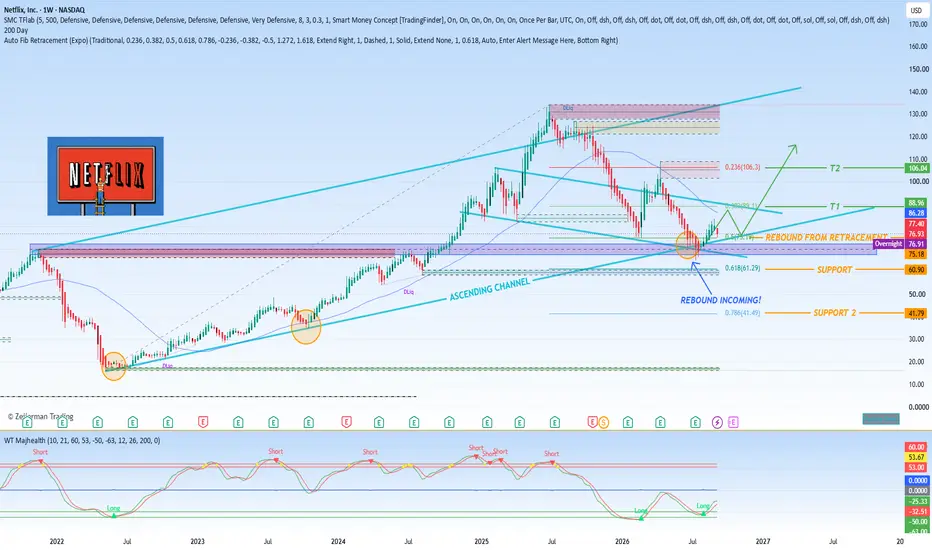
Netflix (NFLX) grew revenue faster over the past twelve months than Amazon, Apple, Comcast, or Disney and earned a wider operating margin than all of them except Apple. Its shares still finished those twelve months down 38.9%, the last of the five. The fall has not made the stock cheap. That is the mismatch worth explaining.
Is There Anything Left for Netflix to Grow Into?
When the question turns to whether Netflix still has room to expand, management’s answer is unambiguous: most of the opportunity has not yet been claimed. According to the company’s CFO, Netflix has reached less than 45% penetration of an estimated 800 million addressable households worldwide. That leaves more than half of the potential market still outside its subscriber base, suggesting that the core streaming business alone has a substantial runway remaining. In management’s view, Netflix is not nearing a ceiling; it is still working through the early chapters of a much larger global opportunity.
That optimism extends beyond traditional streaming. Netflix’s live events are expected to consume only about 5% of the 2026 content budget and to generate roughly 1% of total viewing hours. On those measures alone, live programming might look like a minor part of the business. But Netflix credits live events with driving six of the ten biggest new-member sign-up days over the past five years. That suggests their real value is not measured simply in hours watched. They act as acquisition engines, creating urgency, cultural moments, and reasons for people to subscribe or re-engage with the service.
Cloud gaming is another area where Netflix sees future potential. Management says monthly players for its cloud games have risen elevenfold since the company scaled up the effort in October 2025. The business is still relatively young, and it is not yet clear how large it will become, but the pace of growth gives management reason to believe it can develop into a more meaningful part of the broader Netflix ecosystem over time.
Advertising is likewise positioned as a major source of untapped growth. Netflix’s ads plan is expected to generate about $3.00 billion in advertising revenue in 2026. Against the company’s total 2026 revenue forecast of roughly $51.20 billion, that remains a relatively small slice. Management describes the gap between what an advertising-supported member is currently worth and what that member could eventually be worth as near-term unrealized revenue growth. In other words, the ads tier is already contributing, but Netflix believes it has not yet come close to extracting its full monetization potential.
So what does Netflix need to deliver next? The answer is not simply a repeat of the last twelve months. The CFO has guided full-year 2026 top-line growth of 13% to 14%. Netflix has stopped asking to be paid for acceleration. The company is no longer seeking credit merely for the promise of faster growth; it now has to show that its investments in live events, cloud gaming, and advertising can translate into durable revenue and subscriber gains.
The next phase for Netflix is therefore less about proving that opportunity exists and more about proving that it can capture that opportunity efficiently. The runway may still be long, but the market will judge the company on execution. Management has laid out the case that there is plenty left to grow into. The task now is to convert that potential into measurable results.
Is There Anything Left for Netflix to Grow Into?
When the question turns to whether Netflix still has room to expand, management’s answer is unambiguous: most of the opportunity has not yet been claimed. According to the company’s CFO, Netflix has reached less than 45% penetration of an estimated 800 million addressable households worldwide. That leaves more than half of the potential market still outside its subscriber base, suggesting that the core streaming business alone has a substantial runway remaining. In management’s view, Netflix is not nearing a ceiling; it is still working through the early chapters of a much larger global opportunity.
That optimism extends beyond traditional streaming. Netflix’s live events are expected to consume only about 5% of the 2026 content budget and to generate roughly 1% of total viewing hours. On those measures alone, live programming might look like a minor part of the business. But Netflix credits live events with driving six of the ten biggest new-member sign-up days over the past five years. That suggests their real value is not measured simply in hours watched. They act as acquisition engines, creating urgency, cultural moments, and reasons for people to subscribe or re-engage with the service.
Cloud gaming is another area where Netflix sees future potential. Management says monthly players for its cloud games have risen elevenfold since the company scaled up the effort in October 2025. The business is still relatively young, and it is not yet clear how large it will become, but the pace of growth gives management reason to believe it can develop into a more meaningful part of the broader Netflix ecosystem over time.
Advertising is likewise positioned as a major source of untapped growth. Netflix’s ads plan is expected to generate about $3.00 billion in advertising revenue in 2026. Against the company’s total 2026 revenue forecast of roughly $51.20 billion, that remains a relatively small slice. Management describes the gap between what an advertising-supported member is currently worth and what that member could eventually be worth as near-term unrealized revenue growth. In other words, the ads tier is already contributing, but Netflix believes it has not yet come close to extracting its full monetization potential.
So what does Netflix need to deliver next? The answer is not simply a repeat of the last twelve months. The CFO has guided full-year 2026 top-line growth of 13% to 14%. Netflix has stopped asking to be paid for acceleration. The company is no longer seeking credit merely for the promise of faster growth; it now has to show that its investments in live events, cloud gaming, and advertising can translate into durable revenue and subscriber gains.
The next phase for Netflix is therefore less about proving that opportunity exists and more about proving that it can capture that opportunity efficiently. The runway may still be long, but the market will judge the company on execution. Management has laid out the case that there is plenty left to grow into. The task now is to convert that potential into measurable results.

การนำเสนอที่เกี่ยวข้อง
คำจำกัดสิทธิ์ความรับผิดชอบ
ข้อมูลและบทความไม่ได้มีวัตถุประสงค์เพื่อก่อให้เกิดกิจกรรมทางการเงิน, การลงทุน, การซื้อขาย, ข้อเสนอแนะ หรือคำแนะนำประเภทอื่น ๆ ที่ให้หรือรับรองโดย TradingView อ่านเพิ่มเติมใน ข้อกำหนดการใช้งาน
การนำเสนอที่เกี่ยวข้อง
คำจำกัดสิทธิ์ความรับผิดชอบ
ข้อมูลและบทความไม่ได้มีวัตถุประสงค์เพื่อก่อให้เกิดกิจกรรมทางการเงิน, การลงทุน, การซื้อขาย, ข้อเสนอแนะ หรือคำแนะนำประเภทอื่น ๆ ที่ให้หรือรับรองโดย TradingView อ่านเพิ่มเติมใน ข้อกำหนดการใช้งาน