
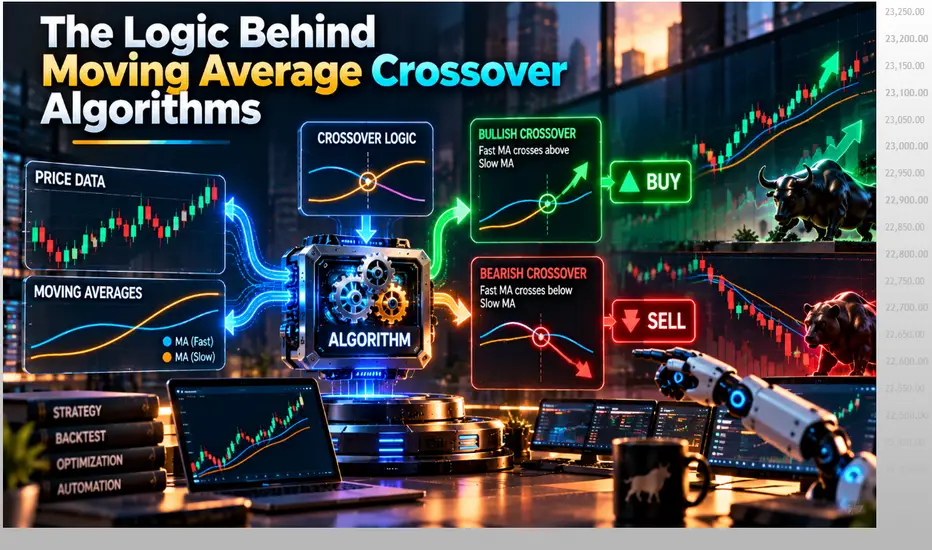
📊 The Logic Behind Moving Average Crossover Algorithms
Moving-average crossover systems are among the simplest forms of algorithmic trend trading.
The basic idea is:
**Fast MA crosses above Slow MA → Bullish Signal**
**Fast MA crosses below Slow MA → Bearish Signal**
But a professional algorithm should not trade every crossover blindly.
The real question is:
**Did the crossover happen inside a market that is genuinely trending?**
---------------------------------
📊 Fast MA vs Slow MA
A fast moving average reacts quickly to recent prices.
A slow moving average reacts more gradually.
For example:
20 EMA = Fast
50 EMA = Slow
When the 20 EMA moves above the 50 EMA, recent price behaviour is becoming stronger than the broader trend.
That may indicate bullish momentum.
---------------------------------
⚠️ The Biggest Problem: Sideways Markets
Crossovers often struggle when the market is ranging.
You may see:
Bullish Cross → Bearish Cross → Bullish Cross
without any real trend developing.
This creates repeated whipsaws.
That is why the crossover itself should not be the complete strategy.
---------------------------------
📈 Better Bullish Crossover Logic
A stronger system may require:
✅ Fast MA crosses above slow MA
✅ Price closes above both averages
✅ Both averages slope upward
✅ Volume expands
✅ Price remains above VWAP
✅ Higher-timeframe trend is bullish
Now the algorithm is checking the environment around the crossover.
---------------------------------
📊 MA Slope and Separation Matter
Two flat averages crossing repeatedly usually indicate noise.
A healthier bullish trend often shows:
• Fast MA above slow MA
• Both averages rising
• Distance between them increasing
This tells the algorithm that momentum is expanding rather than simply oscillating.
---------------------------------
🎯 Price Action Should Confirm
A moving-average crossover is a lagging signal.
Price may already have:
• Broken resistance
• Formed a higher low
• Expanded volume
before the averages cross.
So many stronger systems use:
**Price Action Trigger + MA Trend Confirmation**
instead of relying on the crossover alone.
---------------------------------
🤖 Use Closed-Candle Confirmation
A crossover can appear during a live candle and disappear before the candle closes.
For algorithmic systems, a safer rule is often:
**Generate signal only after the crossover is confirmed on a closed candle.**
This creates more stable, non-repainting execution logic.
---------------------------------
🛡️ Risk Still Comes First
After a valid crossover, the system should check:
• Structural stop
• Position size
• R:R
• Market regime
• Entry extension
A correct crossover can still be a poor trade if price has already moved too far.
---------------------------------
📊 For Option Traders
The underlying may generate the trend signal.
Then the option engine checks:
• CE / PE
• Strike liquidity
• Premium VWAP
• Premium swing breakout
• Risk
**Underlying crossover = Direction**
**Option premium = Execution confirmation**
---------------------------------
📊 Simple Formula
Fast MA Cross + Positive Slope + Price Confirmation + Volume + Trend Alignment + Defined Risk
= Higher-Quality Crossover Setup
But:
Frequent Crosses + Flat MAs + Sideways Price
= Whipsaw Risk
---------------------------------
📊 Finally, the important point to note is:
A moving-average crossover algorithm should not ask only:
“Did the two averages cross?”
It should ask:
**“Did this crossover happen inside a genuine trend transition?”**
That is the difference between a simple crossover alert and a professional crossover trading system.
---------------------------------
Educational Purpose Only.

⭐For Live Trading Courses And Trading Community 📈
Contact ⬇️
📱wa.me/919322295961
📱t.me/+UgF9lES_XxA0MTk9
⭐Advanced courses
⭐Fully Automated Algo Trading
⭐Daily F&O Trade tips
📱 t.me/+UgF9lES_XxA0MTk9
Contact ⬇️
📱wa.me/919322295961
📱t.me/+UgF9lES_XxA0MTk9
⭐Advanced courses
⭐Fully Automated Algo Trading
⭐Daily F&O Trade tips
📱 t.me/+UgF9lES_XxA0MTk9
การนำเสนอที่เกี่ยวข้อง
คำจำกัดสิทธิ์ความรับผิดชอบ
ข้อมูลและบทความไม่ได้มีวัตถุประสงค์เพื่อก่อให้เกิดกิจกรรมทางการเงิน, การลงทุน, การซื้อขาย, ข้อเสนอแนะ หรือคำแนะนำประเภทอื่น ๆ ที่ให้หรือรับรองโดย TradingView อ่านเพิ่มเติมใน ข้อกำหนดการใช้งาน