
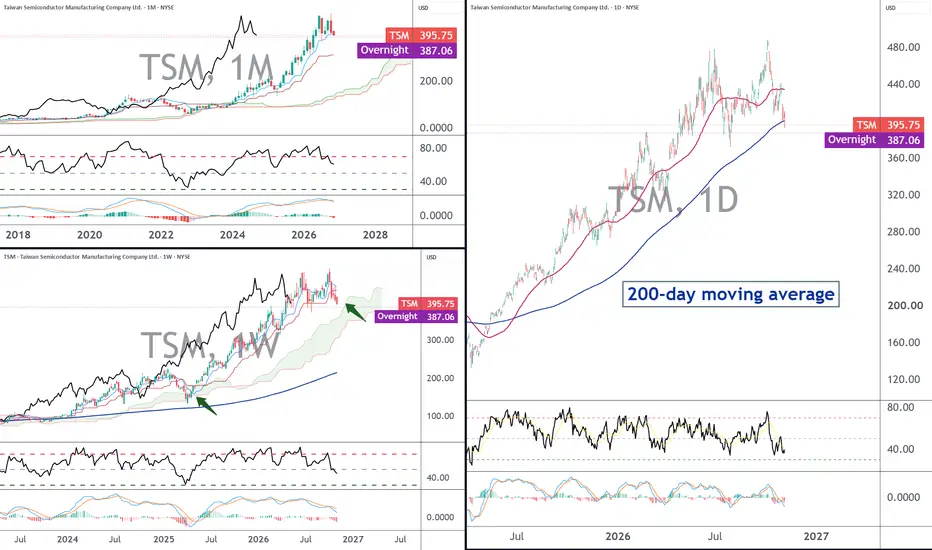
Have the technology sector and the semiconductor segment completed their short-term retracement? This is currently the dominant technical issue, given the technology sector’s significant weight in the S&P 500 index.
When we think of semiconductors, the reflex is to think of Nvidia. But if you think of Nvidia, then you should immediately think of TSMC.
1) TSMC, the global semiconductor barometer
TSMC (Taiwan Semiconductor Manufacturing Company) is the world’s leading contract semiconductor manufacturer (“foundry”). Founded in Taiwan in 1987, the group manufactures chips designed by companies such as Nvidia, Apple, AMD and Broadcom, without itself marketing most of the finished products. Its position is strategic within the global semiconductor industry thanks to its technological lead, particularly in the most advanced manufacturing processes. TSMC has therefore become one of the main beneficiaries of the rise of artificial intelligence and growing demand for computing infrastructure.
2) Massive earnings prospects
The latest results, published on October 15 for the third quarter of 2026, confirm this momentum. Revenue reached $46.72 billion, up 41.2% year-on-year, while net income increased by 68.7%. Advanced technologies (7nm and below) now account for 79% of wafer manufacturing revenue, while 2nm already represents 8%. The HPC segment, which includes AI-related applications, accounts for 68% of revenue and increased by 22% during the quarter.
For the fourth quarter, TSMC is targeting $52.3 billion to $54.3 billion in revenue, representing approximately +58% year-on-year at the midpoint. The group is also maintaining its 2026 capital expenditure budget at $60–64 billion and plans to continue investing heavily to meet what it considers structurally strong AI demand. The main point of vigilance concerns margins, which are temporarily being pressured by the ramp-up of 2nm production and overseas manufacturing capacity.
3) The stock returns to major technical support levels
TSMC shares have corrected since the beginning of October and are now approaching major technical support levels.
These supports are the 200-day moving average, closely watched by institutional traders, and the proximity of the weekly Ichimoku cloud, which defines the underlying bullish trend.
In the first scenario, the stock rebounds from its 200-day moving average and the uptrend resumes towards new record highs by the end of the year. In the second scenario, the market breaks below this moving average, in which case the retracement would continue towards the major $350/$360 support zone, where it meets the weekly Ichimoku cloud.
The chart below shows the weekly Japanese candlesticks for TSMC, highlighting the role of the weekly Ichimoku cloud as long-term support.

The chart below shows the daily Japanese candlesticks for TSMC, highlighting in particular the role of the 200-day moving average as support within the underlying bullish trend.

DISCLAIMER:
This content is intended for individuals who are familiar with financial markets and instruments and is for information purposes only. The presented idea (including market commentary, market data and observations) is not a work product of any research department of Swissquote or its affiliates. This material is intended to highlight market action and does not constitute investment, legal or tax advice. If you are a retail investor or lack experience in trading complex financial products, it is advisable to seek professional advice from licensed advisor before making any financial decisions.
This content is not intended to manipulate the market or encourage any specific financial behavior.
Swissquote makes no representation or warranty as to the quality, completeness, accuracy, comprehensiveness or non-infringement of such content. The views expressed are those of the consultant and are provided for educational purposes only. Any information provided relating to a product or market should not be construed as recommending an investment strategy or transaction. Past performance is not a guarantee of future results.
Swissquote and its employees and representatives shall in no event be held liable for any damages or losses arising directly or indirectly from decisions made on the basis of this content.
The use of any third-party brands or trademarks is for information only and does not imply endorsement by Swissquote, or that the trademark owner has authorised Swissquote to promote its products or services.
Swissquote is the marketing brand for the activities of Swissquote Bank Ltd (Switzerland) regulated by FINMA, Swissquote Capital Markets Limited regulated by CySEC (Cyprus), Swissquote Bank Europe SA (Luxembourg) regulated by the CSSF, Swissquote Ltd (UK) regulated by the FCA, Swissquote Financial Services (Malta) Ltd regulated by the Malta Financial Services Authority, Swissquote MEA Ltd. (UAE) regulated by the Dubai Financial Services Authority, Swissquote Pte Ltd (Singapore) regulated by the Monetary Authority of Singapore, Swissquote Asia Limited (Hong Kong) licensed by the Hong Kong Securities and Futures Commission (SFC) and Swissquote South Africa (Pty) Ltd supervised by the FSCA.
Products and services of Swissquote are only intended for those permitted to receive them under local law.
All investments carry a degree of risk. The risk of loss in trading or holding financial instruments can be substantial. The value of financial instruments, including but not limited to stocks, bonds, cryptocurrencies, and other assets, can fluctuate both upwards and downwards. There is a significant risk of financial loss when buying, selling, holding, staking, or investing in these instruments. SQBE makes no recommendations regarding any specific investment, transaction, or the use of any particular investment strategy.
CFDs are complex instruments and come with a high risk of losing money rapidly due to leverage. The vast majority of retail client accounts suffer capital losses when trading in CFDs. You should consider whether you understand how CFDs work and whether you can afford to take the high risk of losing your money.
Digital Assets are unregulated in most countries and consumer protection rules may not apply. As highly volatile speculative investments, Digital Assets are not suitable for investors without a high-risk tolerance. Make sure you understand each Digital Asset before you trade.
Cryptocurrencies are not considered legal tender in some jurisdictions and are subject to regulatory uncertainties.
The use of Internet-based systems can involve high risks, including, but not limited to, fraud, cyber-attacks, network and communication failures, as well as identity theft and phishing attacks related to crypto-assets.
When we think of semiconductors, the reflex is to think of Nvidia. But if you think of Nvidia, then you should immediately think of TSMC.
1) TSMC, the global semiconductor barometer
TSMC (Taiwan Semiconductor Manufacturing Company) is the world’s leading contract semiconductor manufacturer (“foundry”). Founded in Taiwan in 1987, the group manufactures chips designed by companies such as Nvidia, Apple, AMD and Broadcom, without itself marketing most of the finished products. Its position is strategic within the global semiconductor industry thanks to its technological lead, particularly in the most advanced manufacturing processes. TSMC has therefore become one of the main beneficiaries of the rise of artificial intelligence and growing demand for computing infrastructure.
2) Massive earnings prospects
The latest results, published on October 15 for the third quarter of 2026, confirm this momentum. Revenue reached $46.72 billion, up 41.2% year-on-year, while net income increased by 68.7%. Advanced technologies (7nm and below) now account for 79% of wafer manufacturing revenue, while 2nm already represents 8%. The HPC segment, which includes AI-related applications, accounts for 68% of revenue and increased by 22% during the quarter.
For the fourth quarter, TSMC is targeting $52.3 billion to $54.3 billion in revenue, representing approximately +58% year-on-year at the midpoint. The group is also maintaining its 2026 capital expenditure budget at $60–64 billion and plans to continue investing heavily to meet what it considers structurally strong AI demand. The main point of vigilance concerns margins, which are temporarily being pressured by the ramp-up of 2nm production and overseas manufacturing capacity.
3) The stock returns to major technical support levels
TSMC shares have corrected since the beginning of October and are now approaching major technical support levels.
These supports are the 200-day moving average, closely watched by institutional traders, and the proximity of the weekly Ichimoku cloud, which defines the underlying bullish trend.
In the first scenario, the stock rebounds from its 200-day moving average and the uptrend resumes towards new record highs by the end of the year. In the second scenario, the market breaks below this moving average, in which case the retracement would continue towards the major $350/$360 support zone, where it meets the weekly Ichimoku cloud.
The chart below shows the weekly Japanese candlesticks for TSMC, highlighting the role of the weekly Ichimoku cloud as long-term support.
The chart below shows the daily Japanese candlesticks for TSMC, highlighting in particular the role of the 200-day moving average as support within the underlying bullish trend.
DISCLAIMER:
This content is intended for individuals who are familiar with financial markets and instruments and is for information purposes only. The presented idea (including market commentary, market data and observations) is not a work product of any research department of Swissquote or its affiliates. This material is intended to highlight market action and does not constitute investment, legal or tax advice. If you are a retail investor or lack experience in trading complex financial products, it is advisable to seek professional advice from licensed advisor before making any financial decisions.
This content is not intended to manipulate the market or encourage any specific financial behavior.
Swissquote makes no representation or warranty as to the quality, completeness, accuracy, comprehensiveness or non-infringement of such content. The views expressed are those of the consultant and are provided for educational purposes only. Any information provided relating to a product or market should not be construed as recommending an investment strategy or transaction. Past performance is not a guarantee of future results.
Swissquote and its employees and representatives shall in no event be held liable for any damages or losses arising directly or indirectly from decisions made on the basis of this content.
The use of any third-party brands or trademarks is for information only and does not imply endorsement by Swissquote, or that the trademark owner has authorised Swissquote to promote its products or services.
Swissquote is the marketing brand for the activities of Swissquote Bank Ltd (Switzerland) regulated by FINMA, Swissquote Capital Markets Limited regulated by CySEC (Cyprus), Swissquote Bank Europe SA (Luxembourg) regulated by the CSSF, Swissquote Ltd (UK) regulated by the FCA, Swissquote Financial Services (Malta) Ltd regulated by the Malta Financial Services Authority, Swissquote MEA Ltd. (UAE) regulated by the Dubai Financial Services Authority, Swissquote Pte Ltd (Singapore) regulated by the Monetary Authority of Singapore, Swissquote Asia Limited (Hong Kong) licensed by the Hong Kong Securities and Futures Commission (SFC) and Swissquote South Africa (Pty) Ltd supervised by the FSCA.
Products and services of Swissquote are only intended for those permitted to receive them under local law.
All investments carry a degree of risk. The risk of loss in trading or holding financial instruments can be substantial. The value of financial instruments, including but not limited to stocks, bonds, cryptocurrencies, and other assets, can fluctuate both upwards and downwards. There is a significant risk of financial loss when buying, selling, holding, staking, or investing in these instruments. SQBE makes no recommendations regarding any specific investment, transaction, or the use of any particular investment strategy.
CFDs are complex instruments and come with a high risk of losing money rapidly due to leverage. The vast majority of retail client accounts suffer capital losses when trading in CFDs. You should consider whether you understand how CFDs work and whether you can afford to take the high risk of losing your money.
Digital Assets are unregulated in most countries and consumer protection rules may not apply. As highly volatile speculative investments, Digital Assets are not suitable for investors without a high-risk tolerance. Make sure you understand each Digital Asset before you trade.
Cryptocurrencies are not considered legal tender in some jurisdictions and are subject to regulatory uncertainties.
The use of Internet-based systems can involve high risks, including, but not limited to, fraud, cyber-attacks, network and communication failures, as well as identity theft and phishing attacks related to crypto-assets.

This content is written by Vincent Ganne for Swissquote.
This content is intended for individuals who are familiar with financial markets and instruments and is for information purposes only and does not constitute investment, legal or tax advice.
This content is intended for individuals who are familiar with financial markets and instruments and is for information purposes only and does not constitute investment, legal or tax advice.
คำจำกัดสิทธิ์ความรับผิดชอบ
ข้อมูลและบทความไม่ได้มีวัตถุประสงค์เพื่อก่อให้เกิดกิจกรรมทางการเงิน, การลงทุน, การซื้อขาย, ข้อเสนอแนะ หรือคำแนะนำประเภทอื่น ๆ ที่ให้หรือรับรองโดย TradingView อ่านเพิ่มเติมใน ข้อกำหนดการใช้งาน