
When Institutions Dump and Volatility Explodes: What Retail Traders Must Remember?
“Not every market condition is meant to be traded.”
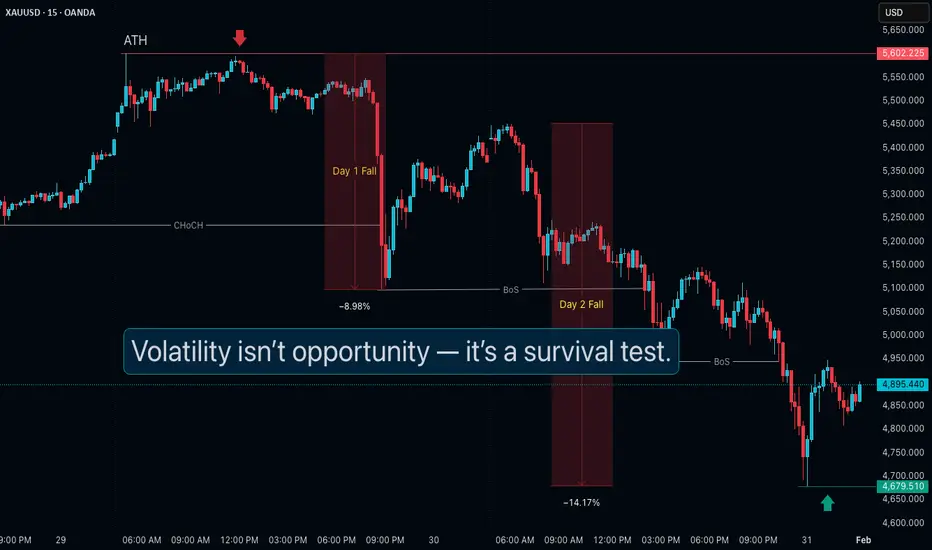
Gold dropping from 5600 to 4700 in just two trading sessions
is not normal price action.
This is not retail-driven movement.
This is institutional liquidation.
And in such phases, most retail losses don’t come from bad analysis —
they come from being present when they shouldn’t be.
What Happens During Institutional Sell-Offs
When institutions unload positions:
• Volatility expands abnormally
• Spreads widen
• Stops get skipped or slipped
• Levels lose respect
• Momentum becomes violent
This is not a technical environment.
It’s a risk environment.
The market is not offering opportunity.
It is testing survival.
Why Retail Traders Get Hurt
Retail traders lose money in these phases because of:
• FOMO after large candles
• Oversized positions
• Trading without context
• Assuming “it can’t go further”
• Treating chaos like structure
Extreme volatility creates the illusion of opportunity.
In reality, it removes control.
Two Valid Choices for Retail Traders
There is no shame in either.
1. Stay Away Completely
If you don’t trade volatility professionally:
• Staying flat is a winning decision
• Protecting capital is the priority
• Waiting for structure to normalize is discipline
No trade is better than a forced trade.
2. Trade Smaller, Not Smarter
If you do participate:
• Reduce position size significantly
• Accept wider stops or don’t trade
• Avoid revenge and “catching bottoms”
• Trade only at higher-timeframe levels
• Expect slippage and imperfect execution
Risk management matters more than accuracy.
What to Avoid at All Costs
• Chasing big candles
• Trading emotionally charged news
• Assuming mean reversion
• Increasing size to “recover”
• Confusing volatility with edge
This is how accounts get wiped — not slowly, but suddenly.
The Professional Mindset in Extreme Markets
Professionals ask one question:
“Is this market tradable for my style?”
Retail traders ask:
“How can I profit from this move?”
That difference decides survival.
Capital saved during chaos
is capital available when clarity returns.
📘 Shared by ChartIsMirror
In extreme volatility, do you step aside — or feel the urge to jump in?
Comment honestly. Awareness matters more than activity.
“Not every market condition is meant to be traded.”
Gold dropping from 5600 to 4700 in just two trading sessions
is not normal price action.
This is not retail-driven movement.
This is institutional liquidation.
And in such phases, most retail losses don’t come from bad analysis —
they come from being present when they shouldn’t be.
What Happens During Institutional Sell-Offs
When institutions unload positions:
• Volatility expands abnormally
• Spreads widen
• Stops get skipped or slipped
• Levels lose respect
• Momentum becomes violent
This is not a technical environment.
It’s a risk environment.
The market is not offering opportunity.
It is testing survival.
Why Retail Traders Get Hurt
Retail traders lose money in these phases because of:
• FOMO after large candles
• Oversized positions
• Trading without context
• Assuming “it can’t go further”
• Treating chaos like structure
Extreme volatility creates the illusion of opportunity.
In reality, it removes control.
Two Valid Choices for Retail Traders
There is no shame in either.
1. Stay Away Completely
If you don’t trade volatility professionally:
• Staying flat is a winning decision
• Protecting capital is the priority
• Waiting for structure to normalize is discipline
No trade is better than a forced trade.
2. Trade Smaller, Not Smarter
If you do participate:
• Reduce position size significantly
• Accept wider stops or don’t trade
• Avoid revenge and “catching bottoms”
• Trade only at higher-timeframe levels
• Expect slippage and imperfect execution
Risk management matters more than accuracy.
What to Avoid at All Costs
• Chasing big candles
• Trading emotionally charged news
• Assuming mean reversion
• Increasing size to “recover”
• Confusing volatility with edge
This is how accounts get wiped — not slowly, but suddenly.
The Professional Mindset in Extreme Markets
Professionals ask one question:
“Is this market tradable for my style?”
Retail traders ask:
“How can I profit from this move?”
That difference decides survival.
Capital saved during chaos
is capital available when clarity returns.
📘 Shared by ChartIsMirror
In extreme volatility, do you step aside — or feel the urge to jump in?
Comment honestly. Awareness matters more than activity.

การนำเสนอที่เกี่ยวข้อง
คำจำกัดสิทธิ์ความรับผิดชอบ
ข้อมูลและบทความไม่ได้มีวัตถุประสงค์เพื่อก่อให้เกิดกิจกรรมทางการเงิน, การลงทุน, การซื้อขาย, ข้อเสนอแนะ หรือคำแนะนำประเภทอื่น ๆ ที่ให้หรือรับรองโดย TradingView อ่านเพิ่มเติมใน ข้อกำหนดการใช้งาน
การนำเสนอที่เกี่ยวข้อง
คำจำกัดสิทธิ์ความรับผิดชอบ
ข้อมูลและบทความไม่ได้มีวัตถุประสงค์เพื่อก่อให้เกิดกิจกรรมทางการเงิน, การลงทุน, การซื้อขาย, ข้อเสนอแนะ หรือคำแนะนำประเภทอื่น ๆ ที่ให้หรือรับรองโดย TradingView อ่านเพิ่มเติมใน ข้อกำหนดการใช้งาน