OPEN-SOURCE SCRIPT
ที่อัปเดต: BISI - SIBI (FVG) + Order Blocks + iFVG Impulsive Candles
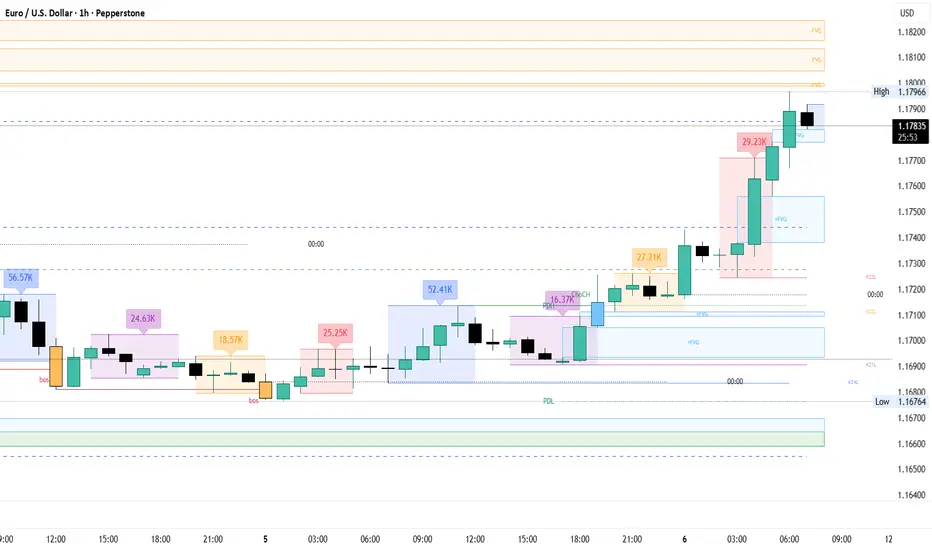
This indicator highlights three core price-action elements used in imbalance and liquidity-based trading:
Fair Value Gaps (FVG) — BISI / SIBI
• Bullish FVG (BISI): when the current low is above the high from two bars ago (low > high[2]).
• Bearish FVG (SIBI): when the current high is below the low from two bars ago (high < low[2]).
Each FVG is drawn as a box with customizable text, color, opacity, and borders.
Order Blocks (OB) — Displacement Logic
• Bullish OB: previous candle is bearish and current close breaks above the previous high (displacement).
• Bearish OB: previous candle is bullish and current close breaks below the previous low.
The Order Block is defined by candle [1] high/low and drawn as a box.
iFVG Candle Coloring (Optional)
Bars are colored when an FVG or strict iFVG condition is detected. This allows quick visual identification of imbalance candles without overcrowding the chart.
AUTO STRETCH & AUTO DELETE — Clean Chart Logic
• Stretch: FVG and OB boxes extend to the right until mitigation.
• Auto-delete: once a zone is considered “filled,” it can be automatically removed to keep charts clean.
Definition of “filled” used in this script:
A zone is considered touched when the candle body (Open/Close range) crosses the box range:
min(open, close) < top AND max(open, close) > bottom.
This is intentionally stricter than wick-based fills to avoid premature invalidations.
KEY SETTINGS
• Lookback Bars — Limits detection range for performance and clarity.
• Max PD Arrays — Controls maximum stored zones to prevent overload.
• Stretch Until Filled — Extends zones dynamically.
• Auto-delete When Filled — Removes mitigated zones.
• Opacity & Borders — Full visual customization.
• Min Penetration (iFVG) — Controls strictness of iFVG qualification.
BEST PRACTICES
• FVGs are commonly used as retracement zones after displacement, especially within HTF structure alignment.
• Order Blocks are most effective when preceded by liquidity sweeps or strong expansion.
• iFVG coloring helps identify impulsive behavior quickly without clutter.
LIMITATIONS
• This is a visual analytical tool, not a standalone entry system.
• Fill logic is based on body penetration (not wick-based).
• Very low timeframes with large lookback settings may impact performance.
Fair Value Gaps (FVG) — BISI / SIBI
• Bullish FVG (BISI): when the current low is above the high from two bars ago (low > high[2]).
• Bearish FVG (SIBI): when the current high is below the low from two bars ago (high < low[2]).
Each FVG is drawn as a box with customizable text, color, opacity, and borders.
Order Blocks (OB) — Displacement Logic
• Bullish OB: previous candle is bearish and current close breaks above the previous high (displacement).
• Bearish OB: previous candle is bullish and current close breaks below the previous low.
The Order Block is defined by candle [1] high/low and drawn as a box.
iFVG Candle Coloring (Optional)
Bars are colored when an FVG or strict iFVG condition is detected. This allows quick visual identification of imbalance candles without overcrowding the chart.
AUTO STRETCH & AUTO DELETE — Clean Chart Logic
• Stretch: FVG and OB boxes extend to the right until mitigation.
• Auto-delete: once a zone is considered “filled,” it can be automatically removed to keep charts clean.
Definition of “filled” used in this script:
A zone is considered touched when the candle body (Open/Close range) crosses the box range:
min(open, close) < top AND max(open, close) > bottom.
This is intentionally stricter than wick-based fills to avoid premature invalidations.
KEY SETTINGS
• Lookback Bars — Limits detection range for performance and clarity.
• Max PD Arrays — Controls maximum stored zones to prevent overload.
• Stretch Until Filled — Extends zones dynamically.
• Auto-delete When Filled — Removes mitigated zones.
• Opacity & Borders — Full visual customization.
• Min Penetration (iFVG) — Controls strictness of iFVG qualification.
BEST PRACTICES
• FVGs are commonly used as retracement zones after displacement, especially within HTF structure alignment.
• Order Blocks are most effective when preceded by liquidity sweeps or strong expansion.
• iFVG coloring helps identify impulsive behavior quickly without clutter.
LIMITATIONS
• This is a visual analytical tool, not a standalone entry system.
• Fill logic is based on body penetration (not wick-based).
• Very low timeframes with large lookback settings may impact performance.
Release Note
This indicator highlights three core price-action elements used in imbalance and liquidity-based trading:Fair Value Gaps (FVG) — BISI / SIBI
• Bullish FVG (BISI): when the current low is above the high from two bars ago (low > high[2]).
• Bearish FVG (SIBI): when the current high is below the low from two bars ago (high < low[2]).
Each FVG is drawn as a box with customizable text, color, opacity, and borders.
Order Blocks (OB) — Displacement Logic
• Bullish OB: previous candle is bearish and current close breaks above the previous high (displacement).
• Bearish OB: previous candle is bullish and current close breaks below the previous low.
The Order Block is defined by candle [1] high/low and drawn as a box.
iFVG Candle Coloring (Optional)
Bars are colored when an FVG or strict iFVG condition is detected. This allows quick visual identification of imbalance candles without overcrowding the chart.
AUTO STRETCH & AUTO DELETE — Clean Chart Logic
• Stretch: FVG and OB boxes extend to the right until mitigation.
• Auto-delete: once a zone is considered “filled,” it can be automatically removed to keep charts clean.
Definition of “filled” used in this script:
A zone is considered touched when the candle body (Open/Close range) crosses the box range:
min(open, close) < top AND max(open, close) > bottom.
This is intentionally stricter than wick-based fills to avoid premature invalidations.
KEY SETTINGS
• Lookback Bars — Limits detection range for performance and clarity.
• Max PD Arrays — Controls maximum stored zones to prevent overload.
• Stretch Until Filled — Extends zones dynamically.
• Auto-delete When Filled — Removes mitigated zones.
• Opacity & Borders — Full visual customization.
• Min Penetration (iFVG) — Controls strictness of iFVG qualification.
BEST PRACTICES
• FVGs are commonly used as retracement zones after displacement, especially within HTF structure alignment.
• Order Blocks are most effective when preceded by liquidity sweeps or strong expansion.
• iFVG coloring helps identify impulsive behavior quickly without clutter.
LIMITATIONS
• This is a visual analytical tool, not a standalone entry system.
• Fill logic is based on body penetration (not wick-based).
• Very low timeframes with large lookback settings may impact performance.
Release Note
This indicator highlights three core price-action elements used in imbalance and liquidity-based trading:Fair Value Gaps (FVG) — BISI / SIBI
• Bullish FVG (BISI): when the current low is above the high from two bars ago (low > high[2]).
• Bearish FVG (SIBI): when the current high is below the low from two bars ago (high < low[2]).
Each FVG is drawn as a box with customizable text, color, opacity, and borders.
Order Blocks (OB) — Displacement Logic
• Bullish OB: previous candle is bearish and current close breaks above the previous high (displacement).
• Bearish OB: previous candle is bullish and current close breaks below the previous low.
The Order Block is defined by candle [1] high/low and drawn as a box.
iFVG Candle Coloring (Optional)
Bars are colored when an FVG or strict iFVG condition is detected. This allows quick visual identification of imbalance candles without overcrowding the chart.
AUTO STRETCH & AUTO DELETE — Clean Chart Logic
• Stretch: FVG and OB boxes extend to the right until mitigation.
• Auto-delete: once a zone is considered “filled,” it can be automatically removed to keep charts clean.
Definition of “filled” used in this script:
A zone is considered touched when the candle body (Open/Close range) crosses the box range:
min(open, close) < top AND max(open, close) > bottom.
This is intentionally stricter than wick-based fills to avoid premature invalidations.
KEY SETTINGS
• Lookback Bars — Limits detection range for performance and clarity.
• Max PD Arrays — Controls maximum stored zones to prevent overload.
• Stretch Until Filled — Extends zones dynamically.
• Auto-delete When Filled — Removes mitigated zones.
• Opacity & Borders — Full visual customization.
• Min Penetration (iFVG) — Controls strictness of iFVG qualification.
BEST PRACTICES
• FVGs are commonly used as retracement zones after displacement, especially within HTF structure alignment.
• Order Blocks are most effective when preceded by liquidity sweeps or strong expansion.
• iFVG coloring helps identify impulsive behavior quickly without clutter.
LIMITATIONS
• This is a visual analytical tool, not a standalone entry system.
• Fill logic is based on body penetration (not wick-based).
• Very low timeframes with large lookback settings may impact performance.
avant-hier
Notes de version
This indicator highlights three core price-action elements used in imbalance and liquidity-based trading:
Fair Value Gaps (FVG) — BISI / SIBI
• Bullish FVG (BISI): when the current low is above the high from two bars ago (low > high[2]).
• Bearish FVG (SIBI): when the current high is below the low from two bars ago (high < low[2]).
Each FVG is drawn as a box with customizable text, color, opacity, and borders.
Order Blocks (OB) — Displacement Logic
• Bullish OB: previous candle is bearish and current close breaks above the previous high (displacement).
• Bearish OB: previous candle is bullish and current close breaks below the previous low.
The Order Block is defined by candle [1] high/low and drawn as a box.
iFVG Candle Coloring (Optional)
Bars are colored when an FVG or strict iFVG condition is detected. This allows quick visual identification of imbalance candles without overcrowding the chart.
AUTO STRETCH & AUTO DELETE — Clean Chart Logic
• Stretch: FVG and OB boxes extend to the right until mitigation.
• Auto-delete: once a zone is considered “filled,” it can be automatically removed to keep charts clean.
Definition of “filled” used in this script:
A zone is considered touched when the candle body (Open/Close range) crosses the box range:
min(open, close) < top AND max(open, close) > bottom.
This is intentionally stricter than wick-based fills to avoid premature invalidations.
KEY SETTINGS
• Lookback Bars — Limits detection range for performance and clarity.
• Max PD Arrays — Controls maximum stored zones to prevent overload.
• Stretch Until Filled — Extends zones dynamically.
• Auto-delete When Filled — Removes mitigated zones.
• Opacity & Borders — Full visual customization.
• Min Penetration (iFVG) — Controls strictness of iFVG qualification.
BEST PRACTICES
• FVGs are commonly used as retracement zones after displacement, especially within HTF structure alignment.
• Order Blocks are most effective when preceded by liquidity sweeps or strong expansion.
• iFVG coloring helps identify impulsive behavior quickly without clutter.
LIMITATIONS
• This is a visual analytical tool, not a standalone entry system.
• Fill logic is based on body penetration (not wick-based).
• Very low timeframes with large lookback settings may impact performance.
Release Note
This indicator highlights three core price-action elements used in imbalance and liquidity-based trading:Fair Value Gaps (FVG) — BISI / SIBI
Bullish FVG (BISI): when the current low is above the high from two bars ago (low > high[2]).
Bearish FVG (SIBI): when the current high is below the low from two bars ago (high < low[2]).
Each FVG is drawn as a box with customizable text, color, opacity, and borders.
Order Blocks (OB) — Displacement Logic
Bullish OB: previous candle is bearish and current close breaks above the previous high (displacement).
Bearish OB: previous candle is bullish and current close breaks below the previous low.
The Order Block is defined by candle [1] high/low and drawn as a box.
iFVG Candle Coloring (Optional)
Bars are colored when an FVG or strict iFVG condition is detected. This allows quick visual identification of imbalance candles without overcrowding the chart.
AUTO STRETCH & AUTO DELETE — Clean Chart Logic
Stretch: FVG and OB boxes extend to the right until mitigation.
Auto-delete: once a zone is considered "filled," it can be automatically removed to keep charts clean.
Definition of "filled" used in this script:
A zone is considered touched when the candle body (Open/Close range) crosses the box range:
min(open, close) < top AND max(open, close) > bottom.
This is intentionally stricter than wick-based fills to avoid premature invalidations.
KEY SETTINGS
Lookback Bars — Limits detection range for performance and clarity.
Max PD Arrays — Controls maximum stored zones to prevent overload.
Stretch Until Filled — Extends zones dynamically.
Auto-delete When Filled — Removes mitigated zones.
Opacity & Borders — Full visual customization.
Min Penetration (iFVG) — Controls strictness of iFVG qualification.
BEST PRACTICES
FVGs are commonly used as retracement zones after displacement, especially within HTF structure alignment.
Order Blocks are most effective when preceded by liquidity sweeps or strong expansion.
iFVG coloring helps identify impulsive behavior quickly without clutter.
LIMITATIONS
This is a visual analytical tool, not a standalone entry system.
Fill logic is based on body penetration (not wick-based).
Very low timeframes with large lookback settings may impact performance.
━━━━━━━━━━━━━━━━━━━━━━━━━━━━━━━━━━━━━━━━
Feb 28 — Update: Refined Order Block Detection
━━━━━━━━━━━━━━━━━━━━━━━━━━━━━━━━━━━━━━━━
This update significantly improves the precision and accuracy of Order Block detection, bringing it closer to pure ICT / Smart Money Concepts methodology.
WHAT CHANGED — ORDER BLOCKS
▸ Lookback-based OB search
Instead of always using the immediately preceding candle [1] as the OB, the script now looks back across a configurable window (default: 5 bars) to find the last valid opposing candle before the displacement. This means the OB is anchored to the true last bearish/bullish candle before the impulsive move, not simply the candle right before it.
▸ Body-based OB zones (optional)
OB boxes can now be drawn using the candle body (open/close range) rather than the full wick range (high/low). This produces tighter, more precise zones that better reflect where institutional orders are likely clustered. Toggle this on/off via the new "Use candle body (no wicks)" setting.
▸ Displacement strength filter
A minimum displacement ratio setting has been added (default: 50% of the OB candle range). This filters out weak or insignificant breakouts, ensuring only genuinely impulsive moves trigger an OB. Increase this value for stricter detection.
NEW SETTINGS (Order Block section)
OB Lookback (candles) — How many bars back to search for the last valid OB candle. Default: 5.
Displacement Min Ratio — Minimum size of the displacement candle relative to the OB candle range. Default: 0.5.
Use candle body (no wicks) — Draw OB zones using open/close instead of high/low. Default: true.
Release Note
This indicator highlights three core price-action elements used in imbalance and liquidity-based trading:Fair Value Gaps (FVG) — BISI / SIBI
• Bullish FVG (BISI): when the current low is above the high from two bars ago (low > high[2]).
• Bearish FVG (SIBI): when the current high is below the low from two bars ago (high < low[2]).
Each FVG is drawn as a box with customizable text, color, opacity, and borders.
Order Blocks (OB) — Displacement Logic
• Bullish OB: previous candle is bearish and current close breaks above the previous high (displacement).
• Bearish OB: previous candle is bullish and current close breaks below the previous low.
The Order Block is defined by candle [1] high/low and drawn as a box.
iFVG Candle Coloring (Optional)
Bars are colored when an FVG or strict iFVG condition is detected. This allows quick visual identification of imbalance candles without overcrowding the chart.
AUTO STRETCH & AUTO DELETE — Clean Chart Logic
• Stretch: FVG and OB boxes extend to the right until mitigation.
• Auto-delete: once a zone is considered "filled," it can be automatically removed to keep charts clean.
Definition of "filled" used in this script:
A zone is considered touched when the candle body (Open/Close range) crosses the box range:
min(open, close) < top AND max(open, close) > bottom.
This is intentionally stricter than wick-based fills to avoid premature invalidations.
KEY SETTINGS
• Lookback Bars — Limits detection range for performance and clarity.
• Max PD Arrays — Controls maximum stored zones to prevent overload.
• Stretch Until Filled — Extends zones dynamically.
• Auto-delete When Filled — Removes mitigated zones.
• Opacity & Borders — Full visual customization.
• Min Penetration (iFVG) — Controls strictness of iFVG qualification.
• Fill Trigger (Wick / Body) — Choose whether a zone is considered filled on wick touch or body close inside. Available independently for FVGs and OBs.
BEST PRACTICES
• FVGs are commonly used as retracement zones after displacement, especially within HTF structure alignment.
• Order Blocks are most effective when preceded by liquidity sweeps or strong expansion.
• iFVG coloring helps identify impulsive behavior quickly without clutter.
LIMITATIONS
• This is a visual analytical tool, not a standalone entry system.
• Very low timeframes with large lookback settings may impact performance.
━━━━━━━━━━━━━━━━━━━━━━━━━━━━━━━━━━━━━━━━
Feb 28 — Update: Refined Order Block Detection
━━━━━━━━━━━━━━━━━━━━━━━━━━━━━━━━━━━━━━━━
This update significantly improves the precision and accuracy of Order Block detection, bringing it closer to pure ICT / Smart Money Concepts methodology.
WHAT CHANGED — ORDER BLOCKS
▸ Lookback-based OB search
Instead of always using the immediately preceding candle [1] as the OB, the script now looks back across a configurable window (default: 5 bars) to find the last valid opposing candle before the displacement. This means the OB is anchored to the true last bearish/bullish candle before the impulsive move, not simply the candle right before it.
▸ Body-based OB zones (optional)
OB boxes can now be drawn using the candle body (open/close range) rather than the full wick range (high/low). This produces tighter, more precise zones that better reflect where institutional orders are likely clustered. Toggle this on/off via the new "Use candle body (no wicks)" setting.
▸ Displacement strength filter
A minimum displacement ratio setting has been added (default: 50% of the OB candle range). This filters out weak or insignificant breakouts, ensuring only genuinely impulsive moves trigger an OB. Increase this value for stricter detection.
NEW SETTINGS (Order Block section)
• OB Lookback (candles) — How many bars back to search for the last valid OB candle. Default: 5.
• Displacement Min Ratio — Minimum size of the displacement candle relative to the OB candle range. Default: 0.5.
• Use candle body (no wicks) — Draw OB zones using open/close instead of high/low. Default: true.
━━━━━━━━━━━━━━━━━━━━━━━━━━━━━━━━━━━━━━━━
Mar 03 — Update: Max PD Arrays Fix & Wick/Body Fill Mode
━━━━━━━━━━━━━━━━━━━━━━━━━━━━━━━━━━━━━━━━
▸ Max PD Arrays now fully editable
The minimum value for Max PD Arrays has been lowered to 1, allowing full control over the number of displayed zones. You can now set it as low as 5 for a clean, minimal chart view. Default has been adjusted to 500.
▸ Fill trigger: Wick or Body — independently for FVGs and OBs
A new "Fill Trigger" dropdown has been added separately for FVGs and Order Blocks, giving you fine-grained control over mitigation behavior:
— Wick: a zone is considered filled as soon as the candle's high or low touches it (previous default behavior).
— Body: a zone is only considered filled when the candle body (open/close range) closes inside it — stricter, avoids false mitigations on spike wicks.
NEW SETTINGS
• Fill Trigger FVG (Wick / Body) — Controls fill detection mode for Fair Value Gaps.
• Fill Trigger OB (Wick / Body) — Controls fill detection mode for Order Blocks.
Release Note
━━━━━━━━━━━━━━━━━━━━━━━━━━━━━━━━━━━━━━━━This update adds six new modules
━━━━━━━━━━━━━━━━━━━━━━━━━━━━━━━━━━━━━━━━
▸ Killzones
Up to 5 fully configurable session zones (time range, color, on/off). Each zone is rendered as a bounded box with top and bottom border lines in a darker shade of the chosen color — no side borders for a clean look. Box height tracks the session high and low in real time and stops precisely at close. Visible below 4H only. History preserved up to two months.
▸ Session Volume
At the close of each killzone session, the total accumulated volume is displayed as a compact label (K / M) centered at the top of the session box. Color follows the killzone color. Visible on H1 and below, history up to two weeks.
▸ Session High / Low Lines
After each killzone closes, a high line and a low line are drawn and held until the price touches them — then they disappear automatically. Color is linked to the killzone border color. Style is configurable (solid / dashed / dotted).
▸ BOS / CHoCH — Market Structure
Tracks confirmed swing pivots and labels each structural break. Breaks in the direction of the current trend are marked bos (continuation). Breaks against it are marked ChoCH (potential reversal). Bull labels sit above the line, bear labels below. Colors fully configurable.
▸ Displacement Candle Detector (replaces iFVG bar coloring)
Replaces the previous iFVG coloring with a more precise and tradeable signal. Only the candle that breaks a confirmed swing pivot is colored — one candle per break, no repetition. This directly identifies the candle responsible for the displacement move and the Order Block behind it.
▸ Liquidity Levels & Opens
PDH / PDL — Previous Day High and Low
PWH / PWL — Previous Week High and Low
PMH / PML — Previous Month High and Low
Opens — Daily, Weekly, Monthly, Yearly and Midnight (00:00 ET)
Each level shows only the most recent period. Labels are anchored at the left of each line. Line style (solid / dashed / dotted) and color are individually configurable per level.
━━━━━━━━━━━━━━━━━━━━━━━━━━━━━━━━━━━━━━━━
Improvements to existing features
━━━━━━━━━━━━━━━━━━━━━━━━━━━━━━━━━━━━━━━━
Fill trigger — FVGs and OBs now have an independent Wick / Body setting. Body mode requires the candle body to close inside the zone before it is considered mitigated, avoiding premature fills on spike wicks.
Max PD Arrays — minimum value lowered to 1, giving full control over displayed zone count.
All interface labels are now in English.
Release Note
Change titleRelease Note
Update fontsRelease Note
Alert system Activated !Release Note
Updates alertsสคริปต์โอเพนซอร์ซ
ด้วยเจตนารมณ์หลักของ TradingView ผู้สร้างสคริปต์นี้ได้ทำให้เป็นโอเพนซอร์ส เพื่อให้เทรดเดอร์สามารถตรวจสอบและยืนยันฟังก์ชันการทำงานของมันได้ ขอชื่นชมผู้เขียน! แม้ว่าคุณจะใช้งานได้ฟรี แต่โปรดจำไว้ว่าการเผยแพร่โค้ดซ้ำจะต้องเป็นไปตาม กฎระเบียบการใช้งาน ของเรา

Rafen, le nectar de l indicateur
คำจำกัดสิทธิ์ความรับผิดชอบ
ข้อมูลและบทความไม่ได้มีวัตถุประสงค์เพื่อก่อให้เกิดกิจกรรมทางการเงิน, การลงทุน, การซื้อขาย, ข้อเสนอแนะ หรือคำแนะนำประเภทอื่น ๆ ที่ให้หรือรับรองโดย TradingView อ่านเพิ่มเติมใน ข้อกำหนดการใช้งาน
สคริปต์โอเพนซอร์ซ
ด้วยเจตนารมณ์หลักของ TradingView ผู้สร้างสคริปต์นี้ได้ทำให้เป็นโอเพนซอร์ส เพื่อให้เทรดเดอร์สามารถตรวจสอบและยืนยันฟังก์ชันการทำงานของมันได้ ขอชื่นชมผู้เขียน! แม้ว่าคุณจะใช้งานได้ฟรี แต่โปรดจำไว้ว่าการเผยแพร่โค้ดซ้ำจะต้องเป็นไปตาม กฎระเบียบการใช้งาน ของเรา
Rafen, le nectar de l indicateur
คำจำกัดสิทธิ์ความรับผิดชอบ
ข้อมูลและบทความไม่ได้มีวัตถุประสงค์เพื่อก่อให้เกิดกิจกรรมทางการเงิน, การลงทุน, การซื้อขาย, ข้อเสนอแนะ หรือคำแนะนำประเภทอื่น ๆ ที่ให้หรือรับรองโดย TradingView อ่านเพิ่มเติมใน ข้อกำหนดการใช้งาน