Jilly's ORB + Noise Band
Jilly's ORB + Noise Band
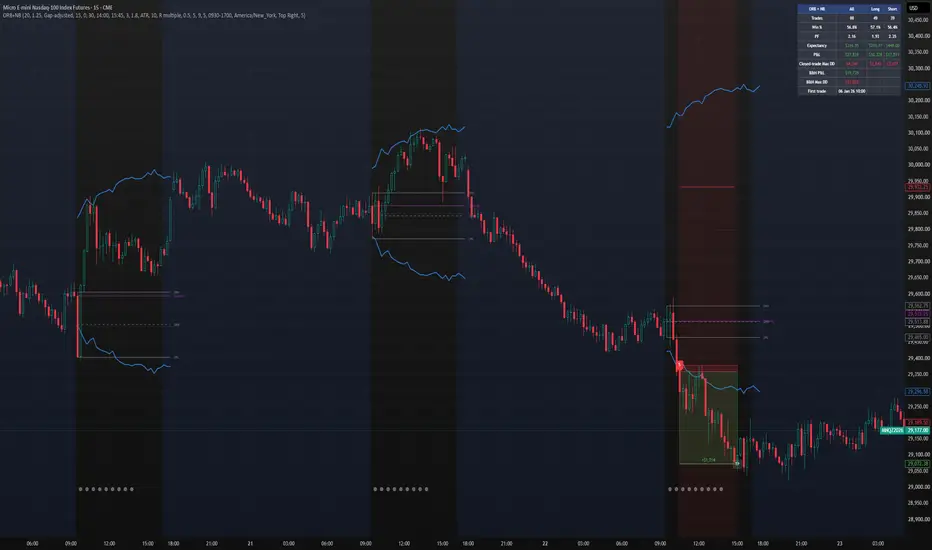
An opening-range breakout that only trades the break when the Noise Band confirms it. Price must close outside the 15-minute opening range AND outside the time-of-day noise band (and beyond session VWAP) at a checkpoint. One trade per session, held with a wide ATR catastrophe stop and closed late in the day.
WHY COMBINE THEM
A plain opening-range breakout takes almost every break, and many of them are noise. The Noise Band measures how far price normally moves from the open by each minute of the session (averaged over the last N sessions) and only counts a move that is bigger than usual for that time of day. Requiring both turns a low-quality, high-frequency ORB into a selective trend-day entry.
HOW IT WORKS
• Opening range: 09:30–09:45 high and low. Trigger = OR high/low ± 0.3 × ATR(9, 5-min).
• Noise Band: σ(t) = average |close / open − 1| at the same minute over the prior N sessions. Bands = reference × (1 ± k·σ). Reference = the session open, or Gap-adjusted (max/min of the open and the prior close).
• Entry: at checkpoint closes (every 15 min, 09:45–14:00). Long when the close is above the OR trigger, above the upper band and above VWAP; shorts mirror this. Fills at the next bar's open. One trade per day.
• Exit: resting stop (ATR multiple, opposite OR line, or OR midpoint), optional take-profit (R multiple or ATR multiple), and a time exit (default 15:45).
• Display: bands, VWAP, OR high/mid/low, session open, entry/exit markers, checkpoint dots, SL/TP boxes that grow with the trade and are stamped with the trade's net $ at the exit, and a performance table (All / Long / Short).
DEFAULTS (from a 1-minute MNQ research backtest)
Noise Band N = 20, k = 1.25, Gap-adjusted · OR 15 min, buffer 0.3 × ATR · 15-min checkpoints, last entry 14:00 · stop 10 × ATR (catastrophe stop) · target 1R · flat 15:45.
BACKTEST RESULTS
MNQ 1-minute data, Jan 2021 – Sep 2026, 1 contract, net of $1.80 round-trip (commission + 1 tick slippage per side). All three versions below use identical exits; only the entry filter differs. Parameters were chosen on 2021–2023 only; 2024 onward is out-of-sample.
Full test (Jan 2021 – Sep 2026):
• ORB + Noise Band: 631 trades · 61% win · PF 1.64 · +$32,774 · max DD $1,744 · $52/trade
• Noise Band alone: 666 trades · 61% win · PF 1.54 · +$31,228 · max DD $2,544 · $47/trade
• ORB alone: 1,350 trades · 56% win · PF 1.18 · +$24,221 · max DD $6,038 · $18/trade
ORB + Noise Band, by period:
• 2021–2023 (in-sample): 344 trades · 64% win · PF 1.80 · +$17,661 · max DD $1,744
• 2024 – Sep 2026 (out-of-sample): 287 trades · 58% win · PF 1.52 · +$15,113 · max DD $1,412
Compared with Noise Band entries alone, adding the opening-range requirement raised the profit factor (1.54 → 1.64) and cut the maximum drawdown by about 30% ($2,544 → $1,744) over the full test, with fewer trades. Most of that edge came in 2021–2023; in the 2024–2026 out-of-sample period the two were level (PF 1.52 each). Against a plain ORB, the Noise Band confirmation nearly tripled the profit per trade and cut the drawdown by more than two-thirds.
Other findings:
• Wide stops work best. Stops tighter than about 4 × ATR cut trades that would have closed green, and the Noise Band's own trailing exit was the weakest exit tested.
• Closing at 15:15–15:45 beat holding to the 16:00 close.
• A take-profit near 5 × ATR (Take Profit → ATR multiple, 5) gave a slightly smoother curve for slightly less profit.
CHART SETUP
• MNQ1! or NQ1! on a 1-, 5- or 15-minute chart, with the default electronic-trading-hours session.
• Turn on back-adjustment (B-ADJ) for the continuous contract.
• The bands need N sessions of history before the first signal.
• The performance table only covers the bars loaded on your chart, so it will not match the full backtest above.
CREDIT
The noise band ("noise area") concept, its time-of-day σ and the gap-adjusted reference come from Carlo Zarattini, Andrew Aziz and Andrea Barbon, "Beat the Market: An Effective Intraday Momentum Strategy for S&P500 ETF (SPY)" (2024). This script is an independent implementation combined with an opening-range breakout.
DISCLAIMER
For research and educational use only. Not financial advice. Results are hypothetical, from modeled fills (next-bar-open entries, stops filled at the stop price or at a gapped open, targets at the limit price), and do not include all real-world trading costs or slippage. Past and simulated performance do not guarantee future results.
An opening-range breakout that only trades the break when the Noise Band confirms it. Price must close outside the 15-minute opening range AND outside the time-of-day noise band (and beyond session VWAP) at a checkpoint. One trade per session, held with a wide ATR catastrophe stop and closed late in the day.
WHY COMBINE THEM
A plain opening-range breakout takes almost every break, and many of them are noise. The Noise Band measures how far price normally moves from the open by each minute of the session (averaged over the last N sessions) and only counts a move that is bigger than usual for that time of day. Requiring both turns a low-quality, high-frequency ORB into a selective trend-day entry.
HOW IT WORKS
• Opening range: 09:30–09:45 high and low. Trigger = OR high/low ± 0.3 × ATR(9, 5-min).
• Noise Band: σ(t) = average |close / open − 1| at the same minute over the prior N sessions. Bands = reference × (1 ± k·σ). Reference = the session open, or Gap-adjusted (max/min of the open and the prior close).
• Entry: at checkpoint closes (every 15 min, 09:45–14:00). Long when the close is above the OR trigger, above the upper band and above VWAP; shorts mirror this. Fills at the next bar's open. One trade per day.
• Exit: resting stop (ATR multiple, opposite OR line, or OR midpoint), optional take-profit (R multiple or ATR multiple), and a time exit (default 15:45).
• Display: bands, VWAP, OR high/mid/low, session open, entry/exit markers, checkpoint dots, SL/TP boxes that grow with the trade and are stamped with the trade's net $ at the exit, and a performance table (All / Long / Short).
DEFAULTS (from a 1-minute MNQ research backtest)
Noise Band N = 20, k = 1.25, Gap-adjusted · OR 15 min, buffer 0.3 × ATR · 15-min checkpoints, last entry 14:00 · stop 10 × ATR (catastrophe stop) · target 1R · flat 15:45.
BACKTEST RESULTS
MNQ 1-minute data, Jan 2021 – Sep 2026, 1 contract, net of $1.80 round-trip (commission + 1 tick slippage per side). All three versions below use identical exits; only the entry filter differs. Parameters were chosen on 2021–2023 only; 2024 onward is out-of-sample.
Full test (Jan 2021 – Sep 2026):
• ORB + Noise Band: 631 trades · 61% win · PF 1.64 · +$32,774 · max DD $1,744 · $52/trade
• Noise Band alone: 666 trades · 61% win · PF 1.54 · +$31,228 · max DD $2,544 · $47/trade
• ORB alone: 1,350 trades · 56% win · PF 1.18 · +$24,221 · max DD $6,038 · $18/trade
ORB + Noise Band, by period:
• 2021–2023 (in-sample): 344 trades · 64% win · PF 1.80 · +$17,661 · max DD $1,744
• 2024 – Sep 2026 (out-of-sample): 287 trades · 58% win · PF 1.52 · +$15,113 · max DD $1,412
Compared with Noise Band entries alone, adding the opening-range requirement raised the profit factor (1.54 → 1.64) and cut the maximum drawdown by about 30% ($2,544 → $1,744) over the full test, with fewer trades. Most of that edge came in 2021–2023; in the 2024–2026 out-of-sample period the two were level (PF 1.52 each). Against a plain ORB, the Noise Band confirmation nearly tripled the profit per trade and cut the drawdown by more than two-thirds.
Other findings:
• Wide stops work best. Stops tighter than about 4 × ATR cut trades that would have closed green, and the Noise Band's own trailing exit was the weakest exit tested.
• Closing at 15:15–15:45 beat holding to the 16:00 close.
• A take-profit near 5 × ATR (Take Profit → ATR multiple, 5) gave a slightly smoother curve for slightly less profit.
CHART SETUP
• MNQ1! or NQ1! on a 1-, 5- or 15-minute chart, with the default electronic-trading-hours session.
• Turn on back-adjustment (B-ADJ) for the continuous contract.
• The bands need N sessions of history before the first signal.
• The performance table only covers the bars loaded on your chart, so it will not match the full backtest above.
CREDIT
The noise band ("noise area") concept, its time-of-day σ and the gap-adjusted reference come from Carlo Zarattini, Andrew Aziz and Andrea Barbon, "Beat the Market: An Effective Intraday Momentum Strategy for S&P500 ETF (SPY)" (2024). This script is an independent implementation combined with an opening-range breakout.
DISCLAIMER
For research and educational use only. Not financial advice. Results are hypothetical, from modeled fills (next-bar-open entries, stops filled at the stop price or at a gapped open, targets at the limit price), and do not include all real-world trading costs or slippage. Past and simulated performance do not guarantee future results.

คำจำกัดสิทธิ์ความรับผิดชอบ
ข้อมูลและบทความไม่ได้มีวัตถุประสงค์เพื่อก่อให้เกิดกิจกรรมทางการเงิน, การลงทุน, การซื้อขาย, ข้อเสนอแนะ หรือคำแนะนำประเภทอื่น ๆ ที่ให้หรือรับรองโดย TradingView อ่านเพิ่มเติมใน ข้อกำหนดการใช้งาน
คำจำกัดสิทธิ์ความรับผิดชอบ
ข้อมูลและบทความไม่ได้มีวัตถุประสงค์เพื่อก่อให้เกิดกิจกรรมทางการเงิน, การลงทุน, การซื้อขาย, ข้อเสนอแนะ หรือคำแนะนำประเภทอื่น ๆ ที่ให้หรือรับรองโดย TradingView อ่านเพิ่มเติมใน ข้อกำหนดการใช้งาน