Jurik Relative Strength Quality Index (RSX)
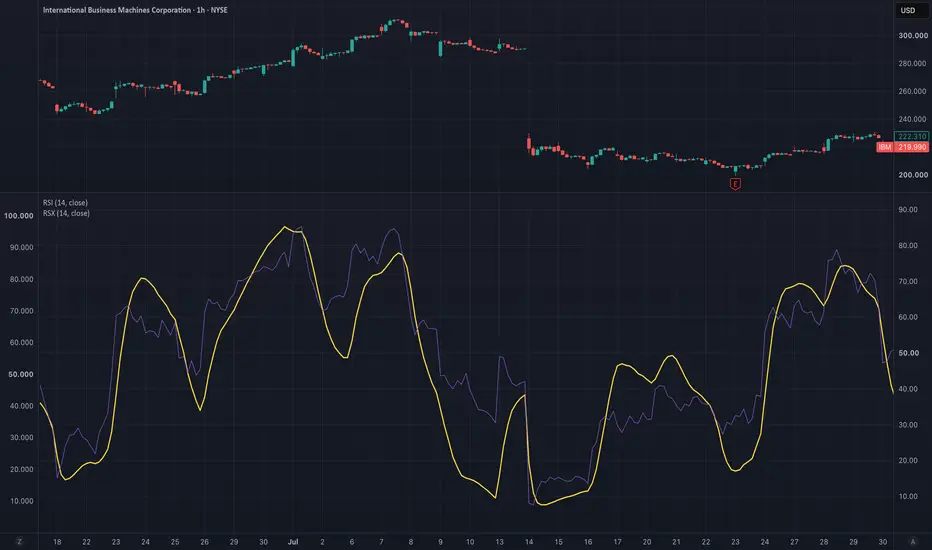
RSX is a bounded 0-100 momentum oscillator measuring the direction and quality of price movement. It keeps the RSI identity (net momentum over total momentum) but replaces Wilder's single-pole smoothing with three cascaded lag-compensated filter stages. The result is far smoother than RSI and turns about one bar behind it at equal length, instead of the several bars a comparably smoothed RSI would need.
HISTORICAL CONTEXT
Jurik Research sold RSX in the 1990s as an encrypted TradeStation add-in, marketed as a "noise-free" RSI. The algorithm was never published. The original user guide uses a default length of 8, typical range 5-30, and allows fractional lengths.
This script implements the community reconstruction that surfaced on MQL4 forums around 2005, later ported to ProRealCode, AmiBroker, and pandas-ta. No numeric parity data against Jurik's DLL exists. Indirect evidence: digitizing the RSX(10) vs RSI(10) chart in Jurik's user guide gives a 1.1-bar turn offset, 0.91 correlation, and 1.40 swing ratio; the reconstruction on random-walk data gives 0.96 bars, 0.91, and 1.36. Consistent, not proof.
HOW IT WORKS
Stage 1: Momentum
M[t] = 100 × (x[t] − x[t−1]), A[t] = |M[t]|
Stage 2: Generalized-DEMA stage
α = 3 / (N + 2), β = 1 − α
E1[t] = β × E1[t−1] + α × u[t]
E2[t] = α × E1[t] + β × E2[t−1]
GD[t] = 1.5 × E1[t] − 0.5 × E2[t]
This is Tillson's generalized DEMA with volume factor 0.5.
Stage 3: Cascade and ratio
H(u) = GD(GD(GD(u)))
RSX = clamp(50 × (1 + H(M) / H(A)), 0, 100), or 50 if H(A) ≤ 1e−10
Why it is still an RSI: Wilder's RSI equals 50 × (1 + RMA(M) / RMA(|M|)). RSX keeps the identity and swaps RMA for the cascade.
Why the clamp: the lag-compensated stages overshoot, so the ratio can briefly leave [−1, 1]. RSX may sit flat at 0 or 100 in strong one-way moves.
Lag profile (N = 14)
- Slow trends: ≈ 6.5 bars delay vs 13 for RSI.
- Fast swings: RSX trails RSI (12-bar cycle: 4.8 vs 2.2 bars; 20-bar: 6.5 vs 3.8). Crossover near a 45-bar cycle.
- Noise: ~21 dB more high-frequency attenuation than RSI(14).
INPUTS & PARAMETERS
- Source: Default close. hlc3 gives the least input lag. Any series works; RSX ignores scale.
- Period: Default 14 (Jurik's original default was 8).
Period selection
- 5-10: Responsive, short swings.
- 10-20: Balanced, daily bars.
- 20-40: Trend state only.
RSX length is not interchangeable with RSI length. To replace RSI(14), start near RSX(10).
HOW TO USE
- Centerline: above 50 = net upward momentum. Crossings whipsaw far less than RSI.
- Slope with zones: go long when RSX is rising above a lower zone, short when falling below an upper zone, hold while in an extreme zone (Jurik's demo system). Optimize zone levels; don't assume 70/30.
- Extremes: readings near 0 or 100 mean one-directional movement, a statement of trend quality, not automatically overbought or oversold.
- Divergences: cleaner than RSI because jitter is removed; still needs confirmation.
- Composition: RSX of pre-smoothed price pushes output toward a two-state trend switch.
REFERENCES
- Jurik Research. RSX User's Guide (TradeStation add-in), 2000.
- Tillson, T. (1998). "Smoothing Techniques for More Accurate Signals." TASC, January 1998.
- Wilder, J. W. (1978). New Concepts in Technical Trading Systems.

Rigorous technical indicators for Pine Script 6 with O(1) streaming, defensible math, and proper initialization. Fully documented, implemented in C#, transcribed to Pine Script, and wrapped for Python.
คำจำกัดสิทธิ์ความรับผิดชอบ
ข้อมูลและบทความไม่ได้มีวัตถุประสงค์เพื่อก่อให้เกิดกิจกรรมทางการเงิน, การลงทุน, การซื้อขาย, ข้อเสนอแนะ หรือคำแนะนำประเภทอื่น ๆ ที่ให้หรือรับรองโดย TradingView อ่านเพิ่มเติมใน ข้อกำหนดการใช้งาน