OPEN-SOURCE SCRIPT
Parallax Covenant Strategy [JOAT]
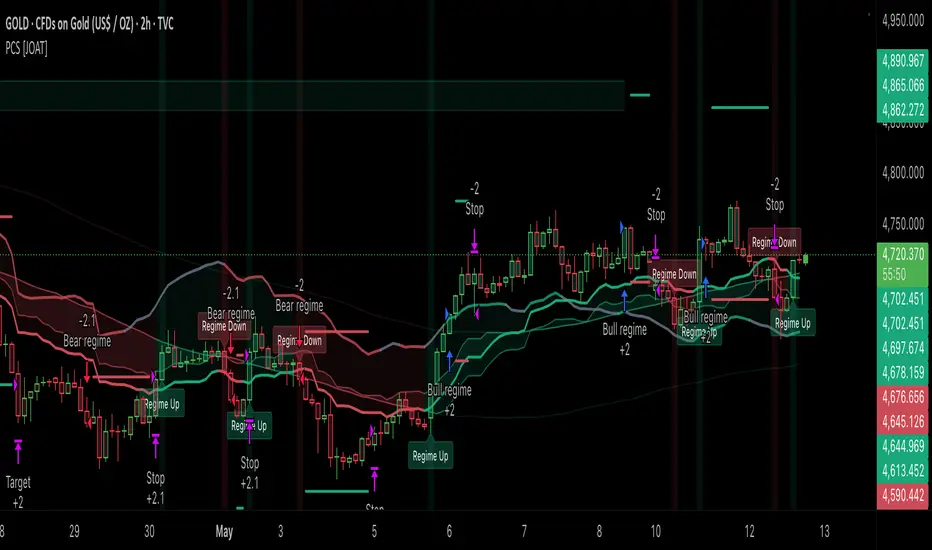
Parallax Covenant Strategy [JOAT]
Introduction
Parallax Covenant Strategy is an open-source, non-repainting TradingView strategy that integrates multiple analytical engines into one realistic execution framework. It combines regime detection, pressure confirmation, mapped bias, structure context, wave release logic, and ATR-based risk management to produce entries and exits only when several independent conditions agree.
The problem this strategy solves is weak single-factor trading. A crossover alone is rarely enough. A structure break alone is often early. A momentum spike alone can be noisy. Parallax Covenant requires alignment between regime, internal pressure, mapped bias, structural context, and release behavior before taking a trade. This creates a more selective, context-aware model than a one-indicator strategy.
Core Concepts
1. Composite Regime Engine
The strategy builds a directional regime from a structural baseline, tolerance corridors, and expansion/compression state. This acts as the primary directional context.
2. Pressure Confirmation
An internal pressure model blends weighted candle force and channel position to avoid taking trades simply because price is above or below a baseline.
3. Mapping and Higher-Timeframe Bias
The strategy uses a mapped momentum framework and an optional confirmed higher-timeframe bias filter so lower-timeframe entries can align with broader conditions.
4. Structure and Release Filters
Demand and supply context, swing structure, and release-from-compression logic help prevent entries from firing in the middle of low-quality noise.
5. Realistic Risk Management
The strategy uses ATR-based stops, reward-to-risk targets, optional trailing logic after a minimum multiple of risk, and regime-failure exits. This makes the model more realistic than fixed-tick toy strategies.
Features
How to Use This Strategy
Step 1: Study the Dashboard
The dashboard shows whether the system currently sees bullish, bearish, or balanced conditions and how the internal engines align.
Step 2: Understand the Entry Stack
Trades only trigger when multiple conditions confirm together. If you see a setup fail to trigger, that is often intentional filtering rather than a bug.
Step 3: Respect the Risk Model
Stops and targets are volatility-based. Results will vary materially across symbols and timeframes because the strategy adapts to local ATR conditions.
Step 4: Evaluate by Regime, Not by Individual Trade
This strategy is meant to be judged over a broad sample. It is a context-and-confirmation model, not a scalping script trying to predict every turn.
Strategy Limitations
Originality Statement
Parallax Covenant Strategy is original in the way it integrates multiple distinct analytical engines into one non-repainting framework. It is not a basic moving average crossover, not a single-oscillator strategy, and not a toy example of ATR stops. Its value comes from requiring alignment between market regime, internal pressure, mapped bias, structure, and release conditions before entering risk.
Disclaimer
This strategy is provided for educational and informational purposes only. It is not financial advice or a recommendation to buy or sell any instrument. Historical backtest results do not guarantee future performance. Always use realistic expectations, proper risk management, and independent judgment.
- Made with passion by jackofalltrades
Introduction
Parallax Covenant Strategy is an open-source, non-repainting TradingView strategy that integrates multiple analytical engines into one realistic execution framework. It combines regime detection, pressure confirmation, mapped bias, structure context, wave release logic, and ATR-based risk management to produce entries and exits only when several independent conditions agree.
The problem this strategy solves is weak single-factor trading. A crossover alone is rarely enough. A structure break alone is often early. A momentum spike alone can be noisy. Parallax Covenant requires alignment between regime, internal pressure, mapped bias, structural context, and release behavior before taking a trade. This creates a more selective, context-aware model than a one-indicator strategy.
Core Concepts
1. Composite Regime Engine
The strategy builds a directional regime from a structural baseline, tolerance corridors, and expansion/compression state. This acts as the primary directional context.
2. Pressure Confirmation
An internal pressure model blends weighted candle force and channel position to avoid taking trades simply because price is above or below a baseline.
3. Mapping and Higher-Timeframe Bias
The strategy uses a mapped momentum framework and an optional confirmed higher-timeframe bias filter so lower-timeframe entries can align with broader conditions.
4. Structure and Release Filters
Demand and supply context, swing structure, and release-from-compression logic help prevent entries from firing in the middle of low-quality noise.
5. Realistic Risk Management
The strategy uses ATR-based stops, reward-to-risk targets, optional trailing logic after a minimum multiple of risk, and regime-failure exits. This makes the model more realistic than fixed-tick toy strategies.
Features
- Multi-engine entry stack: Regime, pressure, mapping, structure, and release alignment
- Confirmed-bar logic: Entry conditions are evaluated on confirmed bars
- Optional higher-timeframe bias filter: Uses confirmed higher-timeframe values
- Demand and supply context: Trade logic includes structural location awareness
- ATR stop and target model: Risk adjusts to symbol volatility
- Trailing stop activation: Trail can engage after a defined reward threshold
- Regime-failure exit: Closes trades when core directional conditions break down
- Maximum time-in-trade control: Avoids stale positions
- Institutional dashboard: Top-right strategy state summary
- Alertconditions: Regime shifts, releases, and setup confirmations
How to Use This Strategy
Step 1: Study the Dashboard
The dashboard shows whether the system currently sees bullish, bearish, or balanced conditions and how the internal engines align.
Step 2: Understand the Entry Stack
Trades only trigger when multiple conditions confirm together. If you see a setup fail to trigger, that is often intentional filtering rather than a bug.
Step 3: Respect the Risk Model
Stops and targets are volatility-based. Results will vary materially across symbols and timeframes because the strategy adapts to local ATR conditions.
Step 4: Evaluate by Regime, Not by Individual Trade
This strategy is meant to be judged over a broad sample. It is a context-and-confirmation model, not a scalping script trying to predict every turn.
Strategy Limitations
- The strategy is intentionally selective and may skip many charts or periods
- Higher-timeframe confirmation uses confirmed data and can therefore feel slower than live-developing bias models
- ATR-based exits adapt to volatility, which means trade statistics can shift significantly across markets
- No strategy can remove all adverse conditions, especially during sudden event-driven repricing
Originality Statement
Parallax Covenant Strategy is original in the way it integrates multiple distinct analytical engines into one non-repainting framework. It is not a basic moving average crossover, not a single-oscillator strategy, and not a toy example of ATR stops. Its value comes from requiring alignment between market regime, internal pressure, mapped bias, structure, and release conditions before entering risk.
Disclaimer
This strategy is provided for educational and informational purposes only. It is not financial advice or a recommendation to buy or sell any instrument. Historical backtest results do not guarantee future performance. Always use realistic expectations, proper risk management, and independent judgment.
- Made with passion by jackofalltrades
สคริปต์โอเพนซอร์ซ
ด้วยเจตนารมณ์หลักของ TradingView ผู้สร้างสคริปต์นี้ได้ทำให้เป็นโอเพนซอร์ส เพื่อให้เทรดเดอร์สามารถตรวจสอบและยืนยันฟังก์ชันการทำงานของมันได้ ขอชื่นชมผู้เขียน! แม้ว่าคุณจะใช้งานได้ฟรี แต่โปรดจำไว้ว่าการเผยแพร่โค้ดซ้ำจะต้องเป็นไปตาม กฎระเบียบการใช้งาน ของเรา

The AI Trading Ecosystem, Built to win trades 📈
Get Full Access 👇
jackofalltrades.vip 🌐
t.me/jackofalltradesvip 🃏
Get Full Access 👇
jackofalltrades.vip 🌐
t.me/jackofalltradesvip 🃏
คำจำกัดสิทธิ์ความรับผิดชอบ
ข้อมูลและบทความไม่ได้มีวัตถุประสงค์เพื่อก่อให้เกิดกิจกรรมทางการเงิน, การลงทุน, การซื้อขาย, ข้อเสนอแนะ หรือคำแนะนำประเภทอื่น ๆ ที่ให้หรือรับรองโดย TradingView อ่านเพิ่มเติมใน ข้อกำหนดการใช้งาน
สคริปต์โอเพนซอร์ซ
ด้วยเจตนารมณ์หลักของ TradingView ผู้สร้างสคริปต์นี้ได้ทำให้เป็นโอเพนซอร์ส เพื่อให้เทรดเดอร์สามารถตรวจสอบและยืนยันฟังก์ชันการทำงานของมันได้ ขอชื่นชมผู้เขียน! แม้ว่าคุณจะใช้งานได้ฟรี แต่โปรดจำไว้ว่าการเผยแพร่โค้ดซ้ำจะต้องเป็นไปตาม กฎระเบียบการใช้งาน ของเรา
The AI Trading Ecosystem, Built to win trades 📈
Get Full Access 👇
jackofalltrades.vip 🌐
t.me/jackofalltradesvip 🃏
Get Full Access 👇
jackofalltrades.vip 🌐
t.me/jackofalltradesvip 🃏
คำจำกัดสิทธิ์ความรับผิดชอบ
ข้อมูลและบทความไม่ได้มีวัตถุประสงค์เพื่อก่อให้เกิดกิจกรรมทางการเงิน, การลงทุน, การซื้อขาย, ข้อเสนอแนะ หรือคำแนะนำประเภทอื่น ๆ ที่ให้หรือรับรองโดย TradingView อ่านเพิ่มเติมใน ข้อกำหนดการใช้งาน