
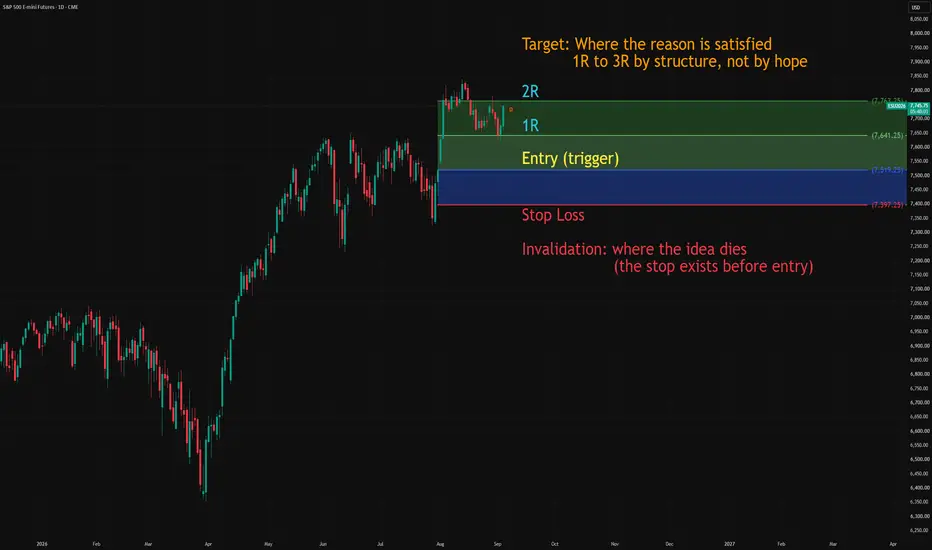
🔵 THE PLAN BEFORE THE TRADE
A trade without a written plan is a guess with leverage. The plan answers four questions before the position exists: where do I enter, where does the idea die, where do I take profit, and how much am I willing to lose? Written down — not in the head. The head rewrites history; the paper does not.
🔵 THE FOUR FIELDS
Entry: the trigger, not the zone — the exact price condition that gets you in. Invalidation: the level where the setup's idea is wrong — that is the stop, and it exists before entry. Target: the level where the reason for the trade is satisfied — 1R to 3R, defined by structure, not by hope. Risk: the fixed budget that converts the stop distance into size.
🔵 WHY WRITING CHANGES BEHAVIOR
Writing forces precision. "Buy near support" is not a plan — "buy on a rejection close above 4,320, stop below 4,290, first target 4,390" is. The act of writing exposes the gaps you would otherwise fill in mid-trade, when the price is moving and the judgment is worst.
🔵 THE PRE-TRADE CHECKLIST
Before entry, four questions, in order: is the setup still valid? Is the invalidation exactly where I wrote it? Does the size match the risk budget? Would I take this trade if I were flat and calm right now? One "no" — no trade.
Next lesson: backtesting — how to test the plan honestly before risking money on it.
Educational content only. Not investment advice.

Full multi-TF zones + COT + Macro Bias + Seasonality → confluenceedge.net
Feragatname
Bilgiler ve yayınlar, TradingView tarafından sağlanan veya onaylanan finansal, yatırım, alım satım veya diğer türden tavsiye veya öneriler anlamına gelmez ve teşkil etmez. Kullanım Koşulları bölümünde daha fazlasını okuyun.