

Japan has once again captured the global market’s attention with the rising possibility of intervention. Warnings have been coming for the last few days, but the clearest signal came from Finance Minister Katayama. She said they have “free hands” to make bold moves, perhaps even departing from classic intervention tactics.

Japan conducted two repeated interventions in both 2022 and 2024. There are no clear known rules about when intervention occurs, but some signals could be important.
The first one is that USDJPY rose too fast over a couple of months. For that, we use the rate of change for 3 months (66 days). When the ROC is very near 7, it rings danger bells.
The second signal is the level of USDJPY. The first intervention came when USDJPY reached 150, and the second one came from near 160. So the 150-160 zone is clearly important for Japan’s economic administration.
The third one is not a signal but rather a market reality. Japan does not have unlimited foreign reserves to stem yen depreciation, so timing will be key. It is logical that when Japanese yen bears are close to being exhausted, yen short positions become too crowded, and market liquidity gets thinner, that is the most efficient time for intervention. The incoming low-liquidity holiday season could be a prime opportunity for Katayama. Although last year when USDJPY was very close to 160, Japan opted out of intervention, the yen still fell in early 2025.
The final move before intervention is preparing the markets. Key players like the currency chief and finance minister start to issue warnings, with each new speech more hawkish than the previous one. Warning of bold moves is a very clear step toward intervention because it creates fear in the market. This fear causes any sudden retreat in USDJPY to turn into a trigger for running away from long positions. Combined with the low-liquidity environment and overly busy long positioning, it multiplies the effect of the intervention.
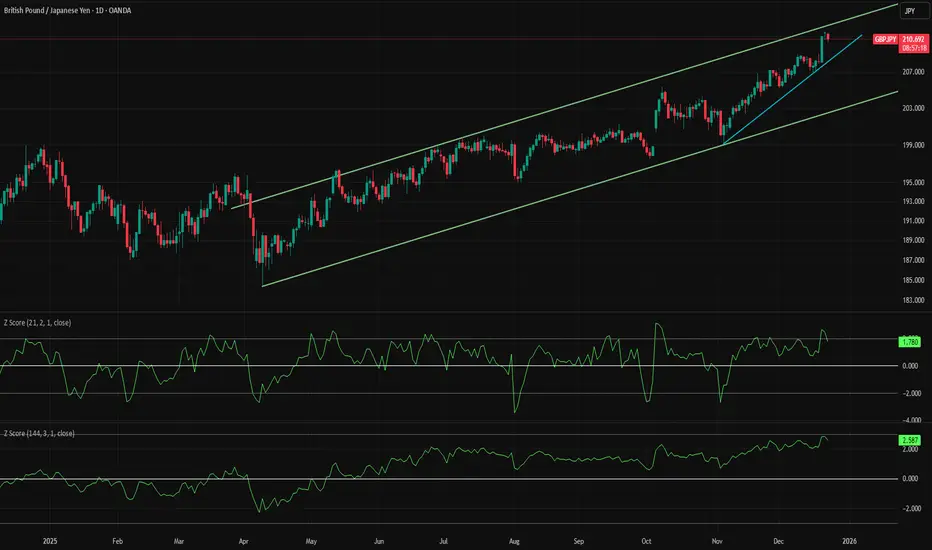
So the intervention threat is real and a possible trend change could be near. To turn this into an advantage, perhaps GBPJPY is one of the most appropriate currencies at the moment. Despite weak GBP fundamentals, it rose 3.12% in the last 22 days (working days in a month) against the USD, higher than EURUSD. If this divergence corrects and a Japanese intervention comes, GBPJPY could be hit by a double combo. Currently, the 21-day z-score shows that GBPJPY has passed +2 standard deviations then retreated, a sell signal that works close to 50 percent of the time. The divergence from the longer-term average (144) has reached nearly 3 standard deviations, showing both short- and medium-term excess. The currency has also tested the upper line of the trend channel, which also supports a correction case. A pricing below 208 might be needed for a clear signal, but as long as the upper line of the channel holds, the downward opportunity might remain a decent possibility.
Japan conducted two repeated interventions in both 2022 and 2024. There are no clear known rules about when intervention occurs, but some signals could be important.
The first one is that USDJPY rose too fast over a couple of months. For that, we use the rate of change for 3 months (66 days). When the ROC is very near 7, it rings danger bells.
The second signal is the level of USDJPY. The first intervention came when USDJPY reached 150, and the second one came from near 160. So the 150-160 zone is clearly important for Japan’s economic administration.
The third one is not a signal but rather a market reality. Japan does not have unlimited foreign reserves to stem yen depreciation, so timing will be key. It is logical that when Japanese yen bears are close to being exhausted, yen short positions become too crowded, and market liquidity gets thinner, that is the most efficient time for intervention. The incoming low-liquidity holiday season could be a prime opportunity for Katayama. Although last year when USDJPY was very close to 160, Japan opted out of intervention, the yen still fell in early 2025.
The final move before intervention is preparing the markets. Key players like the currency chief and finance minister start to issue warnings, with each new speech more hawkish than the previous one. Warning of bold moves is a very clear step toward intervention because it creates fear in the market. This fear causes any sudden retreat in USDJPY to turn into a trigger for running away from long positions. Combined with the low-liquidity environment and overly busy long positioning, it multiplies the effect of the intervention.
So the intervention threat is real and a possible trend change could be near. To turn this into an advantage, perhaps GBPJPY is one of the most appropriate currencies at the moment. Despite weak GBP fundamentals, it rose 3.12% in the last 22 days (working days in a month) against the USD, higher than EURUSD. If this divergence corrects and a Japanese intervention comes, GBPJPY could be hit by a double combo. Currently, the 21-day z-score shows that GBPJPY has passed +2 standard deviations then retreated, a sell signal that works close to 50 percent of the time. The divergence from the longer-term average (144) has reached nearly 3 standard deviations, showing both short- and medium-term excess. The currency has also tested the upper line of the trend channel, which also supports a correction case. A pricing below 208 might be needed for a clear signal, but as long as the upper line of the channel holds, the downward opportunity might remain a decent possibility.

Feragatname
Bilgiler ve yayınlar, TradingView tarafından sağlanan veya onaylanan finansal, yatırım, alım satım veya diğer türden tavsiye veya öneriler anlamına gelmez ve teşkil etmez. Kullanım Koşulları bölümünde daha fazlasını okuyun.
Feragatname
Bilgiler ve yayınlar, TradingView tarafından sağlanan veya onaylanan finansal, yatırım, alım satım veya diğer türden tavsiye veya öneriler anlamına gelmez ve teşkil etmez. Kullanım Koşulları bölümünde daha fazlasını okuyun.