
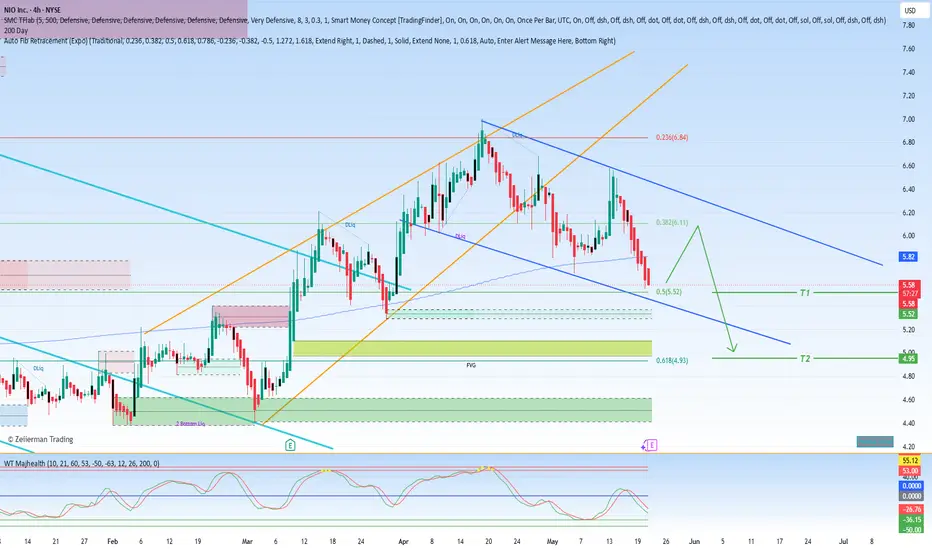
If you are wondering whether NIO still offers compelling value at around US$5.88 per share after its recent rebound, you are far from alone. Investors continue to debate whether the stock’s recovery signals the beginning of a larger turnaround story or whether much of the near-term upside has already been captured.
The share price performance has been volatile, which reflects the uncertainty surrounding the company and the broader electric vehicle sector. Over the past week, the stock has slipped roughly 3.1%, while it has fallen close to 13.9% during the last month. Despite that recent weakness, the longer-term picture still looks stronger, with the stock gaining approximately 14.4% since the beginning of the year and an impressive 45.5% over the past twelve months. Those contrasting timeframes highlight how quickly sentiment around NIO can shift and why investors remain divided about where the stock could head next.
Much of the recent market attention has focused on NIO’s ability to navigate an increasingly competitive EV landscape while managing its financial and operational challenges. Investors are paying close attention to the company’s funding requirements, production expansion plans, delivery growth, and ability to defend market share against both domestic and global rivals. Concerns surrounding profitability, cash burn, pricing pressure, and future capital raises have also played a major role in shaping how the market currently values the business.
At present, NIO carries a value score of 2 out of 6, meaning only two of the standard valuation checks suggest the shares may be undervalued. That mixed score reflects the uncertainty around the company’s future earnings potential and the difficulty of valuing fast-growing EV businesses that are still balancing expansion with profitability. To better understand whether the stock looks attractive at current levels, it helps to examine both the bullish and bearish valuation scenarios.
🐂 The Bull Case for NIO
In the optimistic scenario, NIO’s estimated fair value rises to approximately US$18.27 per share. Compared with the recent trading price near US$5.88, that would imply the stock is trading at roughly a 68% discount to its potential intrinsic value.
This bullish outlook is built on the assumption that NIO can achieve strong long-term revenue growth of around 51%. Supporters of the company believe that while NIO is currently dealing with heavy competition, production bottlenecks, and margin pressure, it still possesses significant long-term opportunities within the rapidly evolving electric vehicle market.
A major part of the positive thesis revolves around NIO’s differentiated ecosystem strategy. Bulls point to the company’s Battery as a Service (BaaS) model as a key competitive advantage that could improve customer loyalty, reduce upfront vehicle costs, and create recurring revenue streams over time. In addition, NIO’s continued push into European markets is viewed as another important growth driver that could expand its global footprint and diversify revenue beyond China.
Optimistic investors also argue that if management successfully executes on production growth, improves operating efficiency, and narrows losses over time, the market may eventually reward the company with a much higher valuation multiple. In this scenario, current share prices may appear deeply discounted relative to the company’s future earnings and sales potential.
🐻 The Bear Case for NIO
The bearish scenario paints a much more cautious picture. Under this view, NIO’s estimated fair value falls closer to US$4.22 per share, suggesting the stock may actually be trading around 39% above its intrinsic value at current prices.
This more conservative valuation assumes revenue growth closer to 18.98%, which is still respectable but far below the aggressive expansion forecasts used in bullish models. Bears argue that NIO faces a number of significant risks that could prevent the company from achieving the scale and profitability required to justify a substantially higher valuation.
Among the biggest concerns are ongoing geopolitical tensions, tariffs, export restrictions, and increasing regulatory uncertainty that could complicate international expansion efforts. Investors are also wary of the company’s continued need for external capital, especially if margins remain under pressure or if operating losses persist longer than expected.
Competition is another major issue. The EV industry is evolving rapidly, with both established automakers and emerging startups aggressively competing on price, technology, battery innovation, and autonomous driving capabilities. Critics argue that this intense environment may limit NIO’s pricing power and make it difficult to sustain strong profit margins even if vehicle deliveries continue to grow.
The bearish case also questions whether some analyst price targets rely on overly optimistic assumptions regarding future earnings and valuation multiples. Even if NIO succeeds in improving revenue and margins, skeptics argue that achieving those higher valuations could require investors to assign extremely elevated future price-to-earnings ratios to the company — something that may prove difficult if market sentiment toward growth stocks weakens.
For investors considering the stock today, the key challenge is deciding which assumptions appear more realistic. Your outlook on NIO likely depends on how confident you are in the company’s ability to execute on growth plans, manage capital needs, improve profitability, and compete effectively in a crowded EV market. The gap between the bullish and bearish valuations highlights just how wide the range of possible outcomes remains.

İlgili yayınlar
Feragatname
Bilgiler ve yayınlar, TradingView tarafından sağlanan veya onaylanan finansal, yatırım, alım satım veya diğer türden tavsiye veya öneriler anlamına gelmez ve teşkil etmez. Kullanım Koşulları bölümünde daha fazlasını okuyun.
İlgili yayınlar
Feragatname
Bilgiler ve yayınlar, TradingView tarafından sağlanan veya onaylanan finansal, yatırım, alım satım veya diğer türden tavsiye veya öneriler anlamına gelmez ve teşkil etmez. Kullanım Koşulları bölümünde daha fazlasını okuyun.