
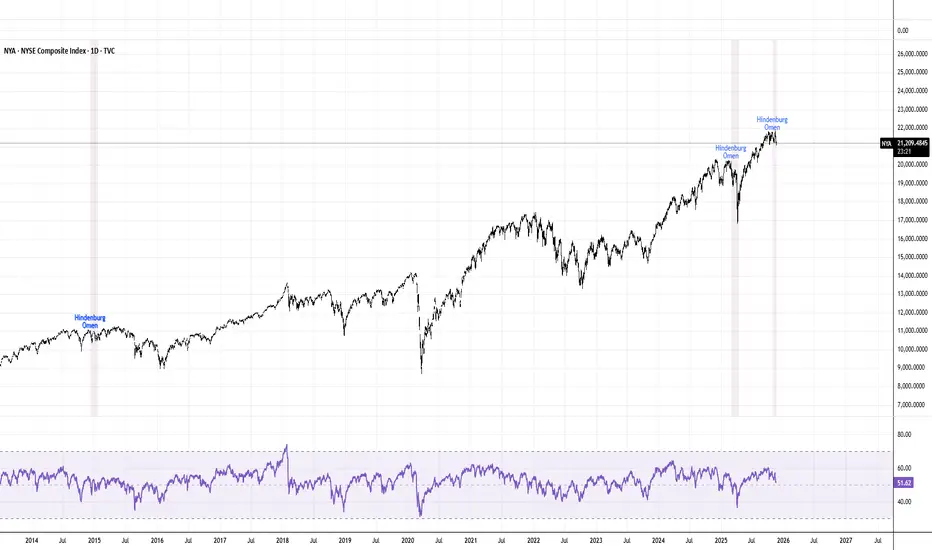
The Hindenburg Omen is a technical indicator of stock market breadth, or "breathing," that is believed to be a harbinger of a major market crash.
It is known to have received its name from the disaster of the German passenger airship Hindenburg, which burned to the ground in just over 30 seconds on May 6, 1937.
This became a dramatic and widely known omen of the end of the airship era and the beginning of the motorized era, which escalated into the all-encompassing "Motor War" — war conflict also known as "World War II" in which motorized technology such as airplanes, tanks, and automobiles, as well as aviation and naval forces, played a key role.
How the indicator works
The Hindenburg Omen indicator is based on an analysis of market breadth—the ratio of stocks reaching new highs and new lows over a given period (usually 52 weeks) on a stock exchange (e.g., the NYSE).
A "signal" occurs when certain conditions are met that suggest the market is experiencing hidden weakness (yet undetected by many market participants), even though the underlying index (S&P 500 or NYSE Composite) continues to rise, reaching its 52-week or even all-time highs.
Key conditions for a signal include:
A large number of stocks, usually a figure of 2.2% threshold or higher (for example, 11 or more stocks out of 500) are reaching new 52-week highs. However, a large number of stocks are also reaching its new 52-week lows on the same day (indicating a strong divergence in investor sentiment).
A market/ exchange index (e.g., the S&P 500 or NYSE Composite) has no reaction yet, and continues to rise, reaching 52-week or all-time highs. In other words, there is no yet outward sign of potential danger in the index's price action. The McClellan Oscillator (another market breadth indicator) should be negative, confirming underlying market weakness.
Importance and Reliability
The 2025 Survey
Practical Application of the "Hindenburg Omen" Indicator on TradingView
In the spirit of TradingView, Pine programming master QuantNomad created the "Hindenburg Omen" indicator directly on the website and made its source code open source so traders can explore it and see its functionality.
Kudos to the author.

It is known to have received its name from the disaster of the German passenger airship Hindenburg, which burned to the ground in just over 30 seconds on May 6, 1937.
This became a dramatic and widely known omen of the end of the airship era and the beginning of the motorized era, which escalated into the all-encompassing "Motor War" — war conflict also known as "World War II" in which motorized technology such as airplanes, tanks, and automobiles, as well as aviation and naval forces, played a key role.
How the indicator works
The Hindenburg Omen indicator is based on an analysis of market breadth—the ratio of stocks reaching new highs and new lows over a given period (usually 52 weeks) on a stock exchange (e.g., the NYSE).
A "signal" occurs when certain conditions are met that suggest the market is experiencing hidden weakness (yet undetected by many market participants), even though the underlying index (S&P 500 or NYSE Composite) continues to rise, reaching its 52-week or even all-time highs.
Key conditions for a signal include:
A large number of stocks, usually a figure of 2.2% threshold or higher (for example, 11 or more stocks out of 500) are reaching new 52-week highs. However, a large number of stocks are also reaching its new 52-week lows on the same day (indicating a strong divergence in investor sentiment).
A market/ exchange index (e.g., the S&P 500 or NYSE Composite) has no reaction yet, and continues to rise, reaching 52-week or all-time highs. In other words, there is no yet outward sign of potential danger in the index's price action. The McClellan Oscillator (another market breadth indicator) should be negative, confirming underlying market weakness.
Importance and Reliability
- While this indicator is associated with predicting major market crashes (for example, it was active before the crashes of 1990, 2000, and 2008), it is not an absolutely accurate forecasting tool and requires refinement based on an analysis of overall market conditions.
- Many analysts consider it controversial and unreliable, as it can generate false signals. Nevertheless, its appearance usually attracts investors' attention, reminding them of potential risks in an overheated market, especially when the "Hindenburg Omen" appears for the first time in a significant period of time (3 months or more), and the market is at peaks and significantly deviates from its key, most common support levels.
- Overall, the "Hindenburg Omen" is more of a warning signal for traders to exercise caution than a guarantee of imminent collapse.
The 2025 Survey
- The 2025 is the first time (at least) over the past twenty years the "Hindenburg Omen" has repeatedly occured twice in one calendar year; both times with a threshold 3.4% as a minimum.
- Over the past twenty years there were just 3 cases at all, the "Hindenburg Omen" has occured with a threshold 3.4% as a minimum.
- November 2007, a hidden start of 2007/09 world financial crisis. There were no new all-time highs in major US indices over the next 6 years, up to December 2013.
- December 2014, no new all-time highs in major US indices over the next 2 years, up to December 2026
- March 2025 - Nowadays.
Practical Application of the "Hindenburg Omen" Indicator on TradingView
In the spirit of TradingView, Pine programming master QuantNomad created the "Hindenburg Omen" indicator directly on the website and made its source code open source so traders can explore it and see its functionality.
Kudos to the author.

Feragatname
Bilgiler ve yayınlar, TradingView tarafından sağlanan veya onaylanan finansal, yatırım, alım satım veya diğer türden tavsiye veya öneriler anlamına gelmez ve teşkil etmez. Kullanım Koşulları bölümünde daha fazlasını okuyun.
Feragatname
Bilgiler ve yayınlar, TradingView tarafından sağlanan veya onaylanan finansal, yatırım, alım satım veya diğer türden tavsiye veya öneriler anlamına gelmez ve teşkil etmez. Kullanım Koşulları bölümünde daha fazlasını okuyun.