
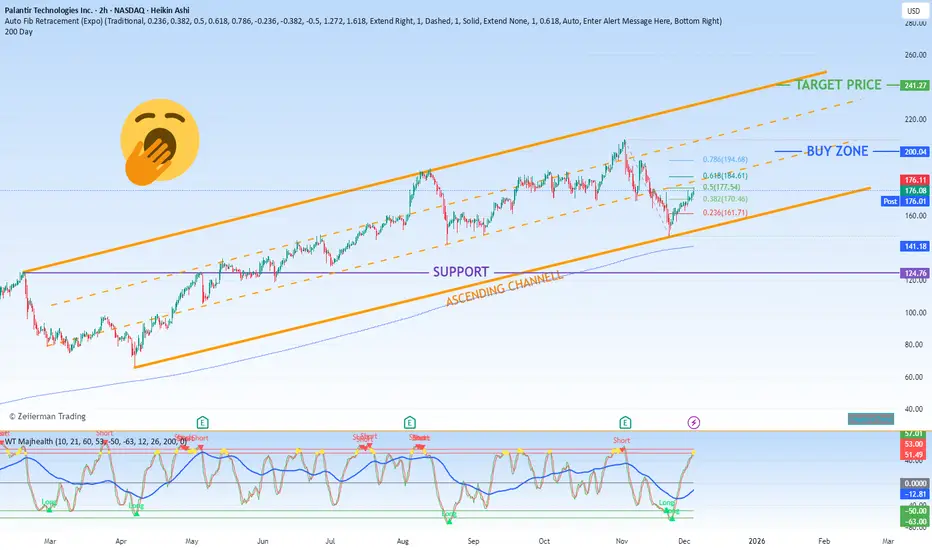
Palantir Technologies Inc. (NYSE: PLTR) presents a compelling case for a cautiously bullish outlook following its rebound from November lows. For traders seeking to capitalize on potential stability or upside while managing defined risk, a bull put spread strategy offers a structured approach.
Market Context and Trade Rationale
Palantir stock has demonstrated resilience, bouncing off its lows from November and establishing a more constructive technical posture. This stabilization makes it a candidate for strategies that benefit from sideways or upward price movement. The bull put spread is particularly suited for this environment, as it allows traders to generate income from option premium while capping maximum risk—a prudent setup in a market that, while showing strength, may still face volatility.
The Bull Put Spread: Structure and Mechanics
A bull put spread is a defined-risk options strategy implemented by simultaneously:
Selling a put option with a higher strike price (the short put).
Buying a put option with a lower strike price (the long put).
Both options share the same expiration date. The goal is for the stock price to remain above the higher strike at expiration, allowing both puts to expire worthless. The trader keeps the net premium received upfront as profit.
Proposed Trade Setup for Palantir (PLTR)
For traders with a view that Palantir will maintain its footing above the $155 level over the coming weeks, the following trade presents an opportunity:
Action: Sell the January 16 expiration 155-150 bull put spread.
Credit Received: Approximately $1.10 per share, or $110 per contract spread.
Maximum Potential Profit: The full $110 premium received. This represents a return of roughly 28% on the capital at risk over the six-week period, contingent on PLTR closing above $155 at expiration.
Maximum Risk: Limited and predefined. It is calculated as the difference between the strike prices ($155 - $150 = $5), minus the premium received ($1.10). Therefore, the maximum loss per spread is $3.90, or $390 per contract. This worst-case scenario would only occur if PLTR stock closes below $150 on the January 16 expiration.
Break-Even Point: $153.90. This is calculated by subtracting the premium received from the short put's strike price ($155 - $1.10). The trade remains profitable at expiration as long as PLTR closes above this level.
Risk Management - Stop Loss: To protect against a sudden downturn, it is prudent to implement a stop-loss order. An effective rule is to exit the spread position if its market value doubles from the initial credit received—for example, if the spread's price increases from $1.10 to $2.20. Alternatively, a technical stop based on the underlying stock breaking below a key support level, such as $160, can serve as an early warning to manage risk and prevent larger losses.
Broader Technical Framework for PLTR Stock
Beyond this specific options trade, the broader technical landscape for Palantir highlights key levels for swing traders and long-term investors:
Critical Support: A major support zone is established near $120. This level is viewed as a foundational floor for the stock's longer-term bullish structure.
Strategic Buy Zone: For those looking to establish or add to equity positions, the area around $200 is considered a compelling buy zone, potentially offering a favorable risk/reward entry on pullbacks.
Primary Take-Profit Target: The next significant resistance and profit-taking target for a bullish move is projected at the $240 level.
Conclusion
In summary, Palantir's recovery from its November lows opens the door for strategic bullish plays. The proposed 155-150 bull put spread for January 16 expiration provides a method to potentially earn a 28% return with controlled, predefined risk, based on the thesis that PLTR will remain above $155. This tactical trade exists within a wider technical framework that identifies $120 as solid support, $200 as a strategic accumulation area, and $240 as a primary upside objective. As with all options strategies, position sizing and adherence to stop-loss disciplines are essential for managing capital effectively.
Market Context and Trade Rationale
Palantir stock has demonstrated resilience, bouncing off its lows from November and establishing a more constructive technical posture. This stabilization makes it a candidate for strategies that benefit from sideways or upward price movement. The bull put spread is particularly suited for this environment, as it allows traders to generate income from option premium while capping maximum risk—a prudent setup in a market that, while showing strength, may still face volatility.
The Bull Put Spread: Structure and Mechanics
A bull put spread is a defined-risk options strategy implemented by simultaneously:
Selling a put option with a higher strike price (the short put).
Buying a put option with a lower strike price (the long put).
Both options share the same expiration date. The goal is for the stock price to remain above the higher strike at expiration, allowing both puts to expire worthless. The trader keeps the net premium received upfront as profit.
Proposed Trade Setup for Palantir (PLTR)
For traders with a view that Palantir will maintain its footing above the $155 level over the coming weeks, the following trade presents an opportunity:
Action: Sell the January 16 expiration 155-150 bull put spread.
Credit Received: Approximately $1.10 per share, or $110 per contract spread.
Maximum Potential Profit: The full $110 premium received. This represents a return of roughly 28% on the capital at risk over the six-week period, contingent on PLTR closing above $155 at expiration.
Maximum Risk: Limited and predefined. It is calculated as the difference between the strike prices ($155 - $150 = $5), minus the premium received ($1.10). Therefore, the maximum loss per spread is $3.90, or $390 per contract. This worst-case scenario would only occur if PLTR stock closes below $150 on the January 16 expiration.
Break-Even Point: $153.90. This is calculated by subtracting the premium received from the short put's strike price ($155 - $1.10). The trade remains profitable at expiration as long as PLTR closes above this level.
Risk Management - Stop Loss: To protect against a sudden downturn, it is prudent to implement a stop-loss order. An effective rule is to exit the spread position if its market value doubles from the initial credit received—for example, if the spread's price increases from $1.10 to $2.20. Alternatively, a technical stop based on the underlying stock breaking below a key support level, such as $160, can serve as an early warning to manage risk and prevent larger losses.
Broader Technical Framework for PLTR Stock
Beyond this specific options trade, the broader technical landscape for Palantir highlights key levels for swing traders and long-term investors:
Critical Support: A major support zone is established near $120. This level is viewed as a foundational floor for the stock's longer-term bullish structure.
Strategic Buy Zone: For those looking to establish or add to equity positions, the area around $200 is considered a compelling buy zone, potentially offering a favorable risk/reward entry on pullbacks.
Primary Take-Profit Target: The next significant resistance and profit-taking target for a bullish move is projected at the $240 level.
Conclusion
In summary, Palantir's recovery from its November lows opens the door for strategic bullish plays. The proposed 155-150 bull put spread for January 16 expiration provides a method to potentially earn a 28% return with controlled, predefined risk, based on the thesis that PLTR will remain above $155. This tactical trade exists within a wider technical framework that identifies $120 as solid support, $200 as a strategic accumulation area, and $240 as a primary upside objective. As with all options strategies, position sizing and adherence to stop-loss disciplines are essential for managing capital effectively.

Feragatname
Bilgiler ve yayınlar, TradingView tarafından sağlanan veya onaylanan finansal, yatırım, alım satım veya diğer türden tavsiye veya öneriler anlamına gelmez ve teşkil etmez. Kullanım Koşulları bölümünde daha fazlasını okuyun.
Feragatname
Bilgiler ve yayınlar, TradingView tarafından sağlanan veya onaylanan finansal, yatırım, alım satım veya diğer türden tavsiye veya öneriler anlamına gelmez ve teşkil etmez. Kullanım Koşulları bölümünde daha fazlasını okuyun.