
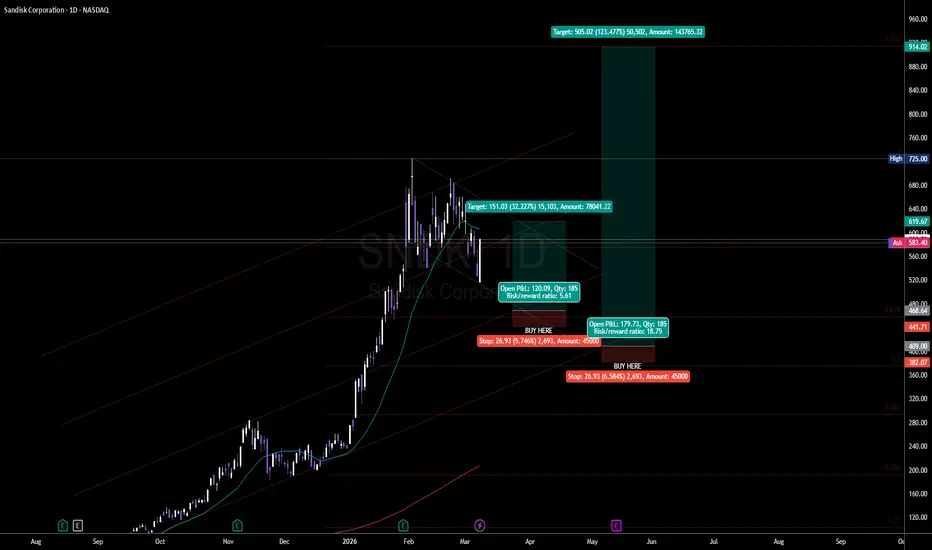
This is one of the most extraordinary charts in the entire market right now. Twelve months ago, SanDisk was trading at $27.89. It hit a 52-week high of $725.00.
That is a 1,200% move in a single year driven by a perfect storm of a strategic spinoff from Western Digital, a global NAND flash shortage, and an AI infrastructure buildout that has made high-performance storage one of the most constrained resources in the semiconductor ecosystem.
And now the Iran war has pulled it back 28% from its peak in two weeks. That is the setup.
Here is the fundamental case before we get to the chart:
SanDisk reported Q2 fiscal 2026 revenue of $3.03 billion, up 31% sequentially and 61% year-over-year, with GAAP net income of $803 million and non-GAAP diluted EPS of $6.20. Datacenter revenue rose 64% sequentially.
The company guided Q3 to $4.4 to $4.8 billion in revenue with non-GAAP EPS of $12.00 to $14.00. Gross margin expanded to over 51% GAAP. Management highlighted sustained pricing strength in NAND flash, driven by constrained supply and AI-related demand that shows no signs of easing with supply agreements now extending to 2028 as customers lock in capacity ahead of projected shortages.
SanDisk and Kioxia extended their Yokkaichi joint venture agreement through December 31, 2034, adding five years to the prior expiry co-developing 3D flash memory and AI-enabled manufacturing to support growing generative AI demand. That JV structure gives SanDisk a structurally different margin and capex profile than any integrated memory manufacturer delivering leading-edge NAND at roughly 5.8% capex-to-revenue, compared to 30%+ at Micron.
Institutional investors have been aggressively rotating out of software and into AI hardware, driving the year-to-date gains. The Tradr 2X Long SNDK Daily ETF reached $650 million AUM in just 24 days after launch making it the fifth-largest single-stock ETF in the US.
Now add the Iran war layer. South Korean semiconductor fabs run 24/7, consuming enormous electricity and process gases, with a significant share of that power coming from LNG-fired plants and when natural gas prices spike, fab operating costs follow. SK Hynix fell 11.5% overnight while Samsung fell 9.9% the two companies that together control the majority of global DRAM supply and a massive share of NAND.
Every percentage point increase in Korean fab operating costs is a percentage point of margin compression for the companies that supply most of the world's flash memory. SanDisk, with its Kioxia JV in Japan and its US listing, is structurally better positioned than its Korean competitors to absorb this shock. The Iran war did not break SanDisk's thesis it reinforced it.
SanDisk has been acting as a stand-in for hardware names riding the AI wave, thanks to the surge in data center spending by big cloud players and tech firms. The selloff is fear-driven, not fundamental.
The Q3 guidance has not been revised. The Kioxia JV has not been cancelled. The AI storage shortage has not been resolved. What changed is oil prices and sentiment.
I have mapped two tiered buy zones on the daily chart targeting a move back toward all-time highs and beyond into mid-2026.
🟢 Buy Zone 1 Current Level ($469 area)
Price has pulled back into the 0.382 Fibonacci retracement from the breakout base, where the blue SMA 20 is flattening after the sharp decline. This is the first structural support after the post-spinoff parabolic move and sits directly above the prior consolidation range.
Stop: $26.93 below entry (5.746%) / $45,000 position
Qty: 185
Risk/Reward Ratio: 5.61
Target: +32.227% ($619.67 area / $78,041)
🟢 Buy Zone 2 Deep Demand ($409 area)
If risk-off from the Iran war continues pushing memory stocks lower, the 0.5 Fibonacci level and prior breakout shelf align at this zone. This is the entry with the highest conviction R/R in the setup and still sits well above the SMA 200.
Stop: $26.93 below entry (6.584%) / $45,000 position
Qty: 185
Risk/Reward Ratio: 18.75
Target: +123.477% ($505.02 area / $143,765)
Key Levels:
🔑 Current Price: ~$588.73
🔑 Buy Zone 1: ~$469 area
🔑 Buy Zone 2: ~$409 area
🔑 52-Week Low: $27.89
🔑 52-Week High: $725.00
🔑 Q3 Revenue Guidance: $4.4 to $4.8B
🔑 Q3 EPS Guidance: $12.00 to $14.00
🎯 Target 1: $619.67 (+32% from Zone 1 / $78,041)
🎯 Target 2: $914 (+123% from Zone 2 / $143,765)
⚠️ Hard Stop Both Zones: $26.93 below entry
A stock that went up 1,200% in twelve months on genuine fundamental acceleration does not simply reverse because of a two-week geopolitical selloff. The NAND shortage is structural.
The AI datacenter buildout is structural. The Kioxia JV advantage is structural. None of those things changed on February 28 when the first strikes hit Iran.
What changed is that scared money sold hardware and bought gold. That is the opportunity.
The bears will point to the parabolic chart and call it a bubble. The bulls will point to $12.00 to $14.00 EPS guidance in a single quarter and call it a generational earnings ramp.
At these buy zones, with defined stops and a clear target back toward all-time highs, the risk/reward is on the side of the bulls.
The war created the entry. The AI shortage closes it.
If you found this analysis valuable, hit the Follow button at the top of the page. Every idea in this Iran war series oil, defense, reconstruction, crypto, chips, cyber, AI infrastructure, domestic manufacturing, and now flash storage is being updated in real time as the conflict develops. You don't want to miss what's coming next.
That is a 1,200% move in a single year driven by a perfect storm of a strategic spinoff from Western Digital, a global NAND flash shortage, and an AI infrastructure buildout that has made high-performance storage one of the most constrained resources in the semiconductor ecosystem.
And now the Iran war has pulled it back 28% from its peak in two weeks. That is the setup.
Here is the fundamental case before we get to the chart:
SanDisk reported Q2 fiscal 2026 revenue of $3.03 billion, up 31% sequentially and 61% year-over-year, with GAAP net income of $803 million and non-GAAP diluted EPS of $6.20. Datacenter revenue rose 64% sequentially.
The company guided Q3 to $4.4 to $4.8 billion in revenue with non-GAAP EPS of $12.00 to $14.00. Gross margin expanded to over 51% GAAP. Management highlighted sustained pricing strength in NAND flash, driven by constrained supply and AI-related demand that shows no signs of easing with supply agreements now extending to 2028 as customers lock in capacity ahead of projected shortages.
SanDisk and Kioxia extended their Yokkaichi joint venture agreement through December 31, 2034, adding five years to the prior expiry co-developing 3D flash memory and AI-enabled manufacturing to support growing generative AI demand. That JV structure gives SanDisk a structurally different margin and capex profile than any integrated memory manufacturer delivering leading-edge NAND at roughly 5.8% capex-to-revenue, compared to 30%+ at Micron.
Institutional investors have been aggressively rotating out of software and into AI hardware, driving the year-to-date gains. The Tradr 2X Long SNDK Daily ETF reached $650 million AUM in just 24 days after launch making it the fifth-largest single-stock ETF in the US.
Now add the Iran war layer. South Korean semiconductor fabs run 24/7, consuming enormous electricity and process gases, with a significant share of that power coming from LNG-fired plants and when natural gas prices spike, fab operating costs follow. SK Hynix fell 11.5% overnight while Samsung fell 9.9% the two companies that together control the majority of global DRAM supply and a massive share of NAND.
Every percentage point increase in Korean fab operating costs is a percentage point of margin compression for the companies that supply most of the world's flash memory. SanDisk, with its Kioxia JV in Japan and its US listing, is structurally better positioned than its Korean competitors to absorb this shock. The Iran war did not break SanDisk's thesis it reinforced it.
SanDisk has been acting as a stand-in for hardware names riding the AI wave, thanks to the surge in data center spending by big cloud players and tech firms. The selloff is fear-driven, not fundamental.
The Q3 guidance has not been revised. The Kioxia JV has not been cancelled. The AI storage shortage has not been resolved. What changed is oil prices and sentiment.
I have mapped two tiered buy zones on the daily chart targeting a move back toward all-time highs and beyond into mid-2026.
🟢 Buy Zone 1 Current Level ($469 area)
Price has pulled back into the 0.382 Fibonacci retracement from the breakout base, where the blue SMA 20 is flattening after the sharp decline. This is the first structural support after the post-spinoff parabolic move and sits directly above the prior consolidation range.
Stop: $26.93 below entry (5.746%) / $45,000 position
Qty: 185
Risk/Reward Ratio: 5.61
Target: +32.227% ($619.67 area / $78,041)
🟢 Buy Zone 2 Deep Demand ($409 area)
If risk-off from the Iran war continues pushing memory stocks lower, the 0.5 Fibonacci level and prior breakout shelf align at this zone. This is the entry with the highest conviction R/R in the setup and still sits well above the SMA 200.
Stop: $26.93 below entry (6.584%) / $45,000 position
Qty: 185
Risk/Reward Ratio: 18.75
Target: +123.477% ($505.02 area / $143,765)
Key Levels:
🔑 Current Price: ~$588.73
🔑 Buy Zone 1: ~$469 area
🔑 Buy Zone 2: ~$409 area
🔑 52-Week Low: $27.89
🔑 52-Week High: $725.00
🔑 Q3 Revenue Guidance: $4.4 to $4.8B
🔑 Q3 EPS Guidance: $12.00 to $14.00
🎯 Target 1: $619.67 (+32% from Zone 1 / $78,041)
🎯 Target 2: $914 (+123% from Zone 2 / $143,765)
⚠️ Hard Stop Both Zones: $26.93 below entry
A stock that went up 1,200% in twelve months on genuine fundamental acceleration does not simply reverse because of a two-week geopolitical selloff. The NAND shortage is structural.
The AI datacenter buildout is structural. The Kioxia JV advantage is structural. None of those things changed on February 28 when the first strikes hit Iran.
What changed is that scared money sold hardware and bought gold. That is the opportunity.
The bears will point to the parabolic chart and call it a bubble. The bulls will point to $12.00 to $14.00 EPS guidance in a single quarter and call it a generational earnings ramp.
At these buy zones, with defined stops and a clear target back toward all-time highs, the risk/reward is on the side of the bulls.
The war created the entry. The AI shortage closes it.
If you found this analysis valuable, hit the Follow button at the top of the page. Every idea in this Iran war series oil, defense, reconstruction, crypto, chips, cyber, AI infrastructure, domestic manufacturing, and now flash storage is being updated in real time as the conflict develops. You don't want to miss what's coming next.

İlgili yayınlar
Feragatname
Bilgiler ve yayınlar, TradingView tarafından sağlanan veya onaylanan finansal, yatırım, alım satım veya diğer türden tavsiye veya öneriler anlamına gelmez ve teşkil etmez. Kullanım Koşulları bölümünde daha fazlasını okuyun.
İlgili yayınlar
Feragatname
Bilgiler ve yayınlar, TradingView tarafından sağlanan veya onaylanan finansal, yatırım, alım satım veya diğer türden tavsiye veya öneriler anlamına gelmez ve teşkil etmez. Kullanım Koşulları bölümünde daha fazlasını okuyun.