

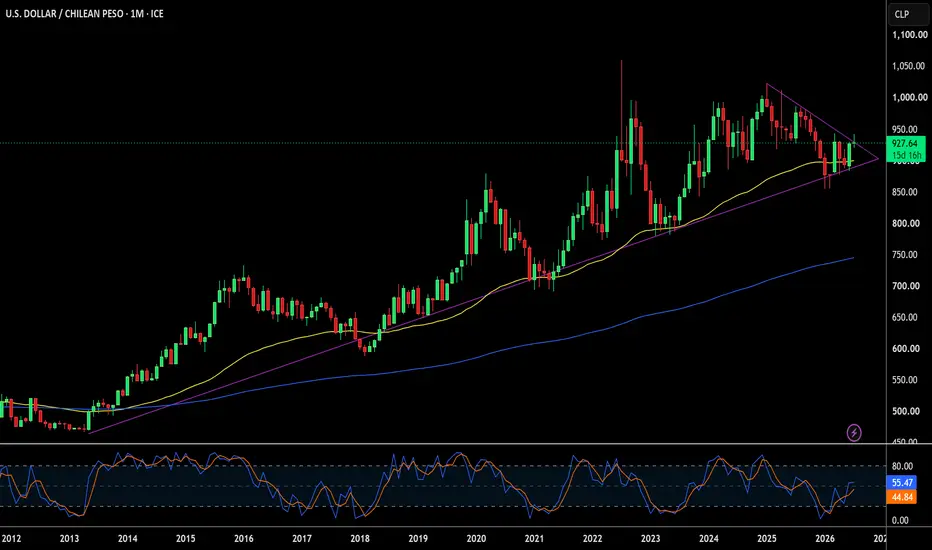
USD/CLP trades near 933 today, up almost 1% in a single session and roughly 4% weaker over the past month. ING's currency strategists see 940 to 950 as the summer ceiling. Their reasoning is simple: firm copper prices should cap the peso's downside even as energy costs rise elsewhere. That single sentence captures the entire Chilean peso story. This currency trades less like a sovereign FX pair and more like a copper derivative with a government attached.
Macroeconomics: A Currency on Autopilot
Chile's central bank holds its policy rate at 4.50%. Real interest rates sit near a modest 1.5%. Markets price a small chance of one more cut, but strategists doubt it happens until the Federal Reserve's own path clarifies. Growth is expected near 2.5% for 2026 and 2027, respectable but unspectacular for an emerging market.
The more interesting number is Chile's current account deficit, running above 2% of GDP. That gap needs financing, and copper exports are what finance it. Copper's terms-of-trade shock has surged as much as 35% from its April low point this year. When copper is this strong, the deficit hardly matters. When it weakens, the peso's real vulnerability shows immediately.
Geopolitics: A Hard-Right Government Meets Global Realignment
Chile just underwent its sharpest political shift in decades. José Antonio Kast won December's runoff with 58% of the vote and took office on March 11, 2026, becoming the country's most conservative president since the Pinochet era. Days after his inauguration, his finance minister announced a $6 billion spending cut, and by May the government had already reshuffled its cabinet. His government immediately positioned itself closer to Washington, with the US ambassador publicly welcoming warmer ties under the new administration.
That alignment is not without friction. China remains Chile's second-largest trading partner at 17% of total trade, and Kast has insisted Chile can maintain strong ties with both Washington and Beijing simultaneously. Analysts are less certain, warning that Chile's economic dependence on China's copper demand could collide with its new ideological alignment with Trump's Washington.
A second geopolitical channel runs through energy and industrial inputs. Petroleum products make up roughly 20% of Chile's imports, so Middle East-driven oil spikes hit directly. Less obviously, Chile's copper producers depend on sulfuric acid for ore leaching, a supply chain also disrupted by Middle East tensions and Chinese export curbs.
Industry Trends and Business Models: The Cathode Exemption
Chile occupies a genuinely privileged position in the global copper trade war. Roughly 99% of its copper exports to the United States arrive as refined cathodes, and cathodes currently enter the US tariff-free even as Washington debates broader Section 232 duties on refined copper. That exemption, for now, insulates Chile's core export from the tariff risk hanging over other producers.
The business model risk sits elsewhere, in the sulfuric acid supply chain. Copper leaching requires steady acid input, and China's export curbs plus Middle East disruption have squeezed that input at exactly the moment global copper demand is accelerating. Producers are diversifying acid sourcing and investing in alternative extraction chemistry to reduce this single point of failure.
Management and Leadership: Fiscal Discipline Under Pressure
Finance Minister Jorge Quiroz set the tone within days of Kast's inauguration, ordering a 3% across-the-board cut to every ministry's budget, targeting roughly $6 billion in savings over eighteen months. That fiscal discipline aims to reassure credit rating agencies and bond markets simultaneously.
The central bank runs its own quiet, parallel operation. Chile's Treasury sells roughly $300 million a week, converting proceeds from FX bond auctions, while the central bank separately buys about $25 million a day, targeting $18 billion in reserve growth over three years. The goal is weaning Chile off its IMF Flexible Credit Line without spooking sovereign ratings, a delicate maneuver given that Chile's FX reserve adequacy already sits below recommended levels.
Technology and Science: Beyond Copper
Chile's technological relevance extends past copper into lithium. The country sits inside the so-called Lithium Triangle alongside Argentina and Bolivia, and ranks among the world's largest lithium producers. Battery-grade lithium extraction technology, including newer direct extraction methods that reduce water use in Chile's arid salt flats, is now a genuine area of scientific investment.
Copper technology itself keeps advancing too. Chilean producers are investing in bioleaching and improved flotation techniques to offset declining ore grades, the same structural challenge facing miners globally.
Patent Analysis and Innovation
Chilean and multinational miners operating in the country are filing patents around lower-acid-intensity leaching processes, directly responding to the sulfuric acid supply vulnerability. Lithium extraction patents are climbing too, particularly around direct lithium extraction technology that bypasses traditional evaporation ponds. Both patent trends point toward the same goal: reducing Chile's exposure to single-input supply shocks.
Cybersecurity in Chile's Financial and Mining Backbone
Chile's economy runs through a small number of critical nodes: state copper giant Codelco, the central bank's reserve operations, and cross-border FX settlement systems. That concentration makes cybersecurity a genuine sovereign concern, not just a corporate one. Mining operations increasingly rely on automated extraction and remote monitoring, systems that require the same industrial control security now standard across the global mining sector.
Company Culture and Innovation
Codelco, Chile's state-owned copper giant, has spent recent years modernizing a historically slow-moving, state-run culture. Automation, remote operations centers, and efficiency-linked management incentives now sit alongside the company's traditional role as a fiscal cash cow for the Chilean state. That cultural shift matters directly for the peso, since Codelco's output efficiency feeds straight into the terms-of-trade story driving USD/CLP.
The Pharmaceutical Connection
Chile's lithium industry creates an unexpected pharmaceutical link. Lithium carbonate, the same class of compound extracted from Chilean brine, is a first-line psychiatric medication for bipolar disorder. Global pharmaceutical-grade lithium supply chains draw on the same Atacama Desert brine operations that feed battery manufacturers. It is a modest connection next to copper's dominance of the peso story, but a genuine one.
Closing Thoughts
USD/CLP is, in practice, a leveraged proxy for global copper demand wrapped in a sovereign currency wrapper. Chile's new hard-right government, its careful reserve-building program, and its cathode tariff exemption all matter, but they are secondary to a single variable: whether copper holds above $13,000 a tonne. Watch three things going forward: the resolution of the sulfuric acid supply squeeze, whether Kast's fiscal consolidation holds against falling approval ratings, and whether Washington ultimately extends Section 232 tariffs to refined copper. Any of the three could move this currency more than a full central bank meeting.
Macroeconomics: A Currency on Autopilot
Chile's central bank holds its policy rate at 4.50%. Real interest rates sit near a modest 1.5%. Markets price a small chance of one more cut, but strategists doubt it happens until the Federal Reserve's own path clarifies. Growth is expected near 2.5% for 2026 and 2027, respectable but unspectacular for an emerging market.
The more interesting number is Chile's current account deficit, running above 2% of GDP. That gap needs financing, and copper exports are what finance it. Copper's terms-of-trade shock has surged as much as 35% from its April low point this year. When copper is this strong, the deficit hardly matters. When it weakens, the peso's real vulnerability shows immediately.
Geopolitics: A Hard-Right Government Meets Global Realignment
Chile just underwent its sharpest political shift in decades. José Antonio Kast won December's runoff with 58% of the vote and took office on March 11, 2026, becoming the country's most conservative president since the Pinochet era. Days after his inauguration, his finance minister announced a $6 billion spending cut, and by May the government had already reshuffled its cabinet. His government immediately positioned itself closer to Washington, with the US ambassador publicly welcoming warmer ties under the new administration.
That alignment is not without friction. China remains Chile's second-largest trading partner at 17% of total trade, and Kast has insisted Chile can maintain strong ties with both Washington and Beijing simultaneously. Analysts are less certain, warning that Chile's economic dependence on China's copper demand could collide with its new ideological alignment with Trump's Washington.
A second geopolitical channel runs through energy and industrial inputs. Petroleum products make up roughly 20% of Chile's imports, so Middle East-driven oil spikes hit directly. Less obviously, Chile's copper producers depend on sulfuric acid for ore leaching, a supply chain also disrupted by Middle East tensions and Chinese export curbs.
Industry Trends and Business Models: The Cathode Exemption
Chile occupies a genuinely privileged position in the global copper trade war. Roughly 99% of its copper exports to the United States arrive as refined cathodes, and cathodes currently enter the US tariff-free even as Washington debates broader Section 232 duties on refined copper. That exemption, for now, insulates Chile's core export from the tariff risk hanging over other producers.
The business model risk sits elsewhere, in the sulfuric acid supply chain. Copper leaching requires steady acid input, and China's export curbs plus Middle East disruption have squeezed that input at exactly the moment global copper demand is accelerating. Producers are diversifying acid sourcing and investing in alternative extraction chemistry to reduce this single point of failure.
Management and Leadership: Fiscal Discipline Under Pressure
Finance Minister Jorge Quiroz set the tone within days of Kast's inauguration, ordering a 3% across-the-board cut to every ministry's budget, targeting roughly $6 billion in savings over eighteen months. That fiscal discipline aims to reassure credit rating agencies and bond markets simultaneously.
The central bank runs its own quiet, parallel operation. Chile's Treasury sells roughly $300 million a week, converting proceeds from FX bond auctions, while the central bank separately buys about $25 million a day, targeting $18 billion in reserve growth over three years. The goal is weaning Chile off its IMF Flexible Credit Line without spooking sovereign ratings, a delicate maneuver given that Chile's FX reserve adequacy already sits below recommended levels.
Technology and Science: Beyond Copper
Chile's technological relevance extends past copper into lithium. The country sits inside the so-called Lithium Triangle alongside Argentina and Bolivia, and ranks among the world's largest lithium producers. Battery-grade lithium extraction technology, including newer direct extraction methods that reduce water use in Chile's arid salt flats, is now a genuine area of scientific investment.
Copper technology itself keeps advancing too. Chilean producers are investing in bioleaching and improved flotation techniques to offset declining ore grades, the same structural challenge facing miners globally.
Patent Analysis and Innovation
Chilean and multinational miners operating in the country are filing patents around lower-acid-intensity leaching processes, directly responding to the sulfuric acid supply vulnerability. Lithium extraction patents are climbing too, particularly around direct lithium extraction technology that bypasses traditional evaporation ponds. Both patent trends point toward the same goal: reducing Chile's exposure to single-input supply shocks.
Cybersecurity in Chile's Financial and Mining Backbone
Chile's economy runs through a small number of critical nodes: state copper giant Codelco, the central bank's reserve operations, and cross-border FX settlement systems. That concentration makes cybersecurity a genuine sovereign concern, not just a corporate one. Mining operations increasingly rely on automated extraction and remote monitoring, systems that require the same industrial control security now standard across the global mining sector.
Company Culture and Innovation
Codelco, Chile's state-owned copper giant, has spent recent years modernizing a historically slow-moving, state-run culture. Automation, remote operations centers, and efficiency-linked management incentives now sit alongside the company's traditional role as a fiscal cash cow for the Chilean state. That cultural shift matters directly for the peso, since Codelco's output efficiency feeds straight into the terms-of-trade story driving USD/CLP.
The Pharmaceutical Connection
Chile's lithium industry creates an unexpected pharmaceutical link. Lithium carbonate, the same class of compound extracted from Chilean brine, is a first-line psychiatric medication for bipolar disorder. Global pharmaceutical-grade lithium supply chains draw on the same Atacama Desert brine operations that feed battery manufacturers. It is a modest connection next to copper's dominance of the peso story, but a genuine one.
Closing Thoughts
USD/CLP is, in practice, a leveraged proxy for global copper demand wrapped in a sovereign currency wrapper. Chile's new hard-right government, its careful reserve-building program, and its cathode tariff exemption all matter, but they are secondary to a single variable: whether copper holds above $13,000 a tonne. Watch three things going forward: the resolution of the sulfuric acid supply squeeze, whether Kast's fiscal consolidation holds against falling approval ratings, and whether Washington ultimately extends Section 232 tariffs to refined copper. Any of the three could move this currency more than a full central bank meeting.

The5ers Funding Forex Traders & Growth Program. Get Funded with up to $2.56M
We Trade Forex - Come Join Us!
the5ers.com
We Trade Forex - Come Join Us!
the5ers.com
Feragatname
Bilgiler ve yayınlar, TradingView tarafından sağlanan veya onaylanan finansal, yatırım, alım satım veya diğer türden tavsiye veya öneriler anlamına gelmez ve teşkil etmez. Kullanım Koşulları bölümünde daha fazlasını okuyun.
The5ers Funding Forex Traders & Growth Program. Get Funded with up to $2.56M
We Trade Forex - Come Join Us!
the5ers.com
We Trade Forex - Come Join Us!
the5ers.com
Feragatname
Bilgiler ve yayınlar, TradingView tarafından sağlanan veya onaylanan finansal, yatırım, alım satım veya diğer türden tavsiye veya öneriler anlamına gelmez ve teşkil etmez. Kullanım Koşulları bölümünde daha fazlasını okuyun.