
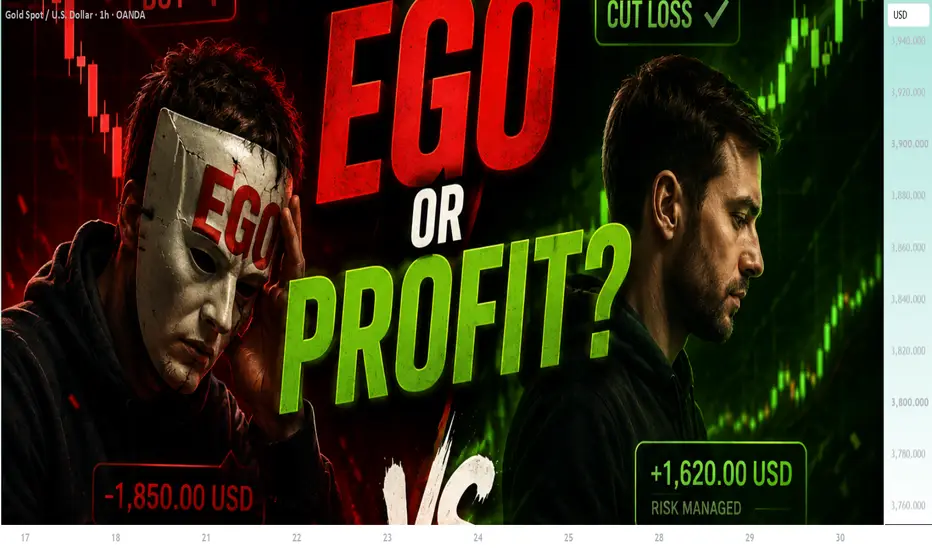
There's a question very few traders dare to ask themselves honestly: "When I'm holding onto this losing trade, am I trying to save my account, or trying to save my ego?"
It sounds similar, but it's actually two completely different things. And confusing these two is the quiet cause behind many blown accounts — not because people lack knowledge, but because they're playing a different game than the one they think they're playing.
Two goals that seem alike but actually conflict
When starting out, everyone assumes the only goal in trading is to make money. But if you closely observe your own behavior in the most stressful moments — when a trade is deeply in the red, when the market moves against your prediction — another goal quietly creeps in: the need to be right.
Needing to profit: making decisions based on probability, cutting losses when a setup is no longer valid, accepting being wrong and exiting quickly.
Needing to be right: holding a trade longer than reasonable just to prove the original analysis wasn't wrong, treating a stop loss as an admission of personal failure.
The problem is these two goals frequently conflict. A skilled trader can be wrong 6 out of 10 times and still profit with good risk management. But if the underlying goal is "I must be right," then every loss gets processed as a threat to the ego, rather than a normal part of probability.
Why this is dangerous
When a losing trade is treated as a personal failure instead of a normal statistical outcome, the brain reacts very differently:
Instead of cutting losses as planned, people start looking for reasons to "wait just a bit longer"
Instead of accepting the original analysis was wrong, people go looking for more news, more indicators to confirm they're right
The heavier the loss, the more threatened the ego becomes, and the stronger the urge to keep holding, "waiting for it to turn around"
This is the root of many classic account blowups — not because the analysis was wrong, but because when wrong, people protected their ego instead of protecting their capital.
Signs you're trading for your ego
A few questions to check yourself:
When a trade goes against your prediction, is your first reaction to review your risk management plan, or to go looking for news/opinions to "prove yourself right"?
Do you feel uncomfortable or embarrassed admitting a losing trade to others?
Do you tend to talk a lot about winning trades but avoid mentioning losing ones?
When moving a stop loss, is the real purpose to adapt to market movement, or just to avoid seeing the word "loss" appear?
If most of your answers lean toward the latter, it's likely your ego is driving your trading decisions more than your system is.
How to separate the two
1. Redefine what makes "a good trade." A good trade is one executed according to the plan and risk management rules — regardless of whether it wins or loses. A bad trade is one that breaks the plan, even if it happens to win. When the standard for evaluating yourself shifts from "outcome" to "process," the need to be right drops significantly because there's nothing left to defend.
2. Journal with honest questions. After each losing trade, instead of asking "why did the market go against me," ask "am I trying to prove something, or am I handling this situation objectively?" Writing down the answer, even briefly, helps reveal recurring patterns over time.
3. Separate your ego from each individual trade. A single trade says nothing about a trader's ability. A system is judged over hundreds of trades, not one transaction. When you view a losing trade as "one data point in a long series" instead of "a verdict on yourself," the urge to be right immediately cools down.
The market doesn't care who's right or wrong — it only reflects supply and demand. Only people attach the meaning of "right/wrong" to each candle, and it's that meaning, not the price movement itself, that causes many traders to hold losing trades too long, keep entering revenge trades, or fail to follow their own plan.
The question worth asking yourself periodically isn't "how do I analyze more accurately," but: am I trading to make money, or trading to feel like I'm good at this? The honest answer to this question is, often, more important than any technical indicator.
It sounds similar, but it's actually two completely different things. And confusing these two is the quiet cause behind many blown accounts — not because people lack knowledge, but because they're playing a different game than the one they think they're playing.
Two goals that seem alike but actually conflict
When starting out, everyone assumes the only goal in trading is to make money. But if you closely observe your own behavior in the most stressful moments — when a trade is deeply in the red, when the market moves against your prediction — another goal quietly creeps in: the need to be right.
Needing to profit: making decisions based on probability, cutting losses when a setup is no longer valid, accepting being wrong and exiting quickly.
Needing to be right: holding a trade longer than reasonable just to prove the original analysis wasn't wrong, treating a stop loss as an admission of personal failure.
The problem is these two goals frequently conflict. A skilled trader can be wrong 6 out of 10 times and still profit with good risk management. But if the underlying goal is "I must be right," then every loss gets processed as a threat to the ego, rather than a normal part of probability.
Why this is dangerous
When a losing trade is treated as a personal failure instead of a normal statistical outcome, the brain reacts very differently:
Instead of cutting losses as planned, people start looking for reasons to "wait just a bit longer"
Instead of accepting the original analysis was wrong, people go looking for more news, more indicators to confirm they're right
The heavier the loss, the more threatened the ego becomes, and the stronger the urge to keep holding, "waiting for it to turn around"
This is the root of many classic account blowups — not because the analysis was wrong, but because when wrong, people protected their ego instead of protecting their capital.
Signs you're trading for your ego
A few questions to check yourself:
When a trade goes against your prediction, is your first reaction to review your risk management plan, or to go looking for news/opinions to "prove yourself right"?
Do you feel uncomfortable or embarrassed admitting a losing trade to others?
Do you tend to talk a lot about winning trades but avoid mentioning losing ones?
When moving a stop loss, is the real purpose to adapt to market movement, or just to avoid seeing the word "loss" appear?
If most of your answers lean toward the latter, it's likely your ego is driving your trading decisions more than your system is.
How to separate the two
1. Redefine what makes "a good trade." A good trade is one executed according to the plan and risk management rules — regardless of whether it wins or loses. A bad trade is one that breaks the plan, even if it happens to win. When the standard for evaluating yourself shifts from "outcome" to "process," the need to be right drops significantly because there's nothing left to defend.
2. Journal with honest questions. After each losing trade, instead of asking "why did the market go against me," ask "am I trying to prove something, or am I handling this situation objectively?" Writing down the answer, even briefly, helps reveal recurring patterns over time.
3. Separate your ego from each individual trade. A single trade says nothing about a trader's ability. A system is judged over hundreds of trades, not one transaction. When you view a losing trade as "one data point in a long series" instead of "a verdict on yourself," the urge to be right immediately cools down.
The market doesn't care who's right or wrong — it only reflects supply and demand. Only people attach the meaning of "right/wrong" to each candle, and it's that meaning, not the price movement itself, that causes many traders to hold losing trades too long, keep entering revenge trades, or fail to follow their own plan.
The question worth asking yourself periodically isn't "how do I analyze more accurately," but: am I trading to make money, or trading to feel like I'm good at this? The honest answer to this question is, often, more important than any technical indicator.

📊 FX | Gold | Crypto
Turning charts into opportunities.
🔍 Volume Analysis
📈 Trend Forecasts
💡 Free Trading Ideas
🌍 Join our growing community:
t.me/+f_vI675IPrQ2N2Q1
Turning charts into opportunities.
🔍 Volume Analysis
📈 Trend Forecasts
💡 Free Trading Ideas
🌍 Join our growing community:
t.me/+f_vI675IPrQ2N2Q1
İlgili yayınlar
Feragatname
Bilgiler ve yayınlar, TradingView tarafından sağlanan veya onaylanan finansal, yatırım, alım satım veya diğer türden tavsiye veya öneriler anlamına gelmez ve teşkil etmez. Kullanım Koşulları bölümünde daha fazlasını okuyun.
📊 FX | Gold | Crypto
Turning charts into opportunities.
🔍 Volume Analysis
📈 Trend Forecasts
💡 Free Trading Ideas
🌍 Join our growing community:
t.me/+f_vI675IPrQ2N2Q1
Turning charts into opportunities.
🔍 Volume Analysis
📈 Trend Forecasts
💡 Free Trading Ideas
🌍 Join our growing community:
t.me/+f_vI675IPrQ2N2Q1
İlgili yayınlar
Feragatname
Bilgiler ve yayınlar, TradingView tarafından sağlanan veya onaylanan finansal, yatırım, alım satım veya diğer türden tavsiye veya öneriler anlamına gelmez ve teşkil etmez. Kullanım Koşulları bölümünde daha fazlasını okuyun.