
Portfolio Education: Strategy Breakdown
1. Core Structure of Portfolio
10% BSV (Vanguard Short-Term ETF)
This portfolio follows the guidelines that Warren Buffett has written in his will for his wife's trust in the 2013 letter to Berkshire Hathaway shareholders. They state that the trustee should invest 90% in a low-cost S&P 500 index fund (VOO), with the remaining 10% invested in a short-term government bonds fund. The basic strategy is to own a major slice of all American businesses that are bound to grow in total. Buffett believes this portfolio is "superior to those attained by most investors - whether pension funds, institutions or individuals."
Role: Dividend Yield, diversification outside traditional assets.
50% Equities (Primary Plays)
Growth + Value core holdings.
TQQQ/Growth: TQQQ/FANG+ is a smart portfolio that consists of 10 of today’s most traded tech giants. It has Meta (META, formerly Facebook), Amazon (AMZN), Apple (AAPL), Netflix (NFLX), Alphabet (GOOGL), Tesla (TSLA), Nvidia (NVDA), Microsoft (MSFT), Advanced Micro Devices (AMD), Snowflake (SNOW) (rotation slot, sometimes replaced by others). I swap SNOW with Broadcom, Baidu, Alibaba, Tencent, Robinhood, or Coinbase depending on index methodology/BTC Cycle.
VTV/Value = Tilted toward financials, energy, healthcare, and industrials. Consists of dividend-paying stocks that could generate constant money flow in the long term. I use APD, CL, EMR, IBM, JNJ, KMB, KO, MMM, PG, and WMT as a leveraged bet.
TQQQ, provides compounding and exposure to economic expansion. TQQQ Breadth: If only 2–3 names are carrying index gains (like NVDA & MSFT), risk of correction is higher.
Value investing is about buying securities for less than their intrinsic value, then holding them until the market recognizes that value. Key Metrics: Price-to-Earnings (P/E) → low P/E may mean undervalued. Price-to-Book (P/B) → useful for banks/asset-heavy firms. Price-to-Sales (P/S) → for low-profit companies. Dividend Yield / Payout Ratio → sustainable income source. PEG Ratio (P/E ÷ Growth) → checks if valuation is fair vs growth rate. Free Cash Flow Yield. (FCF/Market Cap) → shows true cash generation. I would look for 3/6 to be good before buying.
Rule of thumb (forward P/E too high = Risk) adds a macro filter. I prefer a PEG of 2 or less for Large-Caps and 1 or less for Mid-caps. When they pay dividends, I use PEGY over PEG. A ROA >6% and ROE > 8% are very crucial. A strong balance sheet has an Gross Margin > 20~40%, Operating Margin > 5~15%, and a Net Margin 10~20%. Interest Coverage is moat proxy, anything above 3~5 is works. Optionally, FCF is good if >0. P/S < 5, or <20 for Pharmacy/Biotech. P/B < 1.5, better for banks/sector. I avoid small-caps, but when I buy one I first check the Debt/Revenue ratio.
40% Cash/Options/Futures/Futures Options
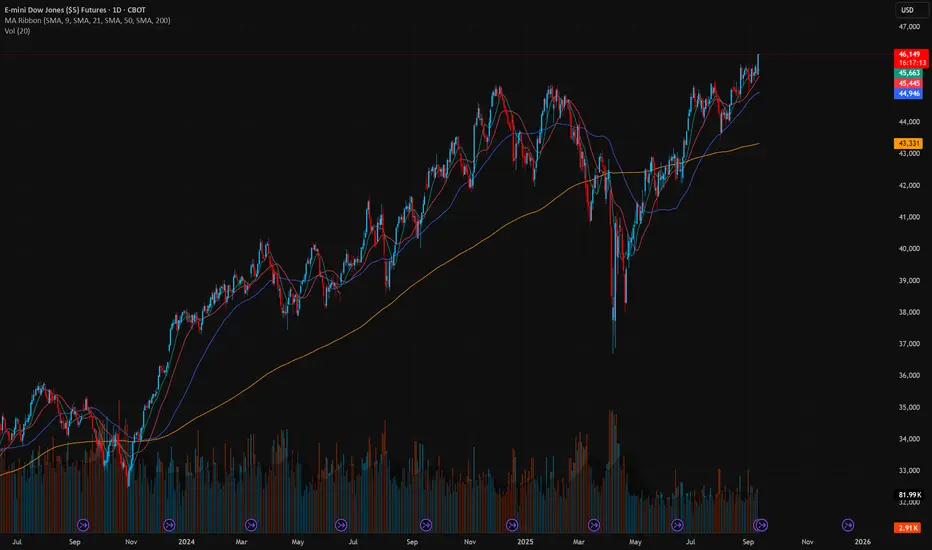
Futures: ES (S&P 500), NQ (Nasdaq), YM (Dow) for intraday or short swing trading.
Options: directional and hedging overlay. Start via the Wheel.
Cash buffer allows tactical pivots (gold, silver, REITs, etc.).
2. Futures Trading (Main Arena)
Preferred Instruments: ES, NQ, YM → highly liquid index futures.
Approach: Funded accounts = less personal margin risk.
Commodities:
Gold: Held overnight in rally phases (safe-haven demand).
Natural Gas: Overnight trades (volatile, seasonally spiky).
⚠️ Key Risk: Overnight NG is notorious for gaps; good to size very small relative to ES/NQ. WTI moves 1 dollar up or down in average every afternoon.
3. Hedging Framework
DXY vs WTI/HO Inverse Play
If DXY rises → WTI/HO usually falls, but edge lies in catching synchronized moves (both rising or falling). Expect the opposite move for WTI that DXY performed the following day, and plan accordingly.
These conditions are more common on “down days,” particularly Thursdays.
Practical Tip: Track inventory reports (EIA on Wed/Thurs) and macro dollar drivers.
Friday Hedge Rule
Buy gold equities (WPM, AEM, etc.) on Friday.
Sell Monday open.
Works best in “inflammatory” macro periods (rate hikes, inflation scares, high valuations).
4. Metals Seasonality
Gold vs Silver Timing
Silver tends to outperform gold:
Dec–Feb: winter demand + industrial rebound.
Jul–Aug: summer volatility + monetary policy lull.
Gold outperforms during inflationary panic or when equities look stretched.
Practical Rule:
Winter/Summer → overweight silver.
Panic macro (e.g., VIX stretched/elevated) → switch to bonds, gold, and other safer assets.
5. REIT Allocation Logic
Optimal Entry Condition: When yields < 2–4%.
Lower yields → cheaper borrowing → REITs rally.
Trend Filter: Only enter if above 21 SMA (trend confirmation).
Style: Slow movers, better for weekly charts & trend following.
Role: Defensive equity exposure; bond proxy with dividend yield.
6. Options Overlay
Tactical Use:
Selling premium (income) in high IV environments.
Buying calls/puts for directional plays (funded futures act).
Macro Filter:
High VIX → collect more premium. I would match my % allocation to VIX levels.
Earnings season → buy options for directional volatility plays.
7. Portfolio Risk Management
Sizing:
10% → BSV.
50% → Equities (core growth + Value/REITs).
40% → Tactical cash (options/futures/hedges). IEF/TLT 40/60 Portfolio can work as well.
Correlation Awareness:
ES/NQ/YM → move together, pick one to trade; hedge with DXY, WTI, Gold.
Metals and REITs can diversify during equity drawdowns.
Crypto is uncorrelated in some regimes, but can collapse in risk-off (-70%). Altcoins peak either during summer or during winter, check before hand. Meme-coins fall off -99% every 2 years, so I would check for something else to invest.
Other:
Good for V-shaped Corrections: 40% PGR, FICO 22%, LLY 16%, VST 10%, NRG 4.5%, ACGL 4.5%, IRM 3%.
Better than holding APY = BOXX 10%, BIL 2%, TBIL 13%, BILS 29%, SGOV 46%.
ETF: CSPX.AS 30%, IUT.L 20%, ISX5.L 20%, IWDA.L 25%, EIMI.L 5%.
Execution Cadence:
Daily: ES/NQ/YM futures.
Weekly: REIT trend checks.
Seasonal: Silver vs Gold switches.
Macro triggers: TLT hedge when valuation chatter spikes.
1. Core Structure of Portfolio
10% BSV (Vanguard Short-Term ETF)
This portfolio follows the guidelines that Warren Buffett has written in his will for his wife's trust in the 2013 letter to Berkshire Hathaway shareholders. They state that the trustee should invest 90% in a low-cost S&P 500 index fund (VOO), with the remaining 10% invested in a short-term government bonds fund. The basic strategy is to own a major slice of all American businesses that are bound to grow in total. Buffett believes this portfolio is "superior to those attained by most investors - whether pension funds, institutions or individuals."
Role: Dividend Yield, diversification outside traditional assets.
50% Equities (Primary Plays)
Growth + Value core holdings.
TQQQ/Growth: TQQQ/FANG+ is a smart portfolio that consists of 10 of today’s most traded tech giants. It has Meta (META, formerly Facebook), Amazon (AMZN), Apple (AAPL), Netflix (NFLX), Alphabet (GOOGL), Tesla (TSLA), Nvidia (NVDA), Microsoft (MSFT), Advanced Micro Devices (AMD), Snowflake (SNOW) (rotation slot, sometimes replaced by others). I swap SNOW with Broadcom, Baidu, Alibaba, Tencent, Robinhood, or Coinbase depending on index methodology/BTC Cycle.
VTV/Value = Tilted toward financials, energy, healthcare, and industrials. Consists of dividend-paying stocks that could generate constant money flow in the long term. I use APD, CL, EMR, IBM, JNJ, KMB, KO, MMM, PG, and WMT as a leveraged bet.
TQQQ, provides compounding and exposure to economic expansion. TQQQ Breadth: If only 2–3 names are carrying index gains (like NVDA & MSFT), risk of correction is higher.
Value investing is about buying securities for less than their intrinsic value, then holding them until the market recognizes that value. Key Metrics: Price-to-Earnings (P/E) → low P/E may mean undervalued. Price-to-Book (P/B) → useful for banks/asset-heavy firms. Price-to-Sales (P/S) → for low-profit companies. Dividend Yield / Payout Ratio → sustainable income source. PEG Ratio (P/E ÷ Growth) → checks if valuation is fair vs growth rate. Free Cash Flow Yield. (FCF/Market Cap) → shows true cash generation. I would look for 3/6 to be good before buying.
Rule of thumb (forward P/E too high = Risk) adds a macro filter. I prefer a PEG of 2 or less for Large-Caps and 1 or less for Mid-caps. When they pay dividends, I use PEGY over PEG. A ROA >6% and ROE > 8% are very crucial. A strong balance sheet has an Gross Margin > 20~40%, Operating Margin > 5~15%, and a Net Margin 10~20%. Interest Coverage is moat proxy, anything above 3~5 is works. Optionally, FCF is good if >0. P/S < 5, or <20 for Pharmacy/Biotech. P/B < 1.5, better for banks/sector. I avoid small-caps, but when I buy one I first check the Debt/Revenue ratio.
40% Cash/Options/Futures/Futures Options
Futures: ES (S&P 500), NQ (Nasdaq), YM (Dow) for intraday or short swing trading.
Options: directional and hedging overlay. Start via the Wheel.
Cash buffer allows tactical pivots (gold, silver, REITs, etc.).
2. Futures Trading (Main Arena)
Preferred Instruments: ES, NQ, YM → highly liquid index futures.
Approach: Funded accounts = less personal margin risk.
Commodities:
Gold: Held overnight in rally phases (safe-haven demand).
Natural Gas: Overnight trades (volatile, seasonally spiky).
⚠️ Key Risk: Overnight NG is notorious for gaps; good to size very small relative to ES/NQ. WTI moves 1 dollar up or down in average every afternoon.
3. Hedging Framework
DXY vs WTI/HO Inverse Play
If DXY rises → WTI/HO usually falls, but edge lies in catching synchronized moves (both rising or falling). Expect the opposite move for WTI that DXY performed the following day, and plan accordingly.
These conditions are more common on “down days,” particularly Thursdays.
Practical Tip: Track inventory reports (EIA on Wed/Thurs) and macro dollar drivers.
Friday Hedge Rule
Buy gold equities (WPM, AEM, etc.) on Friday.
Sell Monday open.
Works best in “inflammatory” macro periods (rate hikes, inflation scares, high valuations).
4. Metals Seasonality
Gold vs Silver Timing
Silver tends to outperform gold:
Dec–Feb: winter demand + industrial rebound.
Jul–Aug: summer volatility + monetary policy lull.
Gold outperforms during inflationary panic or when equities look stretched.
Practical Rule:
Winter/Summer → overweight silver.
Panic macro (e.g., VIX stretched/elevated) → switch to bonds, gold, and other safer assets.
5. REIT Allocation Logic
Optimal Entry Condition: When yields < 2–4%.
Lower yields → cheaper borrowing → REITs rally.
Trend Filter: Only enter if above 21 SMA (trend confirmation).
Style: Slow movers, better for weekly charts & trend following.
Role: Defensive equity exposure; bond proxy with dividend yield.
6. Options Overlay
Tactical Use:
Selling premium (income) in high IV environments.
Buying calls/puts for directional plays (funded futures act).
Macro Filter:
High VIX → collect more premium. I would match my % allocation to VIX levels.
Earnings season → buy options for directional volatility plays.
7. Portfolio Risk Management
Sizing:
10% → BSV.
50% → Equities (core growth + Value/REITs).
40% → Tactical cash (options/futures/hedges). IEF/TLT 40/60 Portfolio can work as well.
Correlation Awareness:
ES/NQ/YM → move together, pick one to trade; hedge with DXY, WTI, Gold.
Metals and REITs can diversify during equity drawdowns.
Crypto is uncorrelated in some regimes, but can collapse in risk-off (-70%). Altcoins peak either during summer or during winter, check before hand. Meme-coins fall off -99% every 2 years, so I would check for something else to invest.
Other:
Good for V-shaped Corrections: 40% PGR, FICO 22%, LLY 16%, VST 10%, NRG 4.5%, ACGL 4.5%, IRM 3%.
Better than holding APY = BOXX 10%, BIL 2%, TBIL 13%, BILS 29%, SGOV 46%.
ETF: CSPX.AS 30%, IUT.L 20%, ISX5.L 20%, IWDA.L 25%, EIMI.L 5%.
Execution Cadence:
Daily: ES/NQ/YM futures.
Weekly: REIT trend checks.
Seasonal: Silver vs Gold switches.
Macro triggers: TLT hedge when valuation chatter spikes.

Feragatname
Bilgiler ve yayınlar, TradingView tarafından sağlanan veya onaylanan finansal, yatırım, alım satım veya diğer türden tavsiye veya öneriler anlamına gelmez ve teşkil etmez. Kullanım Koşulları bölümünde daha fazlasını okuyun.
Feragatname
Bilgiler ve yayınlar, TradingView tarafından sağlanan veya onaylanan finansal, yatırım, alım satım veya diğer türden tavsiye veya öneriler anlamına gelmez ve teşkil etmez. Kullanım Koşulları bölümünde daha fazlasını okuyun.