B3AR's Impulse System
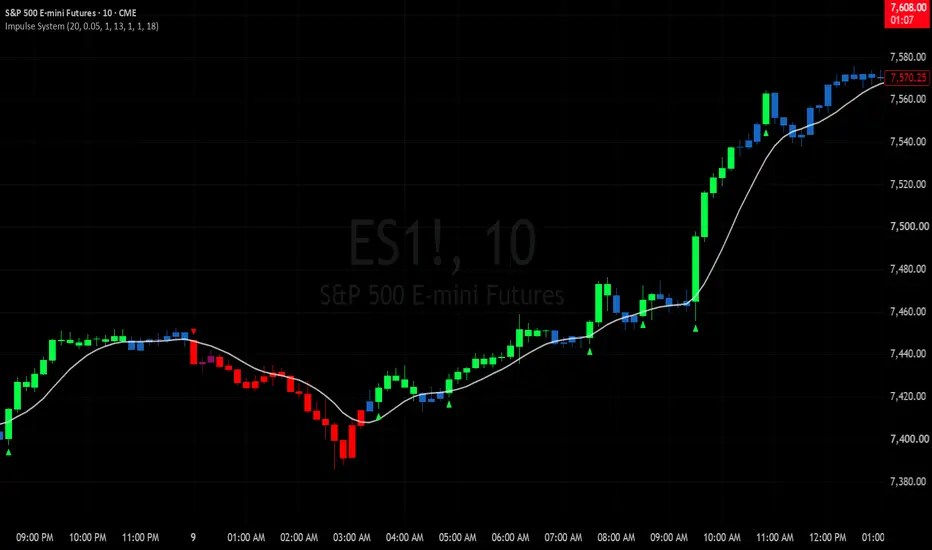
B3AR's Impulse System
A modern take on Dr. Alexander Elder's Impulse System. It reads three layers of momentum: Near-term Trend direction, Momentum strength and Trend Velocity. Each candle is colored by whether they agree. Trend and momentum decide the direction. Trend Velocity adds confirmation by separating impulses all three layers agree on from ones where the adaptive trend disagrees.
─────────────────────────────────────
THE ORIGINAL IDEA
─────────────────────────────────────
Elder's Impulse System, introduced in Come Into My Trading Room, colors bars using two readings: the slope of a 13-period EMA for trend, and the slope of the MACD histogram for momentum. Bars are green when both rise, red when both fall, and blue otherwise. Elder used the colors as a filter rather than as entry signals: no shorting on green, no buying on red.
This version keeps that basic structure, including the blue neutral state, and changes three things:
─────────────────────────────────────
THE THREE LAYERS
─────────────────────────────────────
1. Short Trend
Slope of an Arnaud Legoux Moving Average. The slope is measured relative to the instrument's average bar size (ATR). When the slope is too small to call, the trend counts as flat and the candle stays neutral.
2. Momentum
Triple layered momentum calculation with volatility adaptive lookback. It measures three gaps: price vs. a zero lag EMA, the ZLEMA vs. a medium length DEMA, and the medium vs. a slow DEMA. Each gap is scored, combined, and normalized. Momentum counts as rising or falling based on the bar-to-bar change in that reading.
3. Trend Velocity
The direction of a Kaufman-style adaptive moving average. It uses the Efficiency Ratio to measure how cleanly price is moving. In a clean move the average follows price closely. In chop it barely moves. Trend Velocity never starts an impulse on its own. When trend and momentum already agree, it decides whether the impulse is confirmed (bright color) or unconfirmed (darker color).
─────────────────────────────────────
CANDLE COLORS
─────────────────────────────────────
With Use Trend Velocity turned off, every impulse uses the bright colors, which matches the original two-layer system.
─────────────────────────────────────
FRESH VS EXTENDED
─────────────────────────────────────
The first bar of each impulse is checked against momentum's overbought and oversold levels.
─────────────────────────────────────
HOW TO USE IT
─────────────────────────────────────
Like the original, it works as a filter on your own entries, not as a standalone signal.
─────────────────────────────────────
SETTINGS
─────────────────────────────────────
A modern take on Dr. Alexander Elder's Impulse System. It reads three layers of momentum: Near-term Trend direction, Momentum strength and Trend Velocity. Each candle is colored by whether they agree. Trend and momentum decide the direction. Trend Velocity adds confirmation by separating impulses all three layers agree on from ones where the adaptive trend disagrees.
─────────────────────────────────────
THE ORIGINAL IDEA
─────────────────────────────────────
Elder's Impulse System, introduced in Come Into My Trading Room, colors bars using two readings: the slope of a 13-period EMA for trend, and the slope of the MACD histogram for momentum. Bars are green when both rise, red when both fall, and blue otherwise. Elder used the colors as a filter rather than as entry signals: no shorting on green, no buying on red.
This version keeps that basic structure, including the blue neutral state, and changes three things:
- Each layer uses an adaptive calculation in place of a fixed EMA or MACD
- A dead zone on the trend and a confirmation step on momentum keep the colors from flipping on small moves
- A third layer, Trend Velocity, splits each impulse into confirmed and unconfirmed
─────────────────────────────────────
THE THREE LAYERS
─────────────────────────────────────
1. Short Trend
Slope of an Arnaud Legoux Moving Average. The slope is measured relative to the instrument's average bar size (ATR). When the slope is too small to call, the trend counts as flat and the candle stays neutral.
2. Momentum
Triple layered momentum calculation with volatility adaptive lookback. It measures three gaps: price vs. a zero lag EMA, the ZLEMA vs. a medium length DEMA, and the medium vs. a slow DEMA. Each gap is scored, combined, and normalized. Momentum counts as rising or falling based on the bar-to-bar change in that reading.
3. Trend Velocity
The direction of a Kaufman-style adaptive moving average. It uses the Efficiency Ratio to measure how cleanly price is moving. In a clean move the average follows price closely. In chop it barely moves. Trend Velocity never starts an impulse on its own. When trend and momentum already agree, it decides whether the impulse is confirmed (bright color) or unconfirmed (darker color).
─────────────────────────────────────
CANDLE COLORS
─────────────────────────────────────
- Bright green: Confirmed bullish. Trend, momentum and Trend Velocity are all up.
- Teal: Unconfirmed bullish. Trend and momentum are up, Trend Velocity is not.
- Blue: Neutral. The trend is flat, or trend and momentum disagree.
- Dark magenta: Unconfirmed bearish. Trend and momentum are down, Trend Velocity is not.
- Red: Confirmed bearish. Trend, momentum and Trend Velocity are all down.
With Use Trend Velocity turned off, every impulse uses the bright colors, which matches the original two-layer system.
─────────────────────────────────────
FRESH VS EXTENDED
─────────────────────────────────────
The first bar of each impulse is checked against momentum's overbought and oversold levels.
- Fresh: The impulse started before momentum was stretched. Marked with a triangle.
- Extended: A bullish impulse that started with momentum already overbought, or a bearish impulse that started with momentum already oversold. Marked with a small circle, and the whole impulse is drawn faded.
─────────────────────────────────────
HOW TO USE IT
─────────────────────────────────────
Like the original, it works as a filter on your own entries, not as a standalone signal.
- Green or teal: A bullish impulse. Elder's rule applies: avoid shorting.
- Red or dark magenta: A bearish impulse. Avoid buying.
- Blue: No impulse. Neither side is restricted.
- Bright vs. darker: Bright means all three layers agree. Darker means Trend Velocity disagrees, because the adaptive average hasn't turned with the other two yet.
- Fresh vs. extended: A fresh start began before momentum was stretched. An extended start began after momentum had already run.
─────────────────────────────────────
SETTINGS
─────────────────────────────────────
- Short Trend: Length of the trend line.
- Trend Dead Zone: Flat Threshold (how steep the trend must be to count as up or down) and Slope Lookback.
- Momentum: Length. This is the base length; it adjusts on its own with volatility.
- Momentum Hysteresis: Min Momentum Move and Confirmation Bars, which stop one-bar flips.
- Fresh vs Extended: Turn classification, adaptive levels and start markers on or off.
- Trend Velocity Confirmation: Turn the third layer on or off, and set its Length.
- Display: Candle colors and the moving average line.

discord.gg/REapC6SGtz
b3artrades@gmail.com
b3artrades@gmail.com
Feragatname
Bilgiler ve yayınlar, TradingView tarafından sağlanan veya onaylanan finansal, yatırım, alım satım veya diğer türden tavsiye veya öneriler anlamına gelmez ve teşkil etmez. Kullanım Koşulları bölümünde daha fazlasını okuyun.
discord.gg/REapC6SGtz
b3artrades@gmail.com
b3artrades@gmail.com
Feragatname
Bilgiler ve yayınlar, TradingView tarafından sağlanan veya onaylanan finansal, yatırım, alım satım veya diğer türden tavsiye veya öneriler anlamına gelmez ve teşkil etmez. Kullanım Koşulları bölümünde daha fazlasını okuyun.