Güncellendi
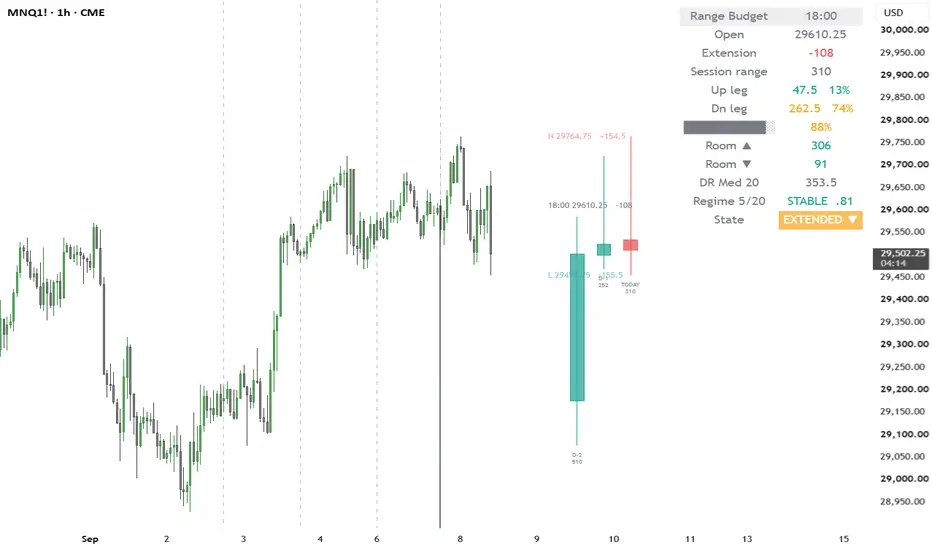
Range Budget - Anchored Extension and Daily Range Exhaustion
============================================================
DESCRIPTION
============================================================
Range Budget measures how much of a typical daily range has
already been delivered, and how far the current directional
leg has travelled, so that a level can be assessed on distance
as well as location.
The problem it addresses is a common one in level-based
trading. A level is identified in advance, price arrives, and
the setup is taken without accounting for how far price
travelled to get there. A level reached after a move that has
already covered a full day's range is a materially different
proposition from the same level reached after a quiet drift,
even though the level itself is identical. This script
quantifies that difference.
WHAT IT CALCULATES
Anchor and extension
The anchor is a chosen session open: the CME open at 18:00,
midnight, 08:30, or the regular session open at 09:30, all in
the selected timezone. The anchor is detected by tracking
minutes elapsed since the anchor time with wraparound across
midnight; a decrease in that value marks a new anchor period.
An optional gap check re-anchors at the Sunday reopen rather
than carrying the prior Friday value through the weekend.
Extension is the signed distance in points from the anchor
open to the current close. Session high and session low are
tracked from the anchor forward.
Leg travel
Up leg is the distance from the session low to the current
close. Down leg is the distance from the session high to the
current close. These are reported separately from extension
because extension understates a move that opened, reversed,
and then ran. A session that opens, falls forty points and
rallies eighty shows an extension of plus forty while the leg
being entered is eighty points old. The two readings answer
different questions: extension describes location relative to
the open, leg travel describes how much of the current move
has already occurred.
Daily range statistic
The denominator is a trailing statistic of daily high minus
low, taken from completed daily bars only. A one-bar offset is
applied inside the higher timeframe request so the forming day
is excluded from its own benchmark. The statistic is constant
intraday by construction.
Three methods are available. The default is the median rather
than the mean. Daily range distributions are right skewed and
a single outlier session, or a holiday half-day, shifts a mean
for the entire length of the window while barely moving a
median. Mean and exponential options are provided for users
who prefer them.
Range basis can be set to the full exchange day or to the
regular session only, which changes both the statistic and the
current day measurement consistently.
Budget and projections
Budget is today's realised daily range expressed as a
percentage of the denominator, displayed as a ten segment
gauge. Projections are drawn at the day low plus the
denominator and the day high minus the denominator. Room
reports the distance in points from current price to each
projection. This formulation is used in preference to
projecting symmetrically from the open because it accounts for
what the session has already delivered rather than assuming
the open sits at the centre of the eventual range.
Regime ratio
A rolling median range over a short window is divided by the
same statistic over the long window. Volatility expands far
faster than a fixed lookback adapts, so on the first day of a
changed environment the long window is still describing the
previous one. The ratio detects that condition immediately
rather than after the window has turned over. Values above the
expansion threshold indicate the short window is the more
representative reading.
State
The state row combines budget and regime. Budget beyond one
hundred percent is ambiguous in isolation: it can mean the day
is finished, or it can mean the denominator is stale. When
budget exceeds the exhaustion threshold and the regime ratio
is simultaneously elevated, the state reports expansion rather
than exhaustion, because the appropriate reading in that case
is a trending environment rather than a completed one.
Pullback levels
Optional retracement levels are drawn at configurable
percentages of the leg delivered since the anchor, measured
back from the extreme in the direction of travel.
WHAT IT DRAWS
A vertical line marking the anchor boundary, with a
configurable number of prior boundaries retained as session
separators.
A horizontal line at the anchor open, plus dotted session high
and low lines, each labelled with price and points from the
open. These are drawn for the current anchor period only and
are rebuilt at each new anchor, so historical periods do not
accumulate on the chart.
Three compact daily candles to the right of the last bar
showing the forming day and the two prior days. They are drawn
at true price levels, so they also serve as visual references
for the previous day high, low and close. The forming day
carries a dashed border and updates live.
Optional projection and retracement lines, both off by
default.
A panel reporting anchor open, extension, session range, up
and down leg with their share of the denominator, the budget
gauge, room to each projection, the denominator with its
method and window stated, the regime ratio, and the state.
Leg cells are colour graded against the exhaustion thresholds.
SETTINGS NOTES
Three separate lookback windows are used and they drive
different things. The slow window drives the denominator, the
gauge, the projections and room. The fast window drives only
the regime ratio. The context window drives only the minimum,
maximum and quartile rows, where responsiveness does not
matter.
A manual denominator override is provided. It exists for the
first session after a clear regime break, when the operator
knows the environment has changed and the window has not yet
caught up.
READING IT
The leg readings graded against the denominator are the
primary output. A leg at or beyond one hundred percent means a
full typical day's range has been delivered in one direction.
Room reports whether a target has space remaining even if the
directional read is correct.
The denominator is a range statistic, not a displacement
statistic. It describes the height of the envelope a session
typically builds, not how far price travels within it, and net
close to close movement is normally much smaller. A setup
requiring a large fraction of the typical envelope in a single
directional leg is an expansion day proposition rather than a
normal day proposition.
LIMITATIONS
This is a context readout. It produces no entries, no
directional bias and no filtering output, and it is not
intended to confirm or reject a setup on its own.
Leg readings measure distance, not recency or velocity. A leg
reset occurs whenever a new session extreme is made, so a leg
built slowly overnight and a leg built rapidly in the last
half hour produce identical readings.
No time of day weighting is applied. A given percentage of
range consumed early in a session and the same percentage late
in a session are not equivalent situations, and the script
does not currently distinguish them.
The denominator lags a genuine volatility regime change by at
least one session. The regime ratio shortens that lag but does
not eliminate it.
Compact daily candles are drawn at true price levels, so on a
strongly zoomed intraday chart the prior days may fall outside
the visible price scale.
DESCRIPTION
============================================================
Range Budget measures how much of a typical daily range has
already been delivered, and how far the current directional
leg has travelled, so that a level can be assessed on distance
as well as location.
The problem it addresses is a common one in level-based
trading. A level is identified in advance, price arrives, and
the setup is taken without accounting for how far price
travelled to get there. A level reached after a move that has
already covered a full day's range is a materially different
proposition from the same level reached after a quiet drift,
even though the level itself is identical. This script
quantifies that difference.
WHAT IT CALCULATES
Anchor and extension
The anchor is a chosen session open: the CME open at 18:00,
midnight, 08:30, or the regular session open at 09:30, all in
the selected timezone. The anchor is detected by tracking
minutes elapsed since the anchor time with wraparound across
midnight; a decrease in that value marks a new anchor period.
An optional gap check re-anchors at the Sunday reopen rather
than carrying the prior Friday value through the weekend.
Extension is the signed distance in points from the anchor
open to the current close. Session high and session low are
tracked from the anchor forward.
Leg travel
Up leg is the distance from the session low to the current
close. Down leg is the distance from the session high to the
current close. These are reported separately from extension
because extension understates a move that opened, reversed,
and then ran. A session that opens, falls forty points and
rallies eighty shows an extension of plus forty while the leg
being entered is eighty points old. The two readings answer
different questions: extension describes location relative to
the open, leg travel describes how much of the current move
has already occurred.
Daily range statistic
The denominator is a trailing statistic of daily high minus
low, taken from completed daily bars only. A one-bar offset is
applied inside the higher timeframe request so the forming day
is excluded from its own benchmark. The statistic is constant
intraday by construction.
Three methods are available. The default is the median rather
than the mean. Daily range distributions are right skewed and
a single outlier session, or a holiday half-day, shifts a mean
for the entire length of the window while barely moving a
median. Mean and exponential options are provided for users
who prefer them.
Range basis can be set to the full exchange day or to the
regular session only, which changes both the statistic and the
current day measurement consistently.
Budget and projections
Budget is today's realised daily range expressed as a
percentage of the denominator, displayed as a ten segment
gauge. Projections are drawn at the day low plus the
denominator and the day high minus the denominator. Room
reports the distance in points from current price to each
projection. This formulation is used in preference to
projecting symmetrically from the open because it accounts for
what the session has already delivered rather than assuming
the open sits at the centre of the eventual range.
Regime ratio
A rolling median range over a short window is divided by the
same statistic over the long window. Volatility expands far
faster than a fixed lookback adapts, so on the first day of a
changed environment the long window is still describing the
previous one. The ratio detects that condition immediately
rather than after the window has turned over. Values above the
expansion threshold indicate the short window is the more
representative reading.
State
The state row combines budget and regime. Budget beyond one
hundred percent is ambiguous in isolation: it can mean the day
is finished, or it can mean the denominator is stale. When
budget exceeds the exhaustion threshold and the regime ratio
is simultaneously elevated, the state reports expansion rather
than exhaustion, because the appropriate reading in that case
is a trending environment rather than a completed one.
Pullback levels
Optional retracement levels are drawn at configurable
percentages of the leg delivered since the anchor, measured
back from the extreme in the direction of travel.
WHAT IT DRAWS
A vertical line marking the anchor boundary, with a
configurable number of prior boundaries retained as session
separators.
A horizontal line at the anchor open, plus dotted session high
and low lines, each labelled with price and points from the
open. These are drawn for the current anchor period only and
are rebuilt at each new anchor, so historical periods do not
accumulate on the chart.
Three compact daily candles to the right of the last bar
showing the forming day and the two prior days. They are drawn
at true price levels, so they also serve as visual references
for the previous day high, low and close. The forming day
carries a dashed border and updates live.
Optional projection and retracement lines, both off by
default.
A panel reporting anchor open, extension, session range, up
and down leg with their share of the denominator, the budget
gauge, room to each projection, the denominator with its
method and window stated, the regime ratio, and the state.
Leg cells are colour graded against the exhaustion thresholds.
SETTINGS NOTES
Three separate lookback windows are used and they drive
different things. The slow window drives the denominator, the
gauge, the projections and room. The fast window drives only
the regime ratio. The context window drives only the minimum,
maximum and quartile rows, where responsiveness does not
matter.
A manual denominator override is provided. It exists for the
first session after a clear regime break, when the operator
knows the environment has changed and the window has not yet
caught up.
READING IT
The leg readings graded against the denominator are the
primary output. A leg at or beyond one hundred percent means a
full typical day's range has been delivered in one direction.
Room reports whether a target has space remaining even if the
directional read is correct.
The denominator is a range statistic, not a displacement
statistic. It describes the height of the envelope a session
typically builds, not how far price travels within it, and net
close to close movement is normally much smaller. A setup
requiring a large fraction of the typical envelope in a single
directional leg is an expansion day proposition rather than a
normal day proposition.
LIMITATIONS
This is a context readout. It produces no entries, no
directional bias and no filtering output, and it is not
intended to confirm or reject a setup on its own.
Leg readings measure distance, not recency or velocity. A leg
reset occurs whenever a new session extreme is made, so a leg
built slowly overnight and a leg built rapidly in the last
half hour produce identical readings.
No time of day weighting is applied. A given percentage of
range consumed early in a session and the same percentage late
in a session are not equivalent situations, and the script
does not currently distinguish them.
The denominator lags a genuine volatility regime change by at
least one session. The regime ratio shortens that lag but does
not eliminate it.
Compact daily candles are drawn at true price levels, so on a
strongly zoomed intraday chart the prior days may fall outside
the visible price scale.
Sürüm Notları
Added points cumulative total for Asian/ London session. 
Hermetic Trader · "What gets measured gets managed."
hermetictrader.com
hermetictrader.com
Feragatname
Bilgiler ve yayınlar, TradingView tarafından sağlanan veya onaylanan finansal, yatırım, alım satım veya diğer türden tavsiye veya öneriler anlamına gelmez ve teşkil etmez. Kullanım Koşulları bölümünde daha fazlasını okuyun.
Hermetic Trader · "What gets measured gets managed."
hermetictrader.com
hermetictrader.com
Feragatname
Bilgiler ve yayınlar, TradingView tarafından sağlanan veya onaylanan finansal, yatırım, alım satım veya diğer türden tavsiye veya öneriler anlamına gelmez ve teşkil etmez. Kullanım Koşulları bölümünde daha fazlasını okuyun.