RaidShift - Liquidity to FVG Reversal Engine [UgurTash]
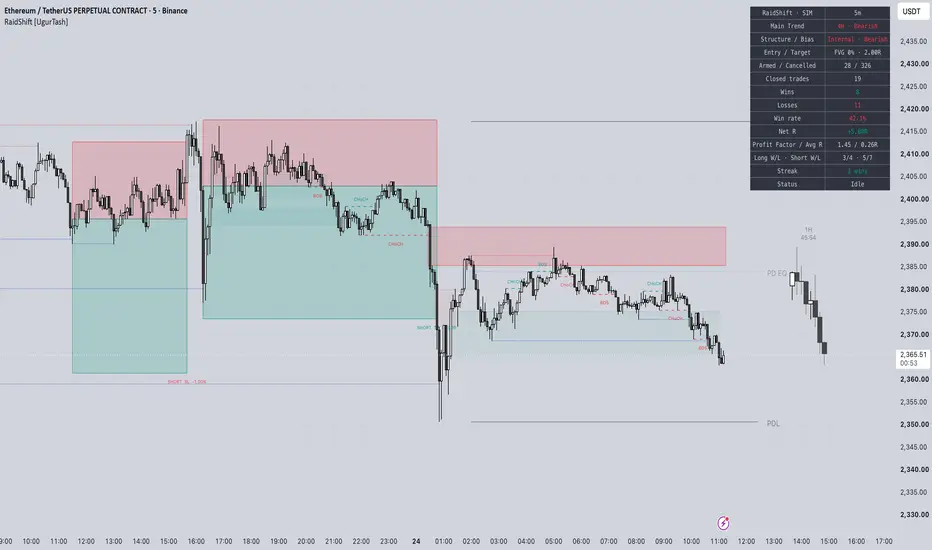
RAIDSHIFT — Liquidity, Market Structure & FVG Reversal Framework
By UgurTash
OVERVIEW
RaidShift is an overlay indicator built around a structured reversal sequence:
Liquidity Raid → Market Structure Shift → Entry Confirmation
It brings liquidity levels, CHoCH/BOS structure, Fair Value Gaps, trade planning, higher-timeframe context, alerts, and simulated performance tracking into a single chart environment.
The purpose is to make the conditions behind a setup visible and consistent. A liquidity sweep alone is not treated as a completed trade signal. RaidShift follows the subsequent structure and entry conditions before qualifying a setup.
1. LIQUIDITY DETECTION
RaidShift identifies potential liquidity levels from confirmed pivot highs and lows.
• Buyside liquidity is tracked above pivot highs.
• Sellside liquidity is tracked below pivot lows.
• Once price takes a pool, that pool is retired from future setup selection.
Three raid modes are available:
Wick Rejection
Price moves beyond a liquidity level and closes back inside it. This identifies a rejection of the swept level.
Close-Through Reversal
Price closes beyond the liquidity level. The indicator then waits for a subsequent structure shift in the opposite direction, looking for a potential failed breakout.
Both
Either raid type can begin the setup sequence.
Raid penetration, rejection requirements, and close-through invalidation buffers can be adjusted. When both directions qualify on the same candle, the indicator avoids starting a new setup from that ambiguous event.
2. MARKET STRUCTURE CONFIRMATION
After a qualifying raid, RaidShift waits for a structure confirmation on a later closed candle.
The structure engine supports:
• Internal structure for shorter-term movements.
• Swing structure for broader market movements.
• Adjustable structure lengths.
• CHoCH and BOS drawings.
• A CHoCH-only option under the Legacy structure rule.
Two setup confirmation rules are available:
Legacy CHoCH / BOS
Uses the indicator’s ongoing market structure classification. With CHoCH-only enabled, continuation BOS events do not qualify as reversal confirmations.
Raid-Bound Structure
Freezes the relevant available, unbroken structure reference when the raid occurs and requires a subsequent closing break of that level. This is a raid-specific structure shift and is not necessarily a globally classified CHoCH.
Separate waiting limits control how long a setup may remain valid between the raid, structure confirmation, and entry stages.
3. FAIR VALUE GAPS
RaidShift detects bullish and bearish three-candle Fair Value Gaps and can display them directly on the chart.
Available controls include:
• Automatic gap filtering.
• Minimum gap height measured in ATR.
• Bullish and bearish zone colors.
• Entry-level drawings.
• The number of FVGs retained in memory.
In FVG Retracement mode, the selected gap must belong to the qualifying post-raid structure sequence. Invalidated gaps are excluded from entry selection.
4. ENTRY MODES
FVG Retracement
The indicator waits for price to return to a selected level inside the qualifying FVG.
Available entry depths:
• 0% — Proximal edge.
• 25%.
• 50% — Consequent Encroachment, or the midpoint.
• 75%.
• 100% — Distal edge.
• Custom depth.
A shallower entry generally requires less retracement, while a deeper entry changes the entry price and stop distance but may remain unfilled. Pending entries expire when their waiting limit is exceeded and can be cancelled when invalidating conditions occur.
CHoCH Candle Close
The indicator uses the closing price of the candle that confirms the selected structure shift instead of waiting for an FVG retracement. The remaining setup conditions and enabled filters still apply.
5. STOP-LOSS AND TARGETS
The initial stop is placed beyond the tracked raid extreme, with optional ATR and tick buffers.
Three target modes are available:
R Multiple
Places the target at a selected multiple of the initial risk distance.
Opposite Liquidity
Uses the nearest retained, unswept opposing liquidity pool beyond the entry. An optional ATR pullback places the target slightly before that pool.
The target must satisfy the selected minimum reward-to-risk requirement after the pullback adjustment. If the nearest pool is too close, or no suitable pool exists, the setup is rejected. The engine does not skip a nearby pool to select a more distant first target.
Percent Gain
Places the target at a selected percentage distance from entry. The resulting R multiple depends on the stop distance.
Optional risk and reward boxes display the planned trade levels. Users can show all armed setups or display drawings only after an entry fills.
6. OPTIONAL SETUP FILTERS
Filters can be enabled individually:
Higher-Timeframe Trend Alignment
Requires the setup direction to agree with the configured higher-timeframe trend. The trend calculation uses completed higher-timeframe candles and considers price relative to an EMA together with the EMA’s direction. Ranging conditions can be allowed separately.
Discount / Premium
Evaluates the entry location within the dealing range defined by confirmed swing levels.
Maximum Risk in ATR
Rejects setups whose initial stop distance exceeds the selected ATR limit.
SMT Divergence
Requires divergence against an explicitly selected comparison symbol. An empty comparison field does not automatically select ETH or another asset. When SMT is required, missing or unaligned comparison data does not qualify the setup.
Session / Killzone Filter
Restricts setup qualification to the configured time windows. Session inputs use New York time.
Filters change which setups qualify. Enabling more filters does not automatically improve performance.
7. OPTIONAL TRADE MANAGEMENT
RaidShift includes simulated trade-management controls:
• Move the stop to breakeven after a selected R threshold.
• Take partial profit at the first target.
• Manage the remaining position toward a second target.
• Activate a percentage-based trailing stop after a selected R threshold.
• Restrict the engine to one armed or active trade at a time.
Partial exits use weighted R results to account for the portion closed at each exit.
These settings can materially change the distribution of wins, losses, and average returns. They should be evaluated together with the entry and target configuration.
8. HIGHER-TIMEFRAME CANDLE BLOCK
A separate candle block displays higher-timeframe candles to the right of the current price action.
Customization includes:
• Automatic or manual timeframe selection.
• Number of candles displayed.
• Distance from the current chart candles.
• Candle width and spacing.
• Optional candle midpoint lines.
• A closing countdown.
• Independent bullish and bearish Body colors.
• Independent bullish and bearish Borders colors.
• Independent bullish and bearish Wick colors.
• Text color.
The selected candle-block timeframe must be higher than the chart timeframe.
The current higher-timeframe candle develops as new price data arrives. Its body, wick, and countdown can therefore change before that candle closes.
9. PREVIOUS-DAY LEVELS
RaidShift can display:
• Previous Day High.
• Previous Day Low.
• The midpoint between those levels.
• Optional labels, including day and date information.
Line color, width, and extension distance are adjustable. These levels provide additional visual context alongside liquidity and structure.
10. INFORMATION AND STATISTICS PANEL
The panel combines market context, setup status, and simulated results.
Depending on the selected configuration, it displays information such as:
• Higher-timeframe trend.
• Structure and directional bias.
• Entry and target mode.
• Armed and cancelled setups.
• Closed trades.
• Wins and losses.
• Win rate.
• Cumulative R.
• Profit factor and average R.
• Long and short results.
• Streak and current setup status.
R represents the trade’s initial planned risk distance. A +2R result is twice that initial risk; a −1R result is a loss equal to that risk.
Drawing limits affect how many historical objects remain visible. They do not restrict the statistics to only the drawings currently shown.
11. ALERTS
RaidShift provides alerts for key events, including:
• Buyside and sellside liquidity raids.
• Bullish and bearish CHoCH.
• Long and short setups becoming armed.
• Entry conditions being reached.
• Take-profit and stop-loss events.
An armed setup and a filled entry are different events in FVG Retracement mode. A setup can become armed and later expire without an entry.
Alert controls allow users to select the events they want to monitor.
12. CONFIRMATION AND SIMULATION BEHAVIOR
Core setup transitions use confirmed chart candles. Pivot-based levels require confirmation, so their availability is delayed by the selected structure or pivot settings. A historical drawing does not mean that its level was known at the original turning point.
The simulation handles entry-candle ambiguity conservatively: a stop reached on the entry candle can count as a loss, while target, breakeven, and trailing evaluation is deferred until subsequent candles.
Historical OHLC bars do not reveal every intrabar price movement or the exact order in which all levels were touched. Simulated fills therefore remain approximations.
HOW TO USE RAIDSHIFT
1. Select the liquidity raid mode.
2. Choose Internal or Swing structure and the setup confirmation rule.
3. Select FVG Retracement or CHoCH Candle Close entry.
4. Configure the stop buffer and target method.
5. Enable any required context filters.
6. Adjust the chart drawings and higher-timeframe candle block.
7. Review individual setups alongside the statistics panel.
8. Create alerts for the events relevant to your workflow.
Evaluate a configuration over sufficient history and different market conditions. Consider trade count, average R, profit factor, and cumulative results together with win rate. A higher win rate alone does not establish a better system.
IMPORTANT LIMITATIONS
RaidShift is an indicator with an internal trade simulation. It is not a broker execution system or a substitute for TradingView’s Strategy Tester.
Panel results depend on the symbol, timeframe, settings, and loaded chart history. They exclude commissions, spread, funding, borrowing costs, execution slippage, and order-queue effects. A price touching an entry level does not guarantee that a real order would fill at that price.
The indicator does not guarantee a specific win rate or profitability. Historical results and visual examples should not be interpreted as expected future returns.
RaidShift is intended for chart analysis, structured trade planning, and research. Users remain responsible for validating their settings and managing their own risk.

For more you can follow me on X. @UgurTash
Feragatname
Bilgiler ve yayınlar, TradingView tarafından sağlanan veya onaylanan finansal, yatırım, alım satım veya diğer türden tavsiye veya öneriler anlamına gelmez ve teşkil etmez. Kullanım Koşulları bölümünde daha fazlasını okuyun.
For more you can follow me on X. @UgurTash
Feragatname
Bilgiler ve yayınlar, TradingView tarafından sağlanan veya onaylanan finansal, yatırım, alım satım veya diğer türden tavsiye veya öneriler anlamına gelmez ve teşkil etmez. Kullanım Koşulları bölümünde daha fazlasını okuyun.