1st 15 ORB 1/5min
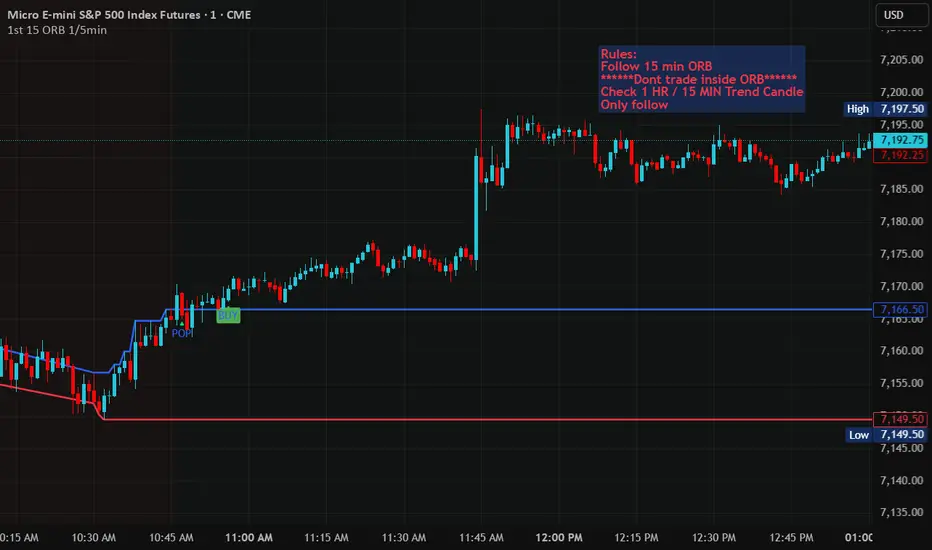
This is a:
Multi-phase Opening Range Breakout (ORB) + Trend Continuation + Compression Detection system
It breaks market behavior into 3 structured regimes:
1. Compression Phase (yellow background)
This is when:
*volatility is shrinking (ATR contraction)
*price is moving sideways
*no clear breakout yet
Meaning:
The market is “loading energy” — not moving decisively
What it is NOT:
*not a buy signal
*not a sell signal
*not directional yet
2. Breakout / Expansion Phase (ORB break)
Triggered when price breaks:
*above ORB high → bullish bias
*below ORB low → bearish bias
This is where:
*DROP / POP signals can appear (impulse moves)
*volatility expands
*direction begins to form
Meaning:
“The market chose a direction”
3. Trend Phase (background color)
After breakout:
🟩 Green = bullish trend active
🟥 Red = bearish trend active
Price is now:
*trending
*creating structure
*producing continuation setups
What each signal actually means
🔻 DROP
*aggressive sell expansion from inside ORB
*early bearish displacement
🔺 POP
*aggressive buy expansion from inside ORB
*early bullish displacement
REV (reversal)
*failed breakout at ORB boundary
*liquidity trap / rejection
CONT (continuation)
*pullback within trend
*re-entry into direction of breakout
How to use this “to the max”
This system is NOT for random entries. It is a phase-based execution model.
⚙️ Step-by-step usage model
🟨 STEP 1 — Wait for Compression
Do nothing
Identify when yellow background is active
Goal:
Let the market “build pressure”
🟦 STEP 2 — Wait for ORB break
*First break of ORB high/low defines bias
*This is your directional decision point
Rule:
You only start trading AFTER breakout
STEP 3 — Trade continuation only
Once trend is established:
Long setup:
*pullback toward structure
*continuation signal in trend direction
Short setup:
*pullback upward
*continuation down
👉 This is where consistency comes from
STEP 4 — Use DROP / POP sparingly
These are NOT primary entries.
They are:
*early expansion clues
*momentum alerts
*sometimes “first leg” entries (higher risk)
STEP 5 — REV signals = warning zones
Use REV for:
*failed breakout detection
*exit timing
*not primary entries
💡 Key concept (most important part)
This indicator is built around:
*Compression → Expansion → Trend → Continuation
Not:
*guessing tops/bottoms
*reacting to every candle
*overtrading signals
🧭 How professionals would actually use it
1. Morning (pre-breakout)
watch compression
2. First move
identify ORB breakout direction
3. Mid-session
only take continuation trades
4. Late session
stop trading unless clean structure remains
📉 What NOT to do
*don’t trade every DROP/POP
*don’t trade inside compression
*don’t counter-trade trend signals
*don’t ignore ORB bias
What makes this powerful
Most indicators try to predict moves.
This one instead:
organizes market behavior into phases so you only trade when probability is structurally in your favor.

Feragatname
Bilgiler ve yayınlar, TradingView tarafından sağlanan veya onaylanan finansal, yatırım, alım satım veya diğer türden tavsiye veya öneriler anlamına gelmez ve teşkil etmez. Kullanım Koşulları bölümünde daha fazlasını okuyun.
Feragatname
Bilgiler ve yayınlar, TradingView tarafından sağlanan veya onaylanan finansal, yatırım, alım satım veya diğer türden tavsiye veya öneriler anlamına gelmez ve teşkil etmez. Kullanım Koşulları bölümünde daha fazlasını okuyun.