Range Enjoyer
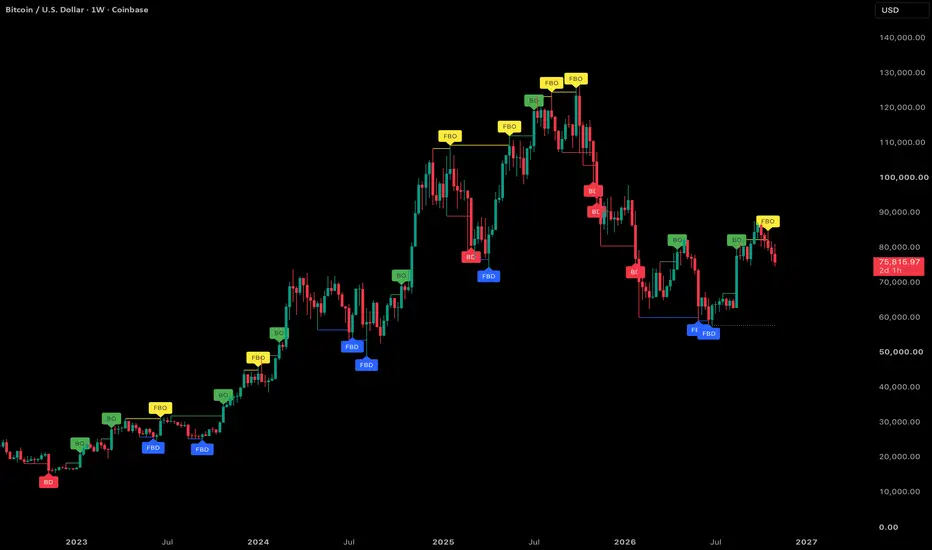
Range Enjoyer tracks the latest swing high and swing low and labels what price does when it reaches them: a breakout, a breakdown or a false move that gets rejected.
THE FOUR SIGNALS
🟩 BO (Breakout): price closes above the swing high.
🟨 FBO (False Breakout): price trades above the swing high but fails to hold it, either by closing back below on the same candle or within the review window after a breakout.
🟥 BD (Breakdown): price closes below the swing low.
🟦 FBD (False Breakdown): price trades below the swing low but fails to stay there, either by closing back above on the same candle or within the review window after a breakdown.
HOW SIGNALS GET UNDONE
A breakout isn’t final the moment it happens. After every signal, the level is watched for a review window (4 bars by default). If price closes back through the level during that window, the signal is undone:
A breakout that closes back below the level becomes a false breakout.
A false breakout that closes back above the level becomes a breakout.
The same applies to breakdowns and false breakdowns.
The old tag is removed and the new one is placed on the candle where the reversal happened, so the chart always shows the latest verdict for each level. Each new signal restarts the window. Once a full window passes with no change, the tag is final.
SWING LEVELS
A swing high is the highest wick of the previous 4 bars that then holds for 2 bars after it. Swing lows work the same way. Untouched levels are shown as dotted lines. Once a level is broken or rejected, the line turns solid in the signal’s color and ends at the event candle.
SETTINGS
Swing lookback (default 4): how many bars before a swing it must exceed. Higher = fewer, more significant levels.
Swing confirmation (default 2): how many bars after a swing it must hold before becoming a level. Lower = levels appear sooner and quick sweeps get caught.
Close buffer % (default 0): how far beyond a level the close must be to count as a break or to undo one. Useful on noisier assets or lower timeframes.
Review window (default 4): how many bars a signal can still be undone.
Display: toggle swing levels, switch between short codes and full tag text and change tag size and colors.
ALERTS
Every signal and every reversal fires an alert on bar close. To set it up, create an alert on this indicator and choose “Any alert() function call.”
NOTES
All signals are evaluated on bar close, so nothing changes mid-candle.
Designed for the weekly chart, but works on any asset and timeframe.
This indicator is a visual tool for reading market structure, not financial advice.

Feragatname
Bilgiler ve yayınlar, TradingView tarafından sağlanan veya onaylanan finansal, yatırım, alım satım veya diğer türden tavsiye veya öneriler anlamına gelmez ve teşkil etmez. Kullanım Koşulları bölümünde daha fazlasını okuyun.
Feragatname
Bilgiler ve yayınlar, TradingView tarafından sağlanan veya onaylanan finansal, yatırım, alım satım veya diğer türden tavsiye veya öneriler anlamına gelmez ve teşkil etmez. Kullanım Koşulları bölümünde daha fazlasını okuyun.