OPEN-SOURCE SCRIPT
CVD Delta Divergence [JOAT]
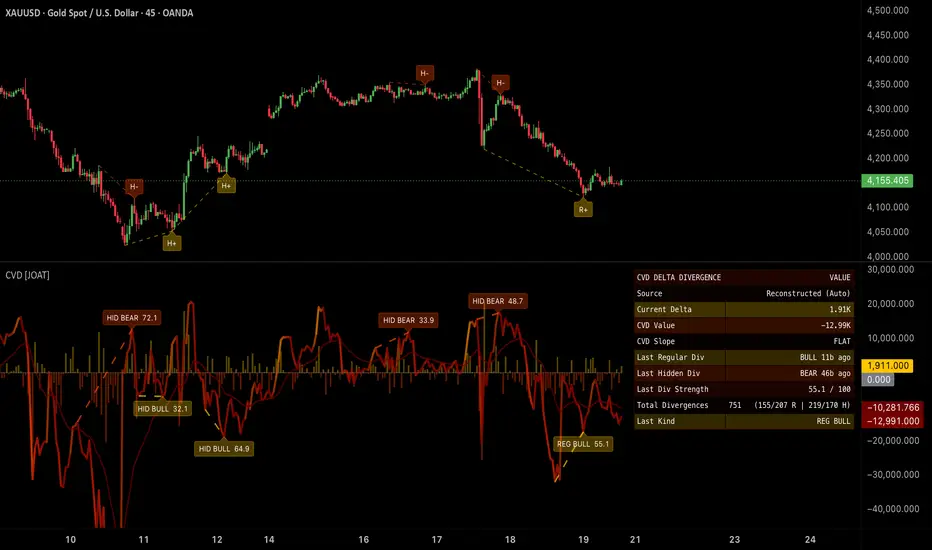
CVD DELTA DIVERGENCE [JOAT]
A full-featured Cumulative Volume Delta engine with proper pivot-based divergence detection. CVD on its own is one of the cleanest reads of net flow you can produce without L2 data — but the value of CVD lives almost entirely in its divergence with price. CVD Delta Divergence builds the CVD properly (with footprint-API or reconstructed-tick options), then runs a strict pivot-vs-pivot divergence engine on top of it, with strength scoring and configurable cooldown.

Three data-source modes
CVD is only as good as the delta classification underneath it. Three modes are exposed:
This is unusual — most public CVD scripts hardcode one method. Auto-mode means the script works correctly on any instrument that has either dataset, without per-instrument configuration.
Four CVD anchors
Cumulative deltas need an anchor — running a sum from inception of data is rarely meaningful. Four anchoring modes:
Pivot-based divergence engine (the headline)
Slope-comparison divergence is noisy. CVD Delta Divergence uses proper pivots:
Four divergence classes are detected:
Divergence markers can be force-overlaid onto the main chart pane (toggleable) so you see them on price without flipping panes.
Visual system
A locked Lava palette (gold bull / orange-red bear / oxblood mid on a deep lava-black ground) gives the pane a distinctive flow-read identity.

Dashboard
Monospaced table, positionable to any of eight corners, with:
Alerts
Six alert conditions, each independently controllable:
How to read it
Three reads, in order of conviction:
Suggested settings
Defaults are tuned for 5m–1H charts on liquid markets in Session Reset mode. For lower timeframes, drop pivot lookback to 3 and divergence window to 30. For higher timeframes, raise pivot lookback to 7–10 and switch anchor to Day Reset. The minimum strength threshold (15) is intentionally loose; raise to 25–30 if you want only the strongest divergences.
Originality / what's reused
CVD (cumulative volume delta) is public-domain market-structure language; the tick rule is standard. The implementation — the Auto/Footprint/Reconstructed source switch, the four-anchor reset logic, the pivot-based divergence engine with strict HL/LL gating and minimum-strength filter, the slope-coloured CVD with histogram backdrop, the force-overlay divergence markers, and the cooldown-per-class state machine — is JOAT-original and tuned together. No third-party code reused.
Open source
Published open-source under the default Mozilla Public License 2.0. The source is sectioned, every input has a tooltip, every helper is documented inline. The CVD engine, the source-mode router, the pivot logic, and the divergence engine are independent modules — adapt any single piece without reading the whole file.
Limitations
Reconstructed CVD is a proxy — the tick rule is the accepted public-market inference but it is not a direct read of bid vs ask volume. Footprint mode requires the TradingView Footprint dataset and is unavailable on some instruments. Pivot divergences are non-repainting once confirmed (they lag by the pivot's right-lookback) but the divergence between two pivots cannot fire until both are confirmed — so the second pivot's lag is the structural lag of the signal.
—
-made with passion by jackofalltrades
A full-featured Cumulative Volume Delta engine with proper pivot-based divergence detection. CVD on its own is one of the cleanest reads of net flow you can produce without L2 data — but the value of CVD lives almost entirely in its divergence with price. CVD Delta Divergence builds the CVD properly (with footprint-API or reconstructed-tick options), then runs a strict pivot-vs-pivot divergence engine on top of it, with strength scoring and configurable cooldown.
Three data-source modes
CVD is only as good as the delta classification underneath it. Three modes are exposed:
- Footprint API — uses TradingView's Footprint dataset when the instrument supports it. The cleanest read, equivalent to professional delta feeds.
- Reconstructed — when Footprint is unavailable, reconstructs buy/sell from a configurable lower-timeframe stream (1m / 3m / 5m / 15m / 30m) using the standard tick rule. Optional intrabar volume weighting.
- Auto — picks Footprint when present, falls back to Reconstructed. The recommended default.
This is unusual — most public CVD scripts hardcode one method. Auto-mode means the script works correctly on any instrument that has either dataset, without per-instrument configuration.
Four CVD anchors
Cumulative deltas need an anchor — running a sum from inception of data is rarely meaningful. Four anchoring modes:
- Cumulative — never resets. Maximum context, slowest divergence detection.
- Session Reset (default) — anchors at the start of each trading session. The most useful read for day-trading reference.
- Day Reset — anchors at midnight exchange time.
- Week Reset — anchors at week boundary. Good for swing-frame divergences.
Pivot-based divergence engine (the headline)
Slope-comparison divergence is noisy. CVD Delta Divergence uses proper pivots:
- ta.pivothigh / ta.pivotlow on price with a configurable lookback (default 5 bars left/right).
- At each confirmed pivot, the corresponding CVD value is recorded.
- A divergence is built only when two price pivots and their CVD readings disagree directionally.
- A minimum-strength filter (default 15.0 on a 0–100 scale) suppresses weak signals — strength is the normalised disagreement magnitude between the price-pivot motion and the CVD-pivot motion.
- A strict HL/LL toggle requires the second pivot to strictly exceed/undershoot the first by a small fraction so equal-pivot edge cases do not produce noise divergences.
- A cooldown per divergence class (default 3 bars) prevents back-to-back fires of the same class.
Four divergence classes are detected:
- Regular Bull — price lower-low, CVD higher-low. Reversal up.
- Regular Bear — price higher-high, CVD lower-high. Reversal down.
- Hidden Bull — price higher-low, CVD lower-low. Trend continuation up.
- Hidden Bear — price lower-high, CVD higher-high. Trend continuation down.
Divergence markers can be force-overlaid onto the main chart pane (toggleable) so you see them on price without flipping panes.
Visual system
- Slope-coloured CVD line — bull / bear gradient based on the CVD's own short-term slope (configurable window).
- Smoothed CVD overlay — toggleable EMA-smoothed CVD on top of the raw line. Useful for cutting through noisy 1m reconstructions.
- Delta histogram — bar-by-bar delta as columns behind the CVD line. Useful for seeing per-bar flow vs cumulative flow.
- Zero line and crossover alerts.
- Divergence connecting lines — when a divergence fires, a connector line is drawn between the two pivots for visual proof.
A locked Lava palette (gold bull / orange-red bear / oxblood mid on a deep lava-black ground) gives the pane a distinctive flow-read identity.
Dashboard
Monospaced table, positionable to any of eight corners, with:
- Current CVD value with sign.
- CVD slope direction (Rising / Falling / Flat).
- Active anchor mode.
- Last divergence class with bar age.
- Source mode in use (Footprint / Reconstructed).
- Zero-cross status with bars-ago.
Alerts
Six alert conditions, each independently controllable:
- Regular Bull Divergence
- Regular Bear Divergence
- Hidden Bull Divergence
- Hidden Bear Divergence
- CVD Crosses Zero
- CVD Slope Flips
How to read it
Three reads, in order of conviction:
- Regular divergence — the classic reversal read. Price made a new extreme, CVD did not. The flow that was needed to extend the move did not show up. A regular divergence at a known structural level is one of the highest-conviction reversal setups in tape reading.
- Hidden divergence — the trend-continuation read. Price retraced, but CVD did not. The flow is still committed in the original direction even though price wavered. Often produces clean re-entry signals in trends.
- CVD zero-cross + slope flip — the regime change read. Cumulative flow has rotated sides — what was net-buying is now net-selling (or vice versa). Useful as a "the tape has flipped" notification.
Suggested settings
Defaults are tuned for 5m–1H charts on liquid markets in Session Reset mode. For lower timeframes, drop pivot lookback to 3 and divergence window to 30. For higher timeframes, raise pivot lookback to 7–10 and switch anchor to Day Reset. The minimum strength threshold (15) is intentionally loose; raise to 25–30 if you want only the strongest divergences.
Originality / what's reused
CVD (cumulative volume delta) is public-domain market-structure language; the tick rule is standard. The implementation — the Auto/Footprint/Reconstructed source switch, the four-anchor reset logic, the pivot-based divergence engine with strict HL/LL gating and minimum-strength filter, the slope-coloured CVD with histogram backdrop, the force-overlay divergence markers, and the cooldown-per-class state machine — is JOAT-original and tuned together. No third-party code reused.
Open source
Published open-source under the default Mozilla Public License 2.0. The source is sectioned, every input has a tooltip, every helper is documented inline. The CVD engine, the source-mode router, the pivot logic, and the divergence engine are independent modules — adapt any single piece without reading the whole file.
Limitations
Reconstructed CVD is a proxy — the tick rule is the accepted public-market inference but it is not a direct read of bid vs ask volume. Footprint mode requires the TradingView Footprint dataset and is unavailable on some instruments. Pivot divergences are non-repainting once confirmed (they lag by the pivot's right-lookback) but the divergence between two pivots cannot fire until both are confirmed — so the second pivot's lag is the structural lag of the signal.
—
-made with passion by jackofalltrades
Açık kaynak kodlu komut dosyası
Gerçek TradingView ruhuyla, bu komut dosyasının mimarı, yatırımcıların işlevselliğini inceleyip doğrulayabilmesi için onu açık kaynaklı hale getirdi. Yazarı tebrik ederiz! Ücretsiz olarak kullanabilseniz de, kodu yeniden yayınlamanın Topluluk Kurallarımıza tabi olduğunu unutmayın.

The Institutional Grade Trading Ecosystem, Built to win trades 📈
Get Access 👇
jackofalltrades.vip 🌐
t.me/jackofalltradesvip 🃏
Get Access 👇
jackofalltrades.vip 🌐
t.me/jackofalltradesvip 🃏
Feragatname
Bilgiler ve yayınlar, TradingView tarafından sağlanan veya onaylanan finansal, yatırım, alım satım veya diğer türden tavsiye veya öneriler anlamına gelmez ve teşkil etmez. Kullanım Koşulları bölümünde daha fazlasını okuyun.
Açık kaynak kodlu komut dosyası
Gerçek TradingView ruhuyla, bu komut dosyasının mimarı, yatırımcıların işlevselliğini inceleyip doğrulayabilmesi için onu açık kaynaklı hale getirdi. Yazarı tebrik ederiz! Ücretsiz olarak kullanabilseniz de, kodu yeniden yayınlamanın Topluluk Kurallarımıza tabi olduğunu unutmayın.
The Institutional Grade Trading Ecosystem, Built to win trades 📈
Get Access 👇
jackofalltrades.vip 🌐
t.me/jackofalltradesvip 🃏
Get Access 👇
jackofalltrades.vip 🌐
t.me/jackofalltradesvip 🃏
Feragatname
Bilgiler ve yayınlar, TradingView tarafından sağlanan veya onaylanan finansal, yatırım, alım satım veya diğer türden tavsiye veya öneriler anlamına gelmez ve teşkil etmez. Kullanım Koşulları bölümünde daha fazlasını okuyun.