OPEN-SOURCE SCRIPT
Balanced Price Range + V-Shape Indicator
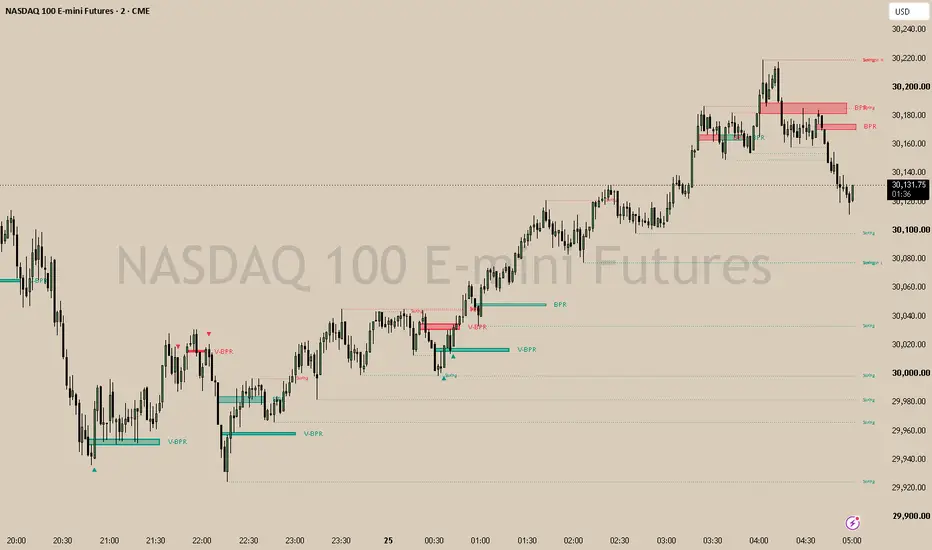
Balanced Price Range + V-Shape Indicator
Overview
This is an open-source intraday scalping model built on ICT-derived price-action concepts. It combines Balanced Price Ranges and V-shaped liquidity-driven reversals into a single contextual system. The scalping method is specific: it looks for a sharp reversal (a "V") off a zone of overlapping imbalance (a Balanced Price Range), but only when that zone is confirmed by higher-timeframe imbalance or a recent liquidity sweep — the kind of fast, location-specific entry used on 1–15 minute charts. Rather than printing every BPR or inverted gap (which is unusably noisy live), it cross-filters them so only confirmed locations are highlighted. The source is fully open; everything below describes exactly what the code does.
Building block 1 — Fair Value Gaps and inversions
A Fair Value Gap (FVG) is a three-candle imbalance: a gap between candle 1's extreme and candle 3's extreme left unfilled by candle 2. The script detects each FVG as it forms and stores the displacement (middle) candle's open and close for later momentum checks. When price later closes back through a gap, that gap is latched as inverted (an iFVG) — its expected support/resistance role flips.
Building block 2 — Balanced Price Range
A Balanced Price Range is the price overlap between a fresh FVG and an opposite-direction iFVG. When a new FVG forms and overlaps an opposite inverted gap within a configurable lookback window, the overlapping band is drawn as a BPR. A minimum-size filter (as a percentage of 14-period ATR) discards slivers too thin to matter. BPR zones extend rightward until price closes through them or a max-extension bar limit is reached.
Building block 3 — Liquidity mapping and sweeps
The script independently maps liquidity from four sources, each toggleable: swing-pivot highs/lows, equal highs/lows (two same-side swings within an ATR tolerance), previous-day high/low, and London / NY-AM session highs and lows. For each level it distinguishes a sweep (wick through, close back — liquidity grab) from a clean break (close beyond — level reclaimed), marking sweeps on the chart.
The V-Shape gate — how the pieces work together
A BPR is upgraded to a "V-BPR" and an entry arrow only fires when the location passes a context gate with two independent confirmation paths, either of which validates the setup:
Two candle-level filters refine the trigger: a clean-V-tip rule (the inversion candle must be preceded by an opposite-direction candle, enforcing a real reversal at the tip) and a strong-close rule (the inverting candle must reclaim a set percentage of the displacement candle's body, confirming momentum). An optional clear-path filter rejects a setup when un-swept opposite-side liquidity rests within an ATR danger zone in the trade's direction, since that pool is often taken first.
Chart Examples:


Settings reference
Settings: max BPRs shown, iFVG lookback window, min BPR size (% ATR), max zone extension.
Higher-TF FVG: show/hide, timeframe multiplier, max stored, colour.
V-Shape Gate & Entry: master gate toggle, HTF-tap window, zone proximity buffer, sweep-path toggle and window, clean-V-tip, clear-path toggle and danger-zone size, hide-non-V-BPR, entry-marker toggle, strong-close percentage.
Liquidity & Sweeps: toggles for swing / PDH-PDL / session / equal-H-L sources, pivot strength, equal tolerance, session windows (NY time), max levels, sweep marking, colours.
Colors: bull/bear BPR, FVG/iFVG components, liquidity, sweep marks.
How to use it
Apply to 1–15 minute charts. Drawn BPRs show overlapping imbalance; thicker V-BPR zones and ▲/▼ markers show locations that passed the gate. Each entry marker's tooltip audits why it fired (which path confirmed it and the reclaim %). Begin with the gate on to see only confirmed scalps; loosen by disabling individual filters, or enable "Hide BPRs that fail the gate" to declutter. Alerts fire on confirmed long and short V-Shape entries.
Non-repainting
All higher-timeframe and previous-day data is requested with offset historical expressions, so no future data is used on historical bars; entries evaluate only on confirmed bar closes and do not repaint.
Overview
This is an open-source intraday scalping model built on ICT-derived price-action concepts. It combines Balanced Price Ranges and V-shaped liquidity-driven reversals into a single contextual system. The scalping method is specific: it looks for a sharp reversal (a "V") off a zone of overlapping imbalance (a Balanced Price Range), but only when that zone is confirmed by higher-timeframe imbalance or a recent liquidity sweep — the kind of fast, location-specific entry used on 1–15 minute charts. Rather than printing every BPR or inverted gap (which is unusably noisy live), it cross-filters them so only confirmed locations are highlighted. The source is fully open; everything below describes exactly what the code does.
Building block 1 — Fair Value Gaps and inversions
A Fair Value Gap (FVG) is a three-candle imbalance: a gap between candle 1's extreme and candle 3's extreme left unfilled by candle 2. The script detects each FVG as it forms and stores the displacement (middle) candle's open and close for later momentum checks. When price later closes back through a gap, that gap is latched as inverted (an iFVG) — its expected support/resistance role flips.
Building block 2 — Balanced Price Range
A Balanced Price Range is the price overlap between a fresh FVG and an opposite-direction iFVG. When a new FVG forms and overlaps an opposite inverted gap within a configurable lookback window, the overlapping band is drawn as a BPR. A minimum-size filter (as a percentage of 14-period ATR) discards slivers too thin to matter. BPR zones extend rightward until price closes through them or a max-extension bar limit is reached.
Building block 3 — Liquidity mapping and sweeps
The script independently maps liquidity from four sources, each toggleable: swing-pivot highs/lows, equal highs/lows (two same-side swings within an ATR tolerance), previous-day high/low, and London / NY-AM session highs and lows. For each level it distinguishes a sweep (wick through, close back — liquidity grab) from a clean break (close beyond — level reclaimed), marking sweeps on the chart.
The V-Shape gate — how the pieces work together
A BPR is upgraded to a "V-BPR" and an entry arrow only fires when the location passes a context gate with two independent confirmation paths, either of which validates the setup:
- HTF FVG tap (continuation path): Fair Value Gaps are read from a higher timeframe (chart TF × a user multiplier, snapped to the nearest standard resolution). The gate checks whether price recently tapped a still-valid HTF gap of matching direction, and whether the BPR sits inside or within an ATR buffer of it.
- Liquidity sweep (reversal path): a correct-side sweep — a low taken for a long, a high taken for a short — within a recent bar window.
Two candle-level filters refine the trigger: a clean-V-tip rule (the inversion candle must be preceded by an opposite-direction candle, enforcing a real reversal at the tip) and a strong-close rule (the inverting candle must reclaim a set percentage of the displacement candle's body, confirming momentum). An optional clear-path filter rejects a setup when un-swept opposite-side liquidity rests within an ATR danger zone in the trade's direction, since that pool is often taken first.
Chart Examples:
Settings reference
Settings: max BPRs shown, iFVG lookback window, min BPR size (% ATR), max zone extension.
Higher-TF FVG: show/hide, timeframe multiplier, max stored, colour.
V-Shape Gate & Entry: master gate toggle, HTF-tap window, zone proximity buffer, sweep-path toggle and window, clean-V-tip, clear-path toggle and danger-zone size, hide-non-V-BPR, entry-marker toggle, strong-close percentage.
Liquidity & Sweeps: toggles for swing / PDH-PDL / session / equal-H-L sources, pivot strength, equal tolerance, session windows (NY time), max levels, sweep marking, colours.
Colors: bull/bear BPR, FVG/iFVG components, liquidity, sweep marks.
How to use it
Apply to 1–15 minute charts. Drawn BPRs show overlapping imbalance; thicker V-BPR zones and ▲/▼ markers show locations that passed the gate. Each entry marker's tooltip audits why it fired (which path confirmed it and the reclaim %). Begin with the gate on to see only confirmed scalps; loosen by disabling individual filters, or enable "Hide BPRs that fail the gate" to declutter. Alerts fire on confirmed long and short V-Shape entries.
Non-repainting
All higher-timeframe and previous-day data is requested with offset historical expressions, so no future data is used on historical bars; entries evaluate only on confirmed bar closes and do not repaint.
Açık kaynak kodlu komut dosyası
Gerçek TradingView ruhuyla, bu komut dosyasının mimarı, yatırımcıların işlevselliğini inceleyip doğrulayabilmesi için onu açık kaynaklı hale getirdi. Yazarı tebrik ederiz! Ücretsiz olarak kullanabilseniz de, kodu yeniden yayınlamanın Topluluk Kurallarımıza tabi olduğunu unutmayın.

Feragatname
Bilgiler ve yayınlar, TradingView tarafından sağlanan veya onaylanan finansal, yatırım, alım satım veya diğer türden tavsiye veya öneriler anlamına gelmez ve teşkil etmez. Kullanım Koşulları bölümünde daha fazlasını okuyun.
Açık kaynak kodlu komut dosyası
Gerçek TradingView ruhuyla, bu komut dosyasının mimarı, yatırımcıların işlevselliğini inceleyip doğrulayabilmesi için onu açık kaynaklı hale getirdi. Yazarı tebrik ederiz! Ücretsiz olarak kullanabilseniz de, kodu yeniden yayınlamanın Topluluk Kurallarımıza tabi olduğunu unutmayın.
Feragatname
Bilgiler ve yayınlar, TradingView tarafından sağlanan veya onaylanan finansal, yatırım, alım satım veya diğer türden tavsiye veya öneriler anlamına gelmez ve teşkil etmez. Kullanım Koşulları bölümünde daha fazlasını okuyun.