Target Race Map [Harmony Algo]
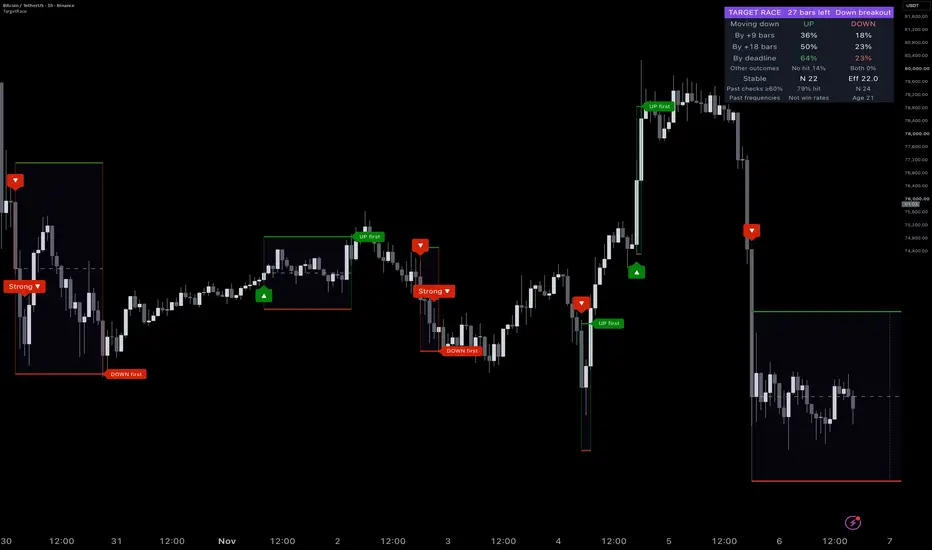
Target Race Map
After a closing breakout, which of two fixed price levels was reached first in comparable historical races, and how quickly did that happen? Target Race Map combines fixed barriers and a deadline with conditional historical endpoint frequencies, remaining-time comparisons and a separate closed-bar Strong confirmation grade.
Read the chart
Green and red lines are the upper and lower barriers. The dashed horizontal line is the setup close; the light box is the observation corridor. Colored labels containing ▲ or ▼ identify a confirmed closing breakout. Strong ▲ or Strong ▼ can appear later on the actual confirmation close. The initial arrow is never moved or retrospectively upgraded. UP first / DOWN first are observed results, not extra entry signals. No hit means expiry; Both means unknown intrabar order.
Only the latest six target maps are drawn by default, adjustable up to 165. Historical setup, Strong and result labels share a separate 500-label budget. Removing an old target map does not remove its labels. Statistical memory is separate.
Fixed observation protocol
Defaults require a close beyond the previous 32-bar high/low plus a 0.10 prior ATR(14) buffer. The script freezes barriers 2.5 prior ATR above and below that close and observes the next 48 chart bars. Only one race is active. Eight complete cooldown bars must pass after a result before another race starts.
The setup candle cannot resolve a race started at its close. A later opening gap at or beyond a barrier has known first priority. Otherwise, if both barriers are touched within one candle, OHLC cannot establish which came first: the result remains Both. Equality counts as a touch. A touch on the deadline bar is processed before expiry. All decisions and alerts commit at close, not at the instant of an intrabar touch.
Conditional historical evidence
Memory holds up to 400 resolved, non-overlapping races across both directions. At the current closed age, the cohort selects earlier races with the same breakout direction that survived beyond that age and occupied a similar normalized price position. Position is 0 at the origin, +1 at the upper barrier and -1 at the lower barrier; default matching tolerance is 0.50. The current unresolved race never trains its own estimate.
The four outcomes are upper first, lower first, expiry without a touch and both with unknown order. Unknown cases are not dropped. At least 20 raw and 20 effective matched examples are required; otherwise rates are unavailable and the panel shows LEARNING. These are conditional past frequencies, not calibrated future probabilities or trade win rates. After a result, the panel identifies the age of its last pre-result evidence.
Movement and remaining time
Movement uses average normalized closing progress over up to three bars to describe upward progress, downward progress or stalling. It does not move the fixed barriers. The panel shows cumulative upper/lower-first fractions by one-third and two-thirds of the remaining bars, then by the original deadline. Two dotted lines mark the intermediate times on the active box. They update at close as time remaining shrinks; the final deadline stays fixed. Fractions are not renormalized to 100% at every milestone: some past races remain unresolved there or have unknown order.
Evidence and Strong confirmation
N is the raw count; Eff is the effective count. The oldest and newest halves of memory must each contain at least 10 effective matched examples. Stable means both directional fractions differ by no more than 15 percentage points across those halves. Mixed means supported disagreement; Limited means insufficient evidence. These are sample descriptions, not certainty about the market.
Strong requires effective sample at least 40, original-direction endpoint frequency at least 65%, an advantage over the opposite endpoint of at least 20 percentage points, Stable evidence, progress of at least 0.10 of the barrier distance in that direction, and aligned closing velocity. All conditions must persist for two consecutive closes. Only one Strong is allowed per still-active race, and none on the resolution bar. This is a rule-based confirmation grade, not an established high-accuracy trading system.
Optional path weighting
Experimental weighting favors historical examples with similar three-bar normalized closing velocity. Weight = 1 / (1 + ((past velocity - current velocity) / width)^2), with default width 0.15 barrier units per bar. Effective count is squared total weight divided by the sum of squared weights. This setting is OFF by default: development comparisons did not establish a consistent gain over position-only matching. Velocity still informs movement and Strong while weighting is off. Enabling it can alter fractions and reduce support.
Rolling checking and alerts
At the fourth surviving close by default, an eligible forecast is frozen and scored only after resolution. The latest 100 scored races support a historical check. The >=60% subgroup contains forecasts favoring one known barrier by at least 60%; its observed first-endpoint hit fraction appears only after 20 resolved cases. This is not the Strong success rate or a trading win rate. Four-class Brier values for model and position-only baseline are in the tooltip. Conditional historical checking is not independent proof of calibration or future performance.
Eight alerts cover new race, upper first, lower first, expiry without a hit, both with unknown order, invalid-data cancellation, Strong upward and Strong downward. Alerts and diagnostic event plots share confirmed-bar conditions. Use Once Per Bar Close; recreate alerts after changing source or inputs. Display switches do not change calculation or alert logic.
Limits and use
Use standard time-based candles. This is a historical first-touch analysis tool, not strategy execution or an entry/exit backtest. It has no cost, slippage, sizing or profitability model. Samples can be serially dependent; effective count does not remove dependence. Regime changes, parameters, sessions, feed, timeframe and loaded history affect results. A bar count is not a fixed clock duration across session gaps.
Invalid delivered OHLC cancels an episode without treating it as a loss; the script cannot repair data or reliably detect every absent bar. No higher-timeframe calls, retrospective pivots or negative plot offsets are used. Open-bar values hold the last confirmed calculation. Data corrections and changed inputs, sessions or loaded history can still change historical results. Neither arrows nor Strong guarantee executable or profitable trades.

Elevate Your Trading ▶ qalphatrade.com
Trade with mathematical certainty,
not emotional guesswork.
Trade with mathematical certainty,
not emotional guesswork.
Feragatname
Bilgiler ve yayınlar, TradingView tarafından sağlanan veya onaylanan finansal, yatırım, alım satım veya diğer türden tavsiye veya öneriler anlamına gelmez ve teşkil etmez. Kullanım Koşulları bölümünde daha fazlasını okuyun.