OPEN-SOURCE SCRIPT
Silver Bullet [GBB]
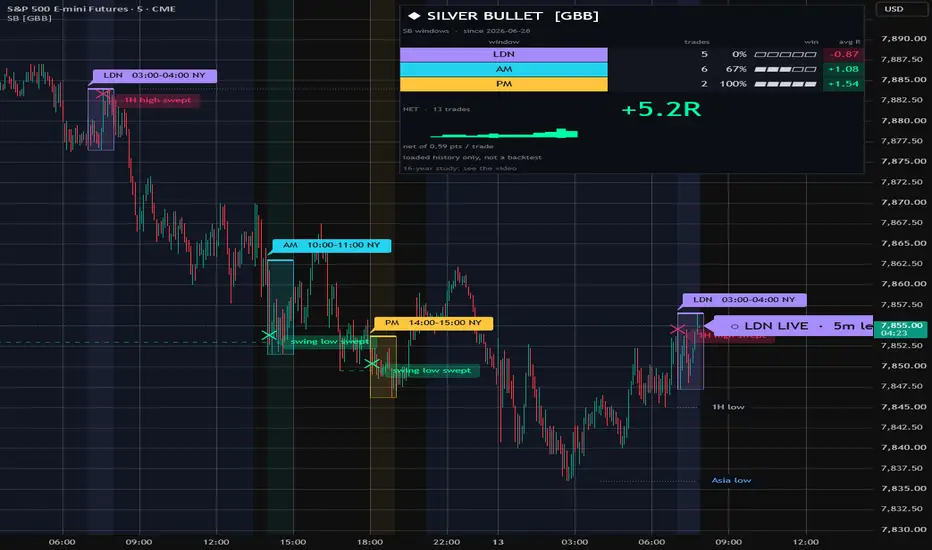
Silver Bullet [GBB] draws ICT's Silver Bullet model on your chart with every step written down as an exact rule, tracks each setup to its result, and keeps score in net R after costs. A second mode, Hour Scan, runs the identical rules in every clock hour of the day, so you can check on your own chart whether the Silver Bullet hours behave any differently from the rest.
THE MODEL
The Silver Bullet trades three one-hour windows, New York time: LDN 03:00-04:00, AM 10:00-11:00 and PM 14:00-15:00. Inside a window the indicator looks for this sequence:
1. Sweep. A candle trades at least one tick through an untouched liquidity level (a wick is enough, an exact touch is not). Levels: swing highs and lows (5 bars either side, strictly higher or lower, kept for 300 bars), the Asia high / low (20:00-24:00), the London high / low (02:00-05:00), the previous day's high / low, and the range of the hour before the window. Each level can be swept once. A swept high looks for a short, a swept low for a long.
2. Displacement. A fair value gap in the opposite direction: three candles inside the window, starting at or after the sweep, with a middle candle whose body is at least 1.0 x ATR(14) and a gap of at least 0.1 x ATR (and 2 ticks). The first such gap per direction in a window arms the setup.
3. Entry. A limit order at the gap's near edge. It fills only if price trades at least one tick through it before the window ends. It is cancelled if price reaches the target first or the window ends unfilled.
4. Stop. One tick beyond the sweep's extreme (the highest high for a short, the lowest low for a long, from the sweep candle to the end of the gap).
5. Target. The nearest untouched liquidity level on the other side. If it is closer than 1.5 R the setup is skipped (SKIP); if there is none, the target is 2 R.
6. Exit. Target, stop, or the time stop at window end + 60 minutes (never past 17:00), whichever comes first. If stop and target are hit in the same candle, it counts as a stop. One trade per window.
WHAT YOU SEE
• Each window framed and tinted in its own colour, with its name and time.
• Live liquidity levels as dotted lines with a short name (PDH, London high, Asia low, 1H low ...). A level disappears when it is swept, except the window's first sweep, which is marked with ✕ and named ("swing low swept").
• The FVG box, dashed while the order is waiting, solid once it fills. The displacement candle can be painted.
• Risk and reward zones from the fill to the exit, entry / stop / target prices, and a result chip: TP, SL or TIME with the R.
• A live status pill next to the last bar: window live with minutes left, setup armed, open trade with its running R, or the next window.
• Stats panel: per window the number of trades, win rate and average net R, the total net R, a small equity curve of the last 30 trades, and the cost per trade in points. In Hour Scan it can show one row per clock hour with a bar either side of zero.
HOUR SCAN
Hour Scan applies exactly the same rules to every clock hour from 18:00 to 16:00 New York time, each hour on its own. The Silver Bullet hours stay framed, so they can be compared directly with the other 20 hours. Chart text switches to a minimal style there, because setups every hour would overlap.
WHAT THE 16-YEAR TEST FOUND
These rules were tested on Sierra Chart 1-minute data from 2011 to 2026 on ES, NQ, YM and GC futures, in all 23 hours, with 2 ticks of slippage and $4.50 commission per round trip. Results are in R (the distance from entry to stop).
• After costs the model lost money in every hour on every market: 92 of 92 hour-market combinations. Before costs it was flat to negative.
• About one trade in four wins; roughly 73% of filled trades hit the stop.
• The Silver Bullet hours look better than the average hour only because they are busy hours: wider stops make the fixed costs a smaller part of each trade. Against hours that move just as much, they were no better on ES, NQ or YM. The one exception, gold's 10:00 hour, beat its comparable hours but still lost money, and was not confirmed.
• Of the armed setups whose limit order never filled, 70-76% reached the target before the stop. The orders that fill tend to be the losing ones.
• Placing the stop beyond the sweep's extreme was the one variant that improved results on both ES and NQ in the held-out years, which is why it is the default. It did not make the model profitable.
In short: with these rules, the Silver Bullet hours are not special, and the model is not a profitable strategy on its own. The indicator is published so you can see the rules at work, check the result on your own markets, and use parts of it (the sweep detection, the levels, the gaps) in your own work.
SETTINGS
• Mode: Silver Bullet or Hour Scan. LDN / AM / PM on or off, plus one custom window.
• Liquidity: which levels count, pivot size and lookback.
• Sweep: required or not, optional close-back filter.
• Displacement: ATR length, body multiple, minimum gap.
• Entry: near edge or 50% of the gap (CE), trade-through or touch fill, grace bars, one trade per window or one per direction.
• Risk: stop beyond the sweep extreme or beyond the gap's first candle, stop buffer, minimum target in points and in R, fallback target, time stop (window end + 60 min, minutes after fill, or 17:00).
• Costs: slippage in ticks and commission per round trip, used for the net R in the panel.
• Display: Neon, GBB or Mono palette, number of days drawn (default 3), text size, and each drawing on or off.
• Stats panel: position, all loaded history or the last N days, rows per window or per hour.
• Alerts: window open, sweep, setup armed, entry filled, target, stop, time exit, setup cancelled; plus alert() messages with window, direction, entry, stop, target and R.
NOTES
• Built for 1-minute and 5-minute charts; signals are off outside 1m to 15m. The first load can take a while.
• Everything is calculated on closed candles and nothing repaints. Fills and exits are resolved on the chart's candles, so a 5m chart is coarser than the 1m test.
• The LDN window and Hour Scan need electronic (overnight) trading hours; on a regular-hours chart the panel shows a warning.
• The panel counts only the history TradingView has loaded. It is a description of that history, not a backtest, and a positive number there says nothing about the 16-year result.
• The Data Window shows the state, last outcome, last R and window id, plus the armed and closed values per bar, for use in other scripts.
• Runs on a free TradingView plan.
This is a tool for studying the Silver Bullet, not a buy or sell signal.
THE MODEL
The Silver Bullet trades three one-hour windows, New York time: LDN 03:00-04:00, AM 10:00-11:00 and PM 14:00-15:00. Inside a window the indicator looks for this sequence:
1. Sweep. A candle trades at least one tick through an untouched liquidity level (a wick is enough, an exact touch is not). Levels: swing highs and lows (5 bars either side, strictly higher or lower, kept for 300 bars), the Asia high / low (20:00-24:00), the London high / low (02:00-05:00), the previous day's high / low, and the range of the hour before the window. Each level can be swept once. A swept high looks for a short, a swept low for a long.
2. Displacement. A fair value gap in the opposite direction: three candles inside the window, starting at or after the sweep, with a middle candle whose body is at least 1.0 x ATR(14) and a gap of at least 0.1 x ATR (and 2 ticks). The first such gap per direction in a window arms the setup.
3. Entry. A limit order at the gap's near edge. It fills only if price trades at least one tick through it before the window ends. It is cancelled if price reaches the target first or the window ends unfilled.
4. Stop. One tick beyond the sweep's extreme (the highest high for a short, the lowest low for a long, from the sweep candle to the end of the gap).
5. Target. The nearest untouched liquidity level on the other side. If it is closer than 1.5 R the setup is skipped (SKIP); if there is none, the target is 2 R.
6. Exit. Target, stop, or the time stop at window end + 60 minutes (never past 17:00), whichever comes first. If stop and target are hit in the same candle, it counts as a stop. One trade per window.
WHAT YOU SEE
• Each window framed and tinted in its own colour, with its name and time.
• Live liquidity levels as dotted lines with a short name (PDH, London high, Asia low, 1H low ...). A level disappears when it is swept, except the window's first sweep, which is marked with ✕ and named ("swing low swept").
• The FVG box, dashed while the order is waiting, solid once it fills. The displacement candle can be painted.
• Risk and reward zones from the fill to the exit, entry / stop / target prices, and a result chip: TP, SL or TIME with the R.
• A live status pill next to the last bar: window live with minutes left, setup armed, open trade with its running R, or the next window.
• Stats panel: per window the number of trades, win rate and average net R, the total net R, a small equity curve of the last 30 trades, and the cost per trade in points. In Hour Scan it can show one row per clock hour with a bar either side of zero.
HOUR SCAN
Hour Scan applies exactly the same rules to every clock hour from 18:00 to 16:00 New York time, each hour on its own. The Silver Bullet hours stay framed, so they can be compared directly with the other 20 hours. Chart text switches to a minimal style there, because setups every hour would overlap.
WHAT THE 16-YEAR TEST FOUND
These rules were tested on Sierra Chart 1-minute data from 2011 to 2026 on ES, NQ, YM and GC futures, in all 23 hours, with 2 ticks of slippage and $4.50 commission per round trip. Results are in R (the distance from entry to stop).
• After costs the model lost money in every hour on every market: 92 of 92 hour-market combinations. Before costs it was flat to negative.
• About one trade in four wins; roughly 73% of filled trades hit the stop.
• The Silver Bullet hours look better than the average hour only because they are busy hours: wider stops make the fixed costs a smaller part of each trade. Against hours that move just as much, they were no better on ES, NQ or YM. The one exception, gold's 10:00 hour, beat its comparable hours but still lost money, and was not confirmed.
• Of the armed setups whose limit order never filled, 70-76% reached the target before the stop. The orders that fill tend to be the losing ones.
• Placing the stop beyond the sweep's extreme was the one variant that improved results on both ES and NQ in the held-out years, which is why it is the default. It did not make the model profitable.
In short: with these rules, the Silver Bullet hours are not special, and the model is not a profitable strategy on its own. The indicator is published so you can see the rules at work, check the result on your own markets, and use parts of it (the sweep detection, the levels, the gaps) in your own work.
SETTINGS
• Mode: Silver Bullet or Hour Scan. LDN / AM / PM on or off, plus one custom window.
• Liquidity: which levels count, pivot size and lookback.
• Sweep: required or not, optional close-back filter.
• Displacement: ATR length, body multiple, minimum gap.
• Entry: near edge or 50% of the gap (CE), trade-through or touch fill, grace bars, one trade per window or one per direction.
• Risk: stop beyond the sweep extreme or beyond the gap's first candle, stop buffer, minimum target in points and in R, fallback target, time stop (window end + 60 min, minutes after fill, or 17:00).
• Costs: slippage in ticks and commission per round trip, used for the net R in the panel.
• Display: Neon, GBB or Mono palette, number of days drawn (default 3), text size, and each drawing on or off.
• Stats panel: position, all loaded history or the last N days, rows per window or per hour.
• Alerts: window open, sweep, setup armed, entry filled, target, stop, time exit, setup cancelled; plus alert() messages with window, direction, entry, stop, target and R.
NOTES
• Built for 1-minute and 5-minute charts; signals are off outside 1m to 15m. The first load can take a while.
• Everything is calculated on closed candles and nothing repaints. Fills and exits are resolved on the chart's candles, so a 5m chart is coarser than the 1m test.
• The LDN window and Hour Scan need electronic (overnight) trading hours; on a regular-hours chart the panel shows a warning.
• The panel counts only the history TradingView has loaded. It is a description of that history, not a backtest, and a positive number there says nothing about the 16-year result.
• The Data Window shows the state, last outcome, last R and window id, plus the armed and closed values per bar, for use in other scripts.
• Runs on a free TradingView plan.
This is a tool for studying the Silver Bullet, not a buy or sell signal.
Açık kaynak kodlu komut dosyası
Gerçek TradingView ruhuyla, bu komut dosyasının mimarı, yatırımcıların işlevselliğini inceleyip doğrulayabilmesi için onu açık kaynaklı hale getirdi. Yazarı tebrik ederiz! Ücretsiz olarak kullanabilseniz de, kodu yeniden yayınlamanın Topluluk Kurallarımıza tabi olduğunu unutmayın.

The Good, the Bad and the Bitcoin — No hype, just data.
Free indicators & honest backtests: youtube.com/@TheGoodTheBadAndTheBitcoin
Free indicators & honest backtests: youtube.com/@TheGoodTheBadAndTheBitcoin
Feragatname
Bilgiler ve yayınlar, TradingView tarafından sağlanan veya onaylanan finansal, yatırım, alım satım veya diğer türden tavsiye veya öneriler anlamına gelmez ve teşkil etmez. Kullanım Koşulları bölümünde daha fazlasını okuyun.
Açık kaynak kodlu komut dosyası
Gerçek TradingView ruhuyla, bu komut dosyasının mimarı, yatırımcıların işlevselliğini inceleyip doğrulayabilmesi için onu açık kaynaklı hale getirdi. Yazarı tebrik ederiz! Ücretsiz olarak kullanabilseniz de, kodu yeniden yayınlamanın Topluluk Kurallarımıza tabi olduğunu unutmayın.
The Good, the Bad and the Bitcoin — No hype, just data.
Free indicators & honest backtests: youtube.com/@TheGoodTheBadAndTheBitcoin
Free indicators & honest backtests: youtube.com/@TheGoodTheBadAndTheBitcoin
Feragatname
Bilgiler ve yayınlar, TradingView tarafından sağlanan veya onaylanan finansal, yatırım, alım satım veya diğer türden tavsiye veya öneriler anlamına gelmez ve teşkil etmez. Kullanım Koşulları bölümünde daha fazlasını okuyun.