OPEN-SOURCE SCRIPT
Confluence Hunter
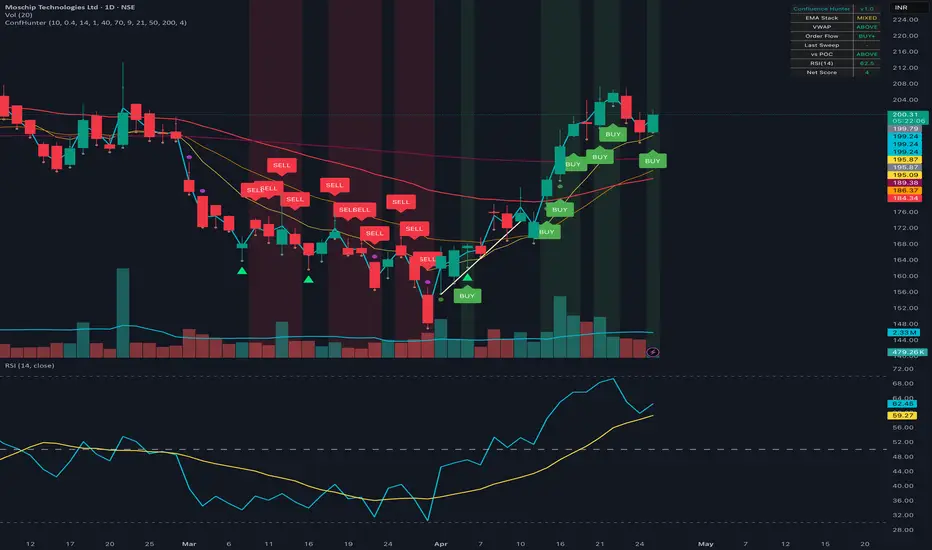
Confluence Hunter is a multi-factor confluence engine that fuses six independent dimensions of market behavior into one signal. Instead of firing on a single condition (a moving average cross, an RSI level), it only triggers when at least 4 of 6 factors agree on the same bar — dramatically cutting false signals.
THE SIX FACTORS
1. EMA STACK (Trend) — 9 / 21 / 50 / 200 EMAs. Stacked up = uptrend; stacked down = downtrend; mixed = chop, stay out.
2. SESSION VWAP (Fair Value) — Volume-weighted average price anchored to the daily session, with a configurable ±σ band. Price above VWAP = bulls in control.
3. LIQUIDITY SWEEPS (Structure) — Detects stop hunts: bars that pierce a recent swing high/low and snap back with a strong rejection wick (≥40% of range by default). These are the highest-edge structural events on the chart and act as the trigger.
4. ORDER FLOW DELTA (Intent) — Bar-by-bar buy/sell pressure derived from close position within range × volume, smoothed with an EMA. Strong-delta bars are highlighted with circle markers below/above.
5. SESSION VOLUME PROFILE (Acceptance) — Plots POC, VAH, and VAL for the active session using a configurable bin count (default 40 rows) and Value Area % (default 70%). Trading above POC with the trend = strong continuation; below POC against the trend = caution.
6. RSI(14) (Momentum) — Tiebreaker confirming momentum supports the bias.
CONFLUENCE SCORING
Each factor returns +1 (bullish), 0 (neutral), or −1 (bearish). The dashboard in the top-right shows the live status of each. A green BUY label fires only when bullish count ≥ 4 AND bearish count ≤ 1 (defaults). The same logic mirrors for SELL labels.
HOW TO USE FOR STOCK SELECTION
Step 1 — Filter by regime: throw it on the daily chart of every name in your watchlist. Skip anything with a MIXED EMA stack or trading on the wrong side of the 200 EMA.
Step 2 — Rank by Net Score: cycle the survivors and rank by the dashboard's Net Score (bullCount − bearCount, max ±6). +5 or +6 = A-tier setup.
Step 3 — Wait for a structural trigger: don't enter at +6 alone (you're late). Wait for either a fresh BUY/SELL label or a sweep arrow near a key level (VWAP, POC, or VAL).
Step 4 — Confirm on lower timeframe: drop to 1H/15m and require the same bullish/bearish state. Multi-timeframe alignment cuts losers significantly.
ENTRY / STOP / TARGET FRAMEWORK
- Entry: close of the BUY/SELL bar, or pullback to VWAP / 9-21 EMA on the next bar.
- Stop: just beyond the wick of the sweep bar.
- Target 1: opposite VWAP band (take 50% off).
- Target 2: prior session POC or next swing high; trail rest with 21 EMA.
INPUTS
All factors are tunable: swing lookback, sweep strictness (wick ratio), VWAP band width, volume profile rows and value area %, EMA lengths, and minimum confluence threshold (default 4 of 6 — raise to 5 for fewer/cleaner signals, lower to 3 for more visual analysis).
ALERTS
Built-in alerts for: Confluence BUY, Confluence SELL, Bullish Liquidity Sweep, Bearish Liquidity Sweep.
LIMITATIONS
- The order-flow delta is a proxy from close-position-in-range × volume. Pine Script does not have access to real exchange tick/footprint data. It is directionally useful but not equivalent to true CVD.
- Volume Profile is session-anchored (resets daily), not visible-range. For multi-day profiles, layer TradingView's built-in Volume Profile Visible Range on top.
- For Forex (where volume is tick-based, not real volume) the OF and VP factors are weaker — lean more on EMAs + VWAP + sweeps.
Works on any market: equities, futures, commodities, crypto, forex. Best on 1H, 4H, and Daily timeframes.
This script is free and open-source. Feedback and forks welcome.
THE SIX FACTORS
1. EMA STACK (Trend) — 9 / 21 / 50 / 200 EMAs. Stacked up = uptrend; stacked down = downtrend; mixed = chop, stay out.
2. SESSION VWAP (Fair Value) — Volume-weighted average price anchored to the daily session, with a configurable ±σ band. Price above VWAP = bulls in control.
3. LIQUIDITY SWEEPS (Structure) — Detects stop hunts: bars that pierce a recent swing high/low and snap back with a strong rejection wick (≥40% of range by default). These are the highest-edge structural events on the chart and act as the trigger.
4. ORDER FLOW DELTA (Intent) — Bar-by-bar buy/sell pressure derived from close position within range × volume, smoothed with an EMA. Strong-delta bars are highlighted with circle markers below/above.
5. SESSION VOLUME PROFILE (Acceptance) — Plots POC, VAH, and VAL for the active session using a configurable bin count (default 40 rows) and Value Area % (default 70%). Trading above POC with the trend = strong continuation; below POC against the trend = caution.
6. RSI(14) (Momentum) — Tiebreaker confirming momentum supports the bias.
CONFLUENCE SCORING
Each factor returns +1 (bullish), 0 (neutral), or −1 (bearish). The dashboard in the top-right shows the live status of each. A green BUY label fires only when bullish count ≥ 4 AND bearish count ≤ 1 (defaults). The same logic mirrors for SELL labels.
HOW TO USE FOR STOCK SELECTION
Step 1 — Filter by regime: throw it on the daily chart of every name in your watchlist. Skip anything with a MIXED EMA stack or trading on the wrong side of the 200 EMA.
Step 2 — Rank by Net Score: cycle the survivors and rank by the dashboard's Net Score (bullCount − bearCount, max ±6). +5 or +6 = A-tier setup.
Step 3 — Wait for a structural trigger: don't enter at +6 alone (you're late). Wait for either a fresh BUY/SELL label or a sweep arrow near a key level (VWAP, POC, or VAL).
Step 4 — Confirm on lower timeframe: drop to 1H/15m and require the same bullish/bearish state. Multi-timeframe alignment cuts losers significantly.
ENTRY / STOP / TARGET FRAMEWORK
- Entry: close of the BUY/SELL bar, or pullback to VWAP / 9-21 EMA on the next bar.
- Stop: just beyond the wick of the sweep bar.
- Target 1: opposite VWAP band (take 50% off).
- Target 2: prior session POC or next swing high; trail rest with 21 EMA.
INPUTS
All factors are tunable: swing lookback, sweep strictness (wick ratio), VWAP band width, volume profile rows and value area %, EMA lengths, and minimum confluence threshold (default 4 of 6 — raise to 5 for fewer/cleaner signals, lower to 3 for more visual analysis).
ALERTS
Built-in alerts for: Confluence BUY, Confluence SELL, Bullish Liquidity Sweep, Bearish Liquidity Sweep.
LIMITATIONS
- The order-flow delta is a proxy from close-position-in-range × volume. Pine Script does not have access to real exchange tick/footprint data. It is directionally useful but not equivalent to true CVD.
- Volume Profile is session-anchored (resets daily), not visible-range. For multi-day profiles, layer TradingView's built-in Volume Profile Visible Range on top.
- For Forex (where volume is tick-based, not real volume) the OF and VP factors are weaker — lean more on EMAs + VWAP + sweeps.
Works on any market: equities, futures, commodities, crypto, forex. Best on 1H, 4H, and Daily timeframes.
This script is free and open-source. Feedback and forks welcome.
Açık kaynak kodlu komut dosyası
Gerçek TradingView ruhuyla, bu komut dosyasının mimarı, yatırımcıların işlevselliğini inceleyip doğrulayabilmesi için onu açık kaynaklı hale getirdi. Yazarı tebrik ederiz! Ücretsiz olarak kullanabilseniz de, kodu yeniden yayınlamanın Topluluk Kurallarımıza tabi olduğunu unutmayın.

Feragatname
Bilgiler ve yayınlar, TradingView tarafından sağlanan veya onaylanan finansal, yatırım, alım satım veya diğer türden tavsiye veya öneriler anlamına gelmez ve teşkil etmez. Kullanım Koşulları bölümünde daha fazlasını okuyun.
Açık kaynak kodlu komut dosyası
Gerçek TradingView ruhuyla, bu komut dosyasının mimarı, yatırımcıların işlevselliğini inceleyip doğrulayabilmesi için onu açık kaynaklı hale getirdi. Yazarı tebrik ederiz! Ücretsiz olarak kullanabilseniz de, kodu yeniden yayınlamanın Topluluk Kurallarımıza tabi olduğunu unutmayın.
Feragatname
Bilgiler ve yayınlar, TradingView tarafından sağlanan veya onaylanan finansal, yatırım, alım satım veya diğer türden tavsiye veya öneriler anlamına gelmez ve teşkil etmez. Kullanım Koşulları bölümünde daha fazlasını okuyun.