OPEN-SOURCE SCRIPT
Güncellendi AI MES London Open Breakout
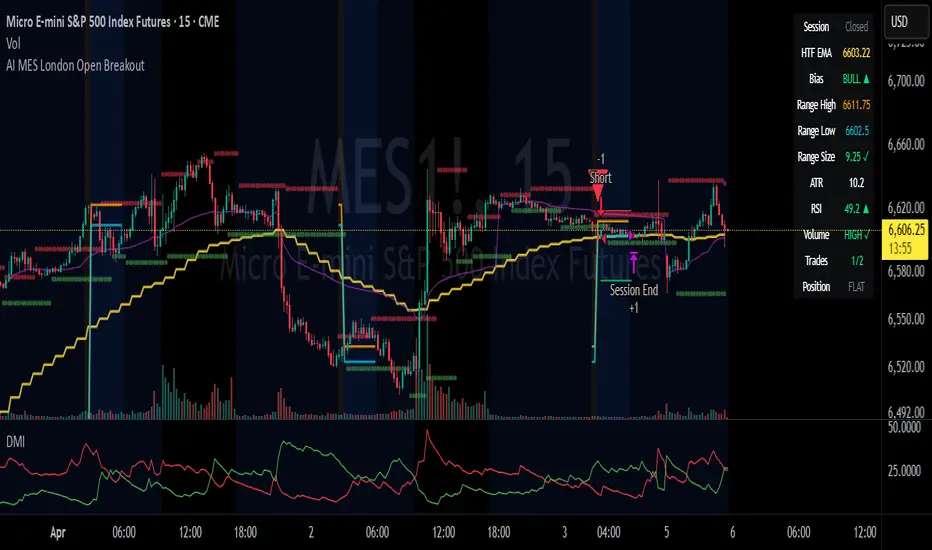
The core idea is the pre-London range — the 30 minutes from 2:30–3:00am ET where MES consolidates before London institutions come in. That range gets locked in at 3:00am and becomes the key levels for the session. A breakout above the range high is a long signal, below the range low is a short.
Two ways to get an entry:
Range breakout — price closes above/below the locked pre-London high/low
Pivot structure break — same as the daytime script, as a secondary trigger
Conservative risk settings specific to London:
Stop uses whichever is wider between the pivot-based stop and a 1.5× ATR floor — this protects against the thinner liquidity during London hours where stops get hunted more easily
Minimum range size filter (3 pts default) — if the pre-London range is too tight it means there's no real consolidation to break from, so no trades are taken
HTF bias uses the 1-hour EMA instead of 15-minute to account for the slower pace of off-hours price action
On the chart you'll see:
Orange shading = pre-London consolidation window (2:30–3:00am)
Blue shading = active London session (3:00–6:00am)
Orange line = locked pre-London high
Aqua line = locked pre-London low
Red background = London is active but range was too small to trade
For the London Open Breakout on MES, 3-minute is the sweet spot for the same reasons as the daytime script — slightly earlier entries than the 5-minute while still filtering out the 1-minute noise.
However the London session has a nuance worth considering:
3-minute — best for catching the initial breakout of the pre-London range cleanly. The first 30–60 minutes of London (3:00–4:00am ET) tends to have a strong directional move and the 3-minute captures it without too much lag. This is the recommended timeframe.
5-minute — slightly safer if you find the 3-minute generates too many false breakouts during the session. London liquidity, while better than Asian hours, is still thinner than the regular session so the 5-minute acts as a natural noise filter. Worth testing if the 3-minute backtest shows a lot of stopped-out trades in the first 15 minutes.
15-minute — only worth considering if you want very few signals and are focused purely on the macro London move rather than the initial breakout. You'll miss the best entries but the signals that do fire tend to be high conviction.
My recommendation: start on the 3-minute, run the Strategy Tester back 3–6 months, then run the same test on the 5-minute and compare the two. Specifically look at the win rate on trades that triggered in the first 30 minutes of the session (3:00–3:30am) vs later in the session — on London that first window is usually where the edge lives and the timeframe that captures it cleanest is your answer.
One thing to check in the backtest: if you see a lot of trades stopping out and then reversing to hit the original target, that's a sign the stop buffer or ATR multiplier needs widening rather than a timeframe problem.
Two ways to get an entry:
Range breakout — price closes above/below the locked pre-London high/low
Pivot structure break — same as the daytime script, as a secondary trigger
Conservative risk settings specific to London:
Stop uses whichever is wider between the pivot-based stop and a 1.5× ATR floor — this protects against the thinner liquidity during London hours where stops get hunted more easily
Minimum range size filter (3 pts default) — if the pre-London range is too tight it means there's no real consolidation to break from, so no trades are taken
HTF bias uses the 1-hour EMA instead of 15-minute to account for the slower pace of off-hours price action
On the chart you'll see:
Orange shading = pre-London consolidation window (2:30–3:00am)
Blue shading = active London session (3:00–6:00am)
Orange line = locked pre-London high
Aqua line = locked pre-London low
Red background = London is active but range was too small to trade
For the London Open Breakout on MES, 3-minute is the sweet spot for the same reasons as the daytime script — slightly earlier entries than the 5-minute while still filtering out the 1-minute noise.
However the London session has a nuance worth considering:
3-minute — best for catching the initial breakout of the pre-London range cleanly. The first 30–60 minutes of London (3:00–4:00am ET) tends to have a strong directional move and the 3-minute captures it without too much lag. This is the recommended timeframe.
5-minute — slightly safer if you find the 3-minute generates too many false breakouts during the session. London liquidity, while better than Asian hours, is still thinner than the regular session so the 5-minute acts as a natural noise filter. Worth testing if the 3-minute backtest shows a lot of stopped-out trades in the first 15 minutes.
15-minute — only worth considering if you want very few signals and are focused purely on the macro London move rather than the initial breakout. You'll miss the best entries but the signals that do fire tend to be high conviction.
My recommendation: start on the 3-minute, run the Strategy Tester back 3–6 months, then run the same test on the 5-minute and compare the two. Specifically look at the win rate on trades that triggered in the first 30 minutes of the session (3:00–3:30am) vs later in the session — on London that first window is usually where the edge lives and the timeframe that captures it cleanest is your answer.
One thing to check in the backtest: if you see a lot of trades stopping out and then reversing to hit the original target, that's a sign the stop buffer or ATR multiplier needs widening rather than a timeframe problem.
Sürüm Notları
Changed nameAçık kaynak kodlu komut dosyası
Gerçek TradingView ruhuyla, bu komut dosyasının mimarı, yatırımcıların işlevselliğini inceleyip doğrulayabilmesi için onu açık kaynaklı hale getirdi. Yazarı tebrik ederiz! Ücretsiz olarak kullanabilseniz de, kodu yeniden yayınlamanın Topluluk Kurallarımıza tabi olduğunu unutmayın.

Feragatname
Bilgiler ve yayınlar, TradingView tarafından sağlanan veya onaylanan finansal, yatırım, alım satım veya diğer türden tavsiye veya öneriler anlamına gelmez ve teşkil etmez. Kullanım Koşulları bölümünde daha fazlasını okuyun.
Açık kaynak kodlu komut dosyası
Gerçek TradingView ruhuyla, bu komut dosyasının mimarı, yatırımcıların işlevselliğini inceleyip doğrulayabilmesi için onu açık kaynaklı hale getirdi. Yazarı tebrik ederiz! Ücretsiz olarak kullanabilseniz de, kodu yeniden yayınlamanın Topluluk Kurallarımıza tabi olduğunu unutmayın.
Feragatname
Bilgiler ve yayınlar, TradingView tarafından sağlanan veya onaylanan finansal, yatırım, alım satım veya diğer türden tavsiye veya öneriler anlamına gelmez ve teşkil etmez. Kullanım Koşulları bölümünde daha fazlasını okuyun.