OPEN-SOURCE SCRIPT
Tulip mania - Holland 1634-1637
It started with a flower. But first, it started with a country that invented modern finance.
In the early 1600s, the tiny Dutch Republic — a soggy sliver of land reclaimed from the sea — somehow became the wealthiest nation on earth. The Dutch didn't just trade goods. They invented the tools of trading itself. In 1602, the Vereenigde Oostindische Compagnie (the VOC, or Dutch East India Company) became the first company in history to issue shares of stock to the public. Ordinary citizens could buy a piece of the enterprise and sell it to someone else. A revolutionary idea. The Amsterdam Bourse, established that same year, became the world's first formal stock exchange — a building where strangers gathered daily for the sole purpose of buying and selling paper that represented ownership of things they would never touch.
The Dutch pioneered futures contracts, short selling, options, debt-equity swaps, and merchant banking. They created the first central bank. They invented the concept of limited liability. They essentially wrote the rulebook for capitalism, four centuries before Wall Street existed. Amsterdam was the financial capital of the known world.
So when a speculative mania came along, it found the most sophisticated financial infrastructure ever built — and the most creative population of traders — ready and waiting.
It started with a flower.
In the 1590s, a Flemish botanist named Carolus Clusius brought tulip bulbs from the Ottoman Empire to the Dutch city of Leiden. The flowers were unlike anything Europe had seen — bold, symmetrical, with petals that seemed painted by hand. The most prized varieties displayed wild streaks of color, flame-like patterns of crimson on white or purple on yellow. Nobody knew it at the time, but these stunning patterns were caused by a virus — the tulip breaking virus — transmitted by aphids. The sicker the bulb, the more beautiful the flower. The more beautiful the flower, the more people wanted it.
By the 1630s, Amsterdam's merchants had money to burn and taste to prove. Tulips became the ultimate status symbol. A rare bulb in your garden said more about you than a portrait by Rembrandt. Growers in Haarlem cultivated prized specimens behind locked gates. Collectors paid handsomely. A gentleman's hobby, nothing more.
Then the speculators arrived.
In 1636, someone realized you didn't need to own a tulip to sell one. "Windhandel" — wind trade — was born: futures contracts for bulbs still buried in the ground. The same nation that had invented stock certificates and short selling now applied its financial genius to flowers. You could buy a tulip in January, sell the contract in February, and never touch soil. Paper changed hands instead of petals. The leverage was extraordinary. A chimney sweep could speculate alongside a merchant prince. And they did.
Trading moved into the taverns. Informal clubs called "collegia" sprang up in cities across Holland. Every evening, men crowded into backrooms to buy and sell tulip futures over mugs of beer and glasses of jenever. Rules were made up on the spot. Contracts were sealed with a handshake. An auction could see dozens of trades in a single night. The Dutch had built the most advanced financial system in history, and they were using it to trade flower bulbs. The atmosphere was electric.
By January 1637, prices had lost all connection to reality. Common Witte Croonen bulbs — nothing special, just white tulips — rose 26 times in a single month. Bulbs changed hands ten times in a day. People mortgaged their houses, sold their tools, borrowed against their furniture. A single Viceroy bulb sold for the equivalent of two tons of wheat, four oxen, eight pigs, twelve sheep, two barrels of wine, four barrels of beer, a thousand pounds of cheese, a bed, a suit of clothes, and a silver drinking cup. All for one flower.
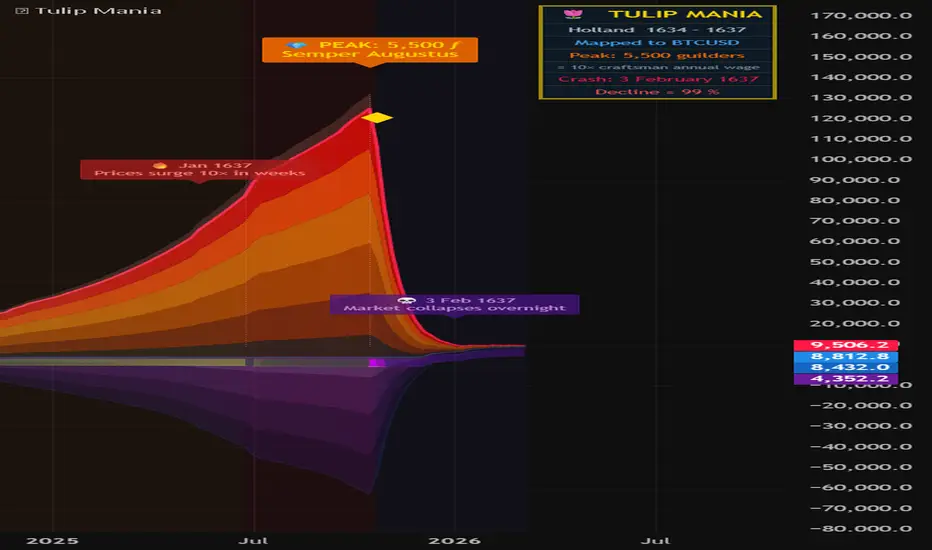
At the peak, the most legendary bulb of all — the Semper Augustus, a white tulip streaked with blood-red flames — fetched 5,500 guilders. That was enough to buy a grand canal house on the Keizersgracht in Amsterdam, complete with coach house and garden. A skilled craftsman earned 300 guilders a year. This was eighteen years of wages. For a single flower bulb. Only about twelve Semper Augustus bulbs existed in the entire world.
Then came Tuesday, 3 February 1637.
A routine auction in Haarlem. The auctioneer called the first lot. Silence. He lowered the price. More silence. No one bid. Not at any price. The room went cold. Word spread overnight. By Wednesday, every tulip market in every Dutch city had collapsed. Buyers refused to honor their contracts. Sellers couldn't find a single taker. Prices that had taken three years to build evaporated in three days.
The Dutch government tried to step in. Courts were asked to enforce the futures contracts. They refused, calling them little better than gambling debts. Parliament eventually ruled that buyers could settle at 3.5 cents on the guilder — paying just 3.5% of the promised price. Many couldn't even manage that. Fortunes built over lifetimes disappeared. Gardeners, weavers, innkeepers, and merchants alike were ruined.
The irony was profound. The nation that had invented the stock market, the futures contract, and the limited liability company — the nation that had given the world the very tools of modern finance — became the first to demonstrate what happens when those tools meet human greed and a beautiful flower.
The bulbs themselves, of course, were fine. They bloomed that spring as beautifully as ever.
Nearly four hundred years later, the Dutch Tulip Mania remains the most vivid cautionary tale in financial history — a reminder that when a crowd decides something is priceless, it usually means the price is about to collapse.
This indicator draws the shape of that bubble on your chart, scaled to whatever asset you are watching. The curve rises slowly through the early trade, accelerates through the speculation, goes vertical during the mania, and crashes to almost nothing. Hover over the labels for the full story at each stage.
Some shapes repeat across centuries. Decide for yourself if you see a resemblance.
In the early 1600s, the tiny Dutch Republic — a soggy sliver of land reclaimed from the sea — somehow became the wealthiest nation on earth. The Dutch didn't just trade goods. They invented the tools of trading itself. In 1602, the Vereenigde Oostindische Compagnie (the VOC, or Dutch East India Company) became the first company in history to issue shares of stock to the public. Ordinary citizens could buy a piece of the enterprise and sell it to someone else. A revolutionary idea. The Amsterdam Bourse, established that same year, became the world's first formal stock exchange — a building where strangers gathered daily for the sole purpose of buying and selling paper that represented ownership of things they would never touch.
The Dutch pioneered futures contracts, short selling, options, debt-equity swaps, and merchant banking. They created the first central bank. They invented the concept of limited liability. They essentially wrote the rulebook for capitalism, four centuries before Wall Street existed. Amsterdam was the financial capital of the known world.
So when a speculative mania came along, it found the most sophisticated financial infrastructure ever built — and the most creative population of traders — ready and waiting.
It started with a flower.
In the 1590s, a Flemish botanist named Carolus Clusius brought tulip bulbs from the Ottoman Empire to the Dutch city of Leiden. The flowers were unlike anything Europe had seen — bold, symmetrical, with petals that seemed painted by hand. The most prized varieties displayed wild streaks of color, flame-like patterns of crimson on white or purple on yellow. Nobody knew it at the time, but these stunning patterns were caused by a virus — the tulip breaking virus — transmitted by aphids. The sicker the bulb, the more beautiful the flower. The more beautiful the flower, the more people wanted it.
By the 1630s, Amsterdam's merchants had money to burn and taste to prove. Tulips became the ultimate status symbol. A rare bulb in your garden said more about you than a portrait by Rembrandt. Growers in Haarlem cultivated prized specimens behind locked gates. Collectors paid handsomely. A gentleman's hobby, nothing more.
Then the speculators arrived.
In 1636, someone realized you didn't need to own a tulip to sell one. "Windhandel" — wind trade — was born: futures contracts for bulbs still buried in the ground. The same nation that had invented stock certificates and short selling now applied its financial genius to flowers. You could buy a tulip in January, sell the contract in February, and never touch soil. Paper changed hands instead of petals. The leverage was extraordinary. A chimney sweep could speculate alongside a merchant prince. And they did.
Trading moved into the taverns. Informal clubs called "collegia" sprang up in cities across Holland. Every evening, men crowded into backrooms to buy and sell tulip futures over mugs of beer and glasses of jenever. Rules were made up on the spot. Contracts were sealed with a handshake. An auction could see dozens of trades in a single night. The Dutch had built the most advanced financial system in history, and they were using it to trade flower bulbs. The atmosphere was electric.
By January 1637, prices had lost all connection to reality. Common Witte Croonen bulbs — nothing special, just white tulips — rose 26 times in a single month. Bulbs changed hands ten times in a day. People mortgaged their houses, sold their tools, borrowed against their furniture. A single Viceroy bulb sold for the equivalent of two tons of wheat, four oxen, eight pigs, twelve sheep, two barrels of wine, four barrels of beer, a thousand pounds of cheese, a bed, a suit of clothes, and a silver drinking cup. All for one flower.
At the peak, the most legendary bulb of all — the Semper Augustus, a white tulip streaked with blood-red flames — fetched 5,500 guilders. That was enough to buy a grand canal house on the Keizersgracht in Amsterdam, complete with coach house and garden. A skilled craftsman earned 300 guilders a year. This was eighteen years of wages. For a single flower bulb. Only about twelve Semper Augustus bulbs existed in the entire world.
Then came Tuesday, 3 February 1637.
A routine auction in Haarlem. The auctioneer called the first lot. Silence. He lowered the price. More silence. No one bid. Not at any price. The room went cold. Word spread overnight. By Wednesday, every tulip market in every Dutch city had collapsed. Buyers refused to honor their contracts. Sellers couldn't find a single taker. Prices that had taken three years to build evaporated in three days.
The Dutch government tried to step in. Courts were asked to enforce the futures contracts. They refused, calling them little better than gambling debts. Parliament eventually ruled that buyers could settle at 3.5 cents on the guilder — paying just 3.5% of the promised price. Many couldn't even manage that. Fortunes built over lifetimes disappeared. Gardeners, weavers, innkeepers, and merchants alike were ruined.
The irony was profound. The nation that had invented the stock market, the futures contract, and the limited liability company — the nation that had given the world the very tools of modern finance — became the first to demonstrate what happens when those tools meet human greed and a beautiful flower.
The bulbs themselves, of course, were fine. They bloomed that spring as beautifully as ever.
Nearly four hundred years later, the Dutch Tulip Mania remains the most vivid cautionary tale in financial history — a reminder that when a crowd decides something is priceless, it usually means the price is about to collapse.
This indicator draws the shape of that bubble on your chart, scaled to whatever asset you are watching. The curve rises slowly through the early trade, accelerates through the speculation, goes vertical during the mania, and crashes to almost nothing. Hover over the labels for the full story at each stage.
Some shapes repeat across centuries. Decide for yourself if you see a resemblance.
Açık kaynak kodlu komut dosyası
Gerçek TradingView ruhuyla, bu komut dosyasının mimarı, yatırımcıların işlevselliğini inceleyip doğrulayabilmesi için onu açık kaynaklı hale getirdi. Yazarı tebrik ederiz! Ücretsiz olarak kullanabilseniz de, kodu yeniden yayınlamanın Topluluk Kurallarımıza tabi olduğunu unutmayın.

Feragatname
Bilgiler ve yayınlar, TradingView tarafından sağlanan veya onaylanan finansal, yatırım, alım satım veya diğer türden tavsiye veya öneriler anlamına gelmez ve teşkil etmez. Kullanım Koşulları bölümünde daha fazlasını okuyun.
Açık kaynak kodlu komut dosyası
Gerçek TradingView ruhuyla, bu komut dosyasının mimarı, yatırımcıların işlevselliğini inceleyip doğrulayabilmesi için onu açık kaynaklı hale getirdi. Yazarı tebrik ederiz! Ücretsiz olarak kullanabilseniz de, kodu yeniden yayınlamanın Topluluk Kurallarımıza tabi olduğunu unutmayın.
Feragatname
Bilgiler ve yayınlar, TradingView tarafından sağlanan veya onaylanan finansal, yatırım, alım satım veya diğer türden tavsiye veya öneriler anlamına gelmez ve teşkil etmez. Kullanım Koşulları bölümünde daha fazlasını okuyun.