

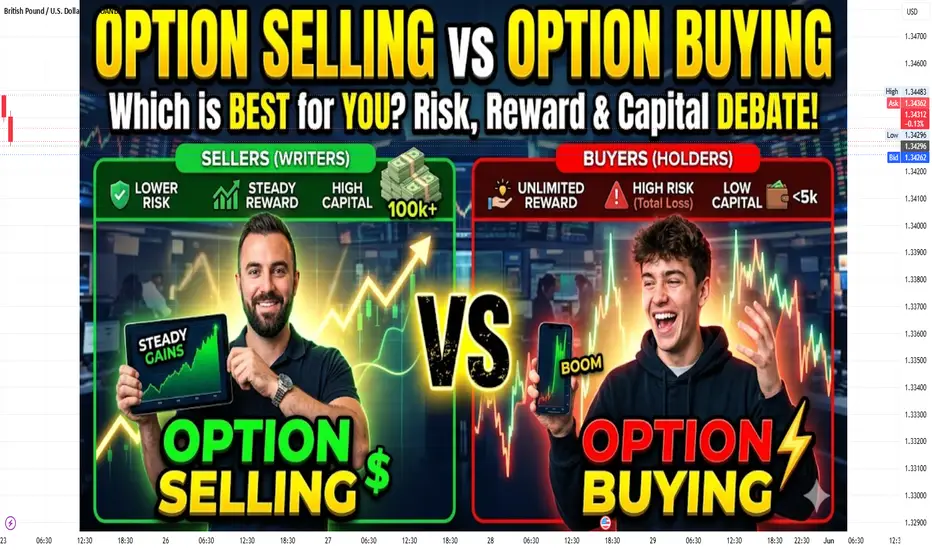
Option Selling vs Option Buying
Compare Risk, Reward & Capital Requirements
Introduction
In the options market, traders mainly use two approaches: Option Buying and Option Selling. Both strategies can generate profits, but they work very differently in terms of risk, reward, probability, and capital requirement.
Many beginners are attracted toward option buying because of small capital and high-return potential, while experienced traders often prefer option selling because of higher probability and time decay advantage.
Understanding the difference between these two approaches is extremely important before entering the derivatives market.
What is Option Buying?
Option buying means purchasing a Call Option (CE) or Put Option (PE) with the expectation that the market will make a strong move.
Buy Call → Bullish View
Buy Put → Bearish View
The buyer pays a premium to the seller for the right to trade the contract.
Key Features of Option Buying
Limited Risk
Unlimited Profit Potential (in theory)
Requires lower capital
Works best during strong trending moves
Highly sensitive to volatility and time decay
What is Option Selling?
Option selling means selling option premiums to earn income from time decay and market stability.
Sell Call → Bearish/Neutral View
Sell Put → Bullish/Neutral View
The seller receives premium upfront and profits if options expire worthless.
Key Features of Option Selling
High Probability Strategy
Limited Profit
Potentially Unlimited Risk (in naked selling)
Requires higher margin capital
Benefits from time decay (Theta)
Risk Comparison
Option Buying Risk
The maximum loss in option buying is limited to the premium paid.
Example:
If a trader buys a NIFTY Call Option for ₹100 premium and the market moves against the position, the maximum loss is only ₹100 per lot quantity.
This makes option buying attractive for small traders.
Main Risks in Option Buying
Time Decay (Theta)
False Breakouts
Volatility Crush
Premium Erosion
Fast Capital Loss During Sideways Markets
Option Selling Risk
Option sellers face higher risk because losses can expand rapidly during sharp market moves.
Example:
If a trader sells a Call Option and the market suddenly rallies strongly, losses may become very large.
Main Risks in Option Selling
Unlimited Risk in Naked Selling
Sudden Gap-Up or Gap-Down Moves
News/Event Volatility
Margin Pressure
Emotional Stress During Trending Markets
Reward Comparison
Option Buying Reward
Option buying offers explosive reward potential.
A small premium can sometimes generate multiple times return during strong momentum.
Example:
Buy Option at ₹20
Premium moves to ₹120
Return = 500%
This is why option buying becomes popular during:
Breakout Trading
News-Based Moves
Budget Day
Election Results
High Volatility Sessions
Option Selling Reward
Option selling generally provides smaller but consistent rewards.
The seller earns from:
Time Decay
Premium Reduction
Sideways Markets
Low Volatility Conditions
Professional traders often focus on:
Consistency
Probability
Risk Management
rather than chasing very large gains.
Capital Requirement Comparison
Factor Option Buying Option Selling
Capital Needed Low High
Margin Requirement Minimal Significant
Leverage High Moderate
Suitable for Small Accounts Yes Limited
Risk Exposure Limited High
Time Decay Advantage
One of the biggest differences between option buying and selling is Theta Decay.
Option Buyers
Time decay works against buyers.
Even if the market remains sideways, option premiums slowly lose value daily.
Option Sellers
Time decay benefits sellers.
As expiry approaches, premiums decay faster, helping sellers earn profits even without major market movement.
Market Condition Suitability
Best Conditions for Option Buying
Strong Trending Market
Breakout Momentum
High Volatility Expansion
News-Driven Sessions
Best Conditions for Option Selling
Sideways Market
Range-Bound Conditions
Volatility Decline
Stable Market Structure
Psychology Difference
Option Buyers
Need:
Patience
Accurate Entry Timing
Fast Decision Making
Momentum Identification
Option buyers often face emotional pressure because premiums move very quickly.
Option Sellers
Need:
Strong Risk Management
Discipline
Hedging Knowledge
Position Sizing Control
Option sellers usually focus more on probability and consistency.
Which Strategy is Better?
There is no single “best” strategy.
The better approach depends on:
Market Condition
Trading Experience
Risk Appetite
Capital Size
Psychological Discipline
Generally:
Beginners often start with option buying because risk is limited.
Experienced traders prefer option selling for consistency and probability advantage.
Professional Insight
Smart traders do not blindly choose buying or selling every day.
They adapt according to:
Volatility
Market Structure
Institutional Activity
Trend Strength
Liquidity Zones
Professional trading is not about predicting every move.
It is about managing risk efficiently while protecting capital.

相關出版品
免責聲明
這些資訊和出版物並非旨在提供,也不構成TradingView提供或認可的任何形式的財務、投資、交易或其他類型的建議或推薦。請閱讀使用條款以了解更多資訊。