
Oracle (ORCL): Oversold Conditions and Strong OCI Demand Point to a Tactical Rebound
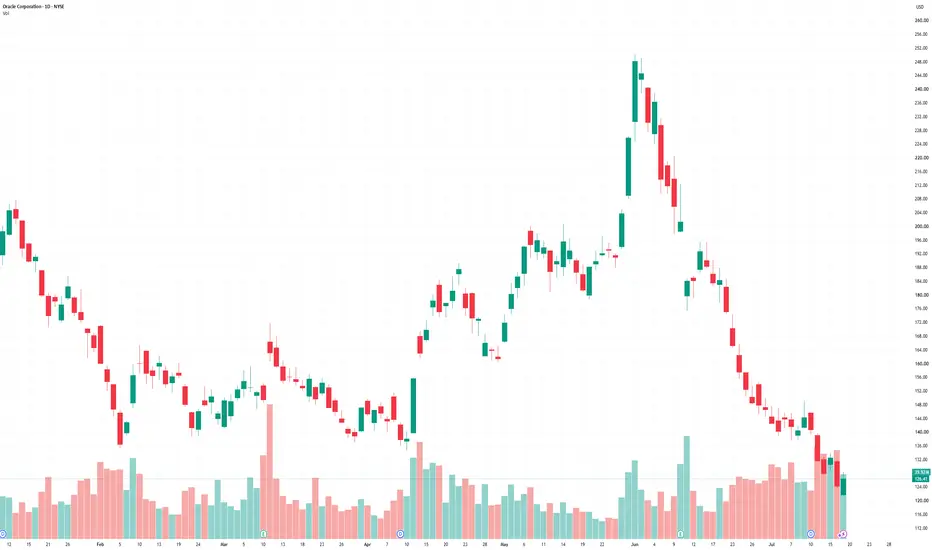
We expect a tactical rebound in Oracle shares over the next two months. The stock has moved into oversold territory following a sharp correction, even though demand for Oracle Cloud Infrastructure (OCI) remains strong and remaining performance obligations (RPO) have reached $638 billion. The main catalyst will be Oracle’s first-quarter fiscal 2027 earnings report, with investors focused on OCI growth, RPO trends, and capital expenditures (capex). Additional support could come from a rotation out of semiconductors and into software: the semiconductor ETF SMH is showing near-term weakness, while the software ETF IGV maintains an upward bias and continues to outperform the broader market.
Ticker: ORCL
Price at the time of analysis (July 16, 2026): $132.49
Current price (July 17, 2026): $123.71
Target: $158.21
Stop-loss: $115.34
Investment Thesis
Oracle combines resilient database and enterprise applications businesses with the rapidly growing OCI platform.
The recent correction appears to reflect concerns about funding and capital intensity rather than weakening demand. In Q4, OCI revenue increased by 93%, while RPO reached $638 billion, up $85 billion quarter over quarter. At the same time, major AI contracts worth $75 billion require customer prepayments or the use of customer-owned equipment, reducing Oracle’s funding burden.
Oracle’s Q1 FY2027 earnings report, expected in mid-September, will be the key near-term catalyst. FactSet consensus estimates call for revenue of $19.1 billion, up 28%; EPS of $1.73; cloud revenue of $11.5 billion; and OCI revenue of approximately $7.1 billion.
Because these estimates are close to management guidance, a modest beat may not be enough to drive a sustained re-rating. Positive signals would include RPO above $617.9 billion, capex below $19.0 billion, and evidence that backlog monetization can offset pressure from a 61.9% gross margin and negative free cash flow of $9.7 billion.
Sector rotation further strengthens the thesis. SMH currently appears weaker, while IGV maintains an upward bias and continues to outperform the broader market. This suggests capital may be rotating from AI semiconductors into software.
Continued OCI growth and a resilient software revenue stream could support ORCL. An RSI reading near 30, combined with the $119–132 support zone, increases the likelihood of a rebound toward $149–152.
Conclusion: Buy
The key conditions supporting the thesis are sustained RPO growth, capex discipline, and continued OCI momentum.
We expect a tactical rebound in Oracle shares over the next two months. The stock has moved into oversold territory following a sharp correction, even though demand for Oracle Cloud Infrastructure (OCI) remains strong and remaining performance obligations (RPO) have reached $638 billion. The main catalyst will be Oracle’s first-quarter fiscal 2027 earnings report, with investors focused on OCI growth, RPO trends, and capital expenditures (capex). Additional support could come from a rotation out of semiconductors and into software: the semiconductor ETF SMH is showing near-term weakness, while the software ETF IGV maintains an upward bias and continues to outperform the broader market.
Ticker: ORCL
Price at the time of analysis (July 16, 2026): $132.49
Current price (July 17, 2026): $123.71
Target: $158.21
Stop-loss: $115.34
Investment Thesis
Oracle combines resilient database and enterprise applications businesses with the rapidly growing OCI platform.
The recent correction appears to reflect concerns about funding and capital intensity rather than weakening demand. In Q4, OCI revenue increased by 93%, while RPO reached $638 billion, up $85 billion quarter over quarter. At the same time, major AI contracts worth $75 billion require customer prepayments or the use of customer-owned equipment, reducing Oracle’s funding burden.
Oracle’s Q1 FY2027 earnings report, expected in mid-September, will be the key near-term catalyst. FactSet consensus estimates call for revenue of $19.1 billion, up 28%; EPS of $1.73; cloud revenue of $11.5 billion; and OCI revenue of approximately $7.1 billion.
Because these estimates are close to management guidance, a modest beat may not be enough to drive a sustained re-rating. Positive signals would include RPO above $617.9 billion, capex below $19.0 billion, and evidence that backlog monetization can offset pressure from a 61.9% gross margin and negative free cash flow of $9.7 billion.
Sector rotation further strengthens the thesis. SMH currently appears weaker, while IGV maintains an upward bias and continues to outperform the broader market. This suggests capital may be rotating from AI semiconductors into software.
Continued OCI growth and a resilient software revenue stream could support ORCL. An RSI reading near 30, combined with the $119–132 support zone, increases the likelihood of a rebound toward $149–152.
Conclusion: Buy
The key conditions supporting the thesis are sustained RPO growth, capex discipline, and continued OCI momentum.

免責聲明
這些資訊和出版物並非旨在提供,也不構成TradingView提供或認可的任何形式的財務、投資、交易或其他類型的建議或推薦。請閱讀使用條款以了解更多資訊。
免責聲明
這些資訊和出版物並非旨在提供,也不構成TradingView提供或認可的任何形式的財務、投資、交易或其他類型的建議或推薦。請閱讀使用條款以了解更多資訊。