
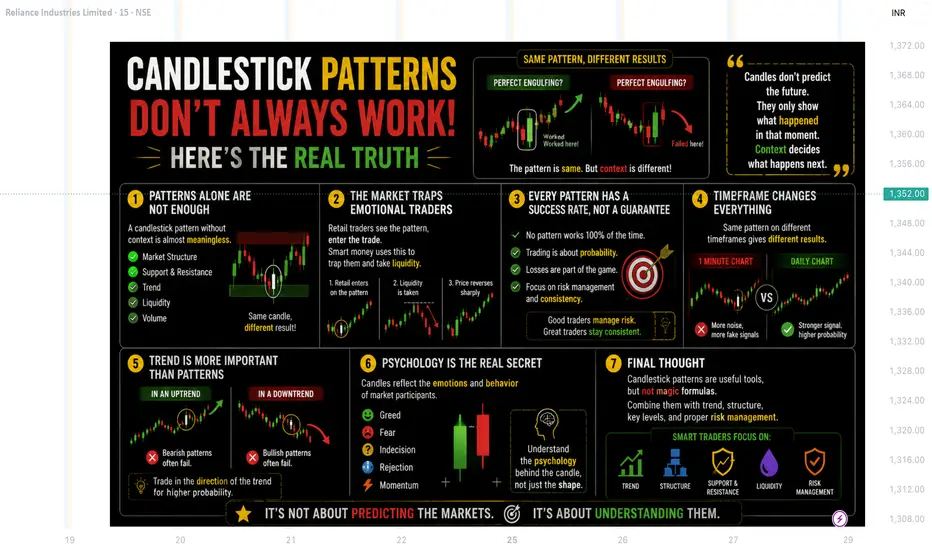
Candlestick patterns are one of the first things every trader learns.
You’ve probably seen patterns like:
* Doji
* Hammer
* Engulfing Candle
* Shooting Star
And many beginners believe:
“If this candle appears, the market will definitely reverse.”
But after some time, reality hits hard.
The pattern looks perfect… You enter the trade… And price moves in the opposite direction.
So the big question is:
Do candlestick patterns actually work?
The answer is: Yes — but not the way most traders think.
Let’s understand the real truth behind candlestick patterns in simple language.
1. Candlestick Patterns Alone Are Not Enough
This is the biggest mistake beginners make.
Most traders treat candlestick patterns like magic signals.
For example:
* Hammer = Buy
* Bearish Engulfing = Sell
But markets are not that simple.
A candlestick pattern without proper context is almost meaningless.
The same bullish candle can:
* work perfectly in one area,
* and fail completely in another.
Professional traders never trade candles alone. They combine them with:
* market structure,
* support & resistance,
* trend,
* liquidity,
* and volume.
Context matters more than the candle itself.
2. The Market Traps Emotional Traders
Candlestick patterns are very popular.
And because millions of retail traders watch the same patterns, markets often create fake signals.
For example:
* a perfect breakout candle appears,
* traders enter emotionally,
* smart money traps them,
* and price reverses sharply.
This is why beginners feel:
“The market always moves against me.”
In reality, the market reacts to liquidity and emotions — not textbook patterns.
3. Every Pattern Has a Success Rate — Not a Guarantee
Many traders think candlestick patterns predict the future.
That is completely wrong.
No pattern works 100% of the time.
Even the best setups can fail.
Trading is about:
* probability,
* risk management,
* and consistency.
Professional traders understand that losses are part of the game.
They focus on managing risk instead of searching for “perfect patterns.”
4. Timeframe Changes Everything
A candlestick pattern on a 1-minute chart is very different from one on a daily chart.
Lower timeframes contain:
* more noise,
* fake moves,
* and emotional trading.
Higher timeframe patterns are usually more reliable because they reflect stronger market participation.
For example:
* a bullish engulfing candle on the daily chart carries more weight than one on the 1-minute chart.
Always check the bigger picture before taking trades.
5. Trend Is More Important Than Patterns
Many beginners try to sell every bearish candle and buy every bullish candle.
But strong trends can destroy reversal setups.
For example:
* In a strong uptrend, bearish candles may fail repeatedly.
* In a strong downtrend, bullish reversals may not work.
That’s why smart traders always ask:
“What is the overall market direction?”
Trading with the trend increases probability significantly.
6. Psychology Is the Real Secret
Candlestick patterns work because they reflect trader psychology.
A candle simply shows:
* fear,
* greed,
* rejection,
* momentum,
* or indecision.
The candle itself is not magical.
The real skill is understanding:
* who is in control,
* where traders are trapped,
* and why price is reacting.
Once you understand psychology, candles start making much more sense.
7. Final Thoughts
Candlestick patterns are useful tools — but they are not magic formulas.
Most beginners fail because they:
* trade patterns blindly,
* ignore market context,
* and expect every setup to work perfectly.
The real truth is:
Candlestick patterns only work when combined with proper market understanding.
Focus on:
* trend,
* structure,
* support & resistance,
* liquidity,
* and risk management.
Because in trading, understanding the story behind the candle is more important than the candle itself.
You’ve probably seen patterns like:
* Doji
* Hammer
* Engulfing Candle
* Shooting Star
And many beginners believe:
“If this candle appears, the market will definitely reverse.”
But after some time, reality hits hard.
The pattern looks perfect… You enter the trade… And price moves in the opposite direction.
So the big question is:
Do candlestick patterns actually work?
The answer is: Yes — but not the way most traders think.
Let’s understand the real truth behind candlestick patterns in simple language.
1. Candlestick Patterns Alone Are Not Enough
This is the biggest mistake beginners make.
Most traders treat candlestick patterns like magic signals.
For example:
* Hammer = Buy
* Bearish Engulfing = Sell
But markets are not that simple.
A candlestick pattern without proper context is almost meaningless.
The same bullish candle can:
* work perfectly in one area,
* and fail completely in another.
Professional traders never trade candles alone. They combine them with:
* market structure,
* support & resistance,
* trend,
* liquidity,
* and volume.
Context matters more than the candle itself.
2. The Market Traps Emotional Traders
Candlestick patterns are very popular.
And because millions of retail traders watch the same patterns, markets often create fake signals.
For example:
* a perfect breakout candle appears,
* traders enter emotionally,
* smart money traps them,
* and price reverses sharply.
This is why beginners feel:
“The market always moves against me.”
In reality, the market reacts to liquidity and emotions — not textbook patterns.
3. Every Pattern Has a Success Rate — Not a Guarantee
Many traders think candlestick patterns predict the future.
That is completely wrong.
No pattern works 100% of the time.
Even the best setups can fail.
Trading is about:
* probability,
* risk management,
* and consistency.
Professional traders understand that losses are part of the game.
They focus on managing risk instead of searching for “perfect patterns.”
4. Timeframe Changes Everything
A candlestick pattern on a 1-minute chart is very different from one on a daily chart.
Lower timeframes contain:
* more noise,
* fake moves,
* and emotional trading.
Higher timeframe patterns are usually more reliable because they reflect stronger market participation.
For example:
* a bullish engulfing candle on the daily chart carries more weight than one on the 1-minute chart.
Always check the bigger picture before taking trades.
5. Trend Is More Important Than Patterns
Many beginners try to sell every bearish candle and buy every bullish candle.
But strong trends can destroy reversal setups.
For example:
* In a strong uptrend, bearish candles may fail repeatedly.
* In a strong downtrend, bullish reversals may not work.
That’s why smart traders always ask:
“What is the overall market direction?”
Trading with the trend increases probability significantly.
6. Psychology Is the Real Secret
Candlestick patterns work because they reflect trader psychology.
A candle simply shows:
* fear,
* greed,
* rejection,
* momentum,
* or indecision.
The candle itself is not magical.
The real skill is understanding:
* who is in control,
* where traders are trapped,
* and why price is reacting.
Once you understand psychology, candles start making much more sense.
7. Final Thoughts
Candlestick patterns are useful tools — but they are not magic formulas.
Most beginners fail because they:
* trade patterns blindly,
* ignore market context,
* and expect every setup to work perfectly.
The real truth is:
Candlestick patterns only work when combined with proper market understanding.
Focus on:
* trend,
* structure,
* support & resistance,
* liquidity,
* and risk management.
Because in trading, understanding the story behind the candle is more important than the candle itself.

免責聲明
這些資訊和出版物並非旨在提供,也不構成TradingView提供或認可的任何形式的財務、投資、交易或其他類型的建議或推薦。請閱讀使用條款以了解更多資訊。
免責聲明
這些資訊和出版物並非旨在提供,也不構成TradingView提供或認可的任何形式的財務、投資、交易或其他類型的建議或推薦。請閱讀使用條款以了解更多資訊。