
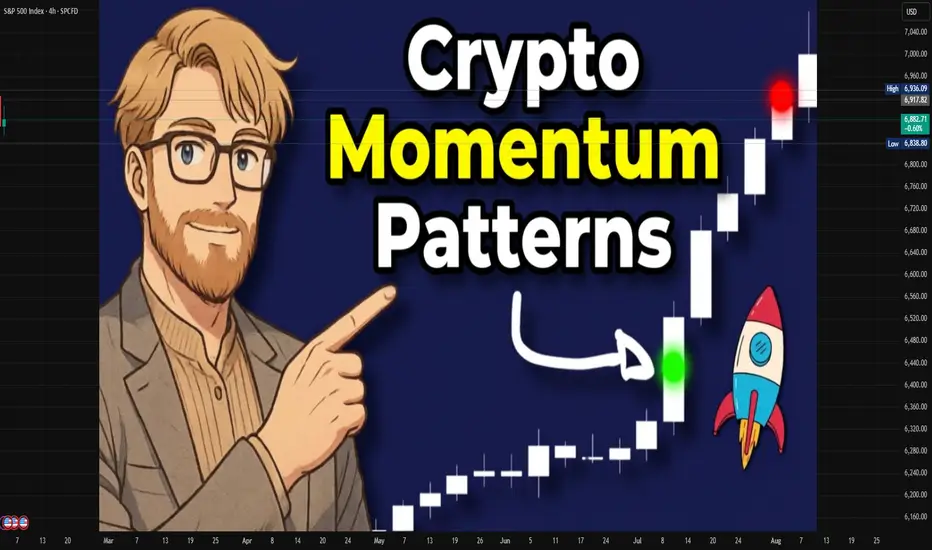
Understanding Momentum in Crypto Markets
Momentum refers to the speed and strength of price movement in a particular direction. In crypto markets, momentum is driven by a combination of factors such as liquidity inflows, news events, social media hype, whale activity, derivatives positioning, and macroeconomic sentiment.
Unlike equities, where institutional flows dominate, crypto momentum often begins with retail enthusiasm and is amplified by leverage in futures markets. This creates exaggerated price movements, making momentum patterns more pronounced and more frequent.
Why Momentum Is Stronger in Cryptocurrencies
Cryptocurrency markets exhibit stronger momentum patterns than most traditional assets due to:
High Volatility – Daily moves of 5–15% are common.
Leverage Availability – Futures allow 10x–100x leverage, accelerating trends.
24/7 Trading – No closing bell means trends evolve continuously.
Narrative-Driven Moves – News, tweets, and narratives can trigger instant momentum.
Lower Liquidity in Altcoins – Small capital inflows can cause explosive price action.
These characteristics make momentum trading especially attractive—but also risky.
Major Momentum Patterns in Cryptocurrency Markets
1. Breakout Momentum Pattern
Breakouts occur when price moves beyond a well-defined resistance or support zone with increased volume.
Crypto-specific traits:
Breakouts often happen during low-liquidity periods.
Fake breakouts are common due to stop-hunting.
Volume confirmation is crucial.
Strong breakout signals include:
Expansion in volume
Large candle bodies
Open Interest increasing with price
Breakout momentum works best in high-liquidity coins like Bitcoin, Ethereum, and top-tier altcoins.
2. Trend Continuation Momentum
Once a trend is established, crypto markets often show extended continuation phases.
Common continuation patterns include:
Bull flags
Bear flags
Ascending or descending channels
Consolidation above key moving averages
In strong bull markets, cryptocurrencies can remain overbought for extended periods, making traditional indicators less effective. Traders who wait for “cheap” prices often miss the move entirely.
3. Parabolic Momentum Pattern
Parabolic moves are unique to crypto markets and occur when buying pressure becomes exponential.
Characteristics:
Steep price angle
Increasing candle size
RSI staying above 70 for long periods
Media and social hype at extremes
While parabolic momentum can produce massive gains, it is unsustainable. The end often comes with a sharp vertical drop, trapping late buyers.
4. Momentum Divergence Pattern
Divergences occur when price continues to make higher highs or lower lows while momentum indicators fail to confirm.
Common divergence types:
Bearish divergence (price up, momentum down)
Bullish divergence (price down, momentum up)
In crypto, divergences are early warnings, not immediate reversal signals. Strong trends can ignore divergences for extended periods, especially in Bitcoin during macro-driven cycles.
5. Mean Reversion Momentum Exhaustion
Crypto markets frequently experience momentum exhaustion, where price moves too far too fast.
Signs include:
Long wick candles
Declining volume at highs
Extreme funding rates
Overcrowded long or short positions
This often leads to sharp pullbacks or sideways consolidation rather than immediate trend reversal.
Momentum Indicators Commonly Used in Crypto Trading
Relative Strength Index (RSI)
RSI measures momentum strength but behaves differently in crypto:
RSI above 70 can persist for weeks
RSI below 30 often leads to short-term bounces
RSI mid-range (40–60) signals consolidation
Moving Averages
Momentum traders watch:
20 EMA for short-term momentum
50 EMA for trend confirmation
200 EMA for macro bias
Strong momentum often keeps price above key EMAs with shallow pullbacks.
MACD
MACD works best on higher time frames in crypto. Frequent false signals appear on lower time frames due to volatility.
Volume and Open Interest
True momentum requires participation:
Rising price + rising volume = healthy momentum
Rising price + falling volume = weak momentum
Rising Open Interest confirms leveraged participation
Role of Derivatives in Crypto Momentum
Futures and options markets significantly influence momentum patterns.
Key elements:
Funding rates reflect crowd bias
Liquidations accelerate momentum
Stop-loss cascades amplify moves
Large liquidation events often create forced momentum, leading to exaggerated candles known as “liquidation wicks.”
Momentum Across Market Cycles
Bull Market Momentum
Strong continuation patterns
Shallow pullbacks
Altcoins outperform Bitcoin
Narratives dominate fundamentals
Bear Market Momentum
Sharp relief rallies
Lower highs and lower lows
Momentum fades quickly
Volume dries up
Understanding the broader cycle is critical because the same momentum signal behaves differently depending on market conditions.
Risks of Momentum Trading in Crypto
Momentum trading is not without danger.
Major risks include:
Fake breakouts
Sudden reversals from whale activity
News-driven volatility
High leverage liquidation
Risk management is essential. Stop-loss placement, position sizing, and avoiding emotional entries are more important than indicator selection.
Best Practices for Trading Momentum in Crypto
Trade in the direction of the higher-time-frame trend
Use volume and Open Interest confirmation
Avoid chasing late-stage parabolic moves
Combine price action with momentum indicators
Respect volatility—reduce leverage during high uncertainty
Successful momentum traders focus not on predicting tops or bottoms but on participating in the middle of the move.
Conclusion
Momentum patterns in cryptocurrency markets are powerful, fast-moving, and emotionally charged. They arise from a unique blend of retail behavior, leverage, narrative influence, and structural market features. While momentum can generate outsized profits, it demands discipline, adaptability, and strong risk management.
By understanding breakout momentum, trend continuation, parabolic phases, divergence signals, and exhaustion patterns, traders can better navigate crypto’s volatile landscape. In a market where prices can double or halve in days, mastering momentum is not optional—it is essential.
Momentum refers to the speed and strength of price movement in a particular direction. In crypto markets, momentum is driven by a combination of factors such as liquidity inflows, news events, social media hype, whale activity, derivatives positioning, and macroeconomic sentiment.
Unlike equities, where institutional flows dominate, crypto momentum often begins with retail enthusiasm and is amplified by leverage in futures markets. This creates exaggerated price movements, making momentum patterns more pronounced and more frequent.
Why Momentum Is Stronger in Cryptocurrencies
Cryptocurrency markets exhibit stronger momentum patterns than most traditional assets due to:
High Volatility – Daily moves of 5–15% are common.
Leverage Availability – Futures allow 10x–100x leverage, accelerating trends.
24/7 Trading – No closing bell means trends evolve continuously.
Narrative-Driven Moves – News, tweets, and narratives can trigger instant momentum.
Lower Liquidity in Altcoins – Small capital inflows can cause explosive price action.
These characteristics make momentum trading especially attractive—but also risky.
Major Momentum Patterns in Cryptocurrency Markets
1. Breakout Momentum Pattern
Breakouts occur when price moves beyond a well-defined resistance or support zone with increased volume.
Crypto-specific traits:
Breakouts often happen during low-liquidity periods.
Fake breakouts are common due to stop-hunting.
Volume confirmation is crucial.
Strong breakout signals include:
Expansion in volume
Large candle bodies
Open Interest increasing with price
Breakout momentum works best in high-liquidity coins like Bitcoin, Ethereum, and top-tier altcoins.
2. Trend Continuation Momentum
Once a trend is established, crypto markets often show extended continuation phases.
Common continuation patterns include:
Bull flags
Bear flags
Ascending or descending channels
Consolidation above key moving averages
In strong bull markets, cryptocurrencies can remain overbought for extended periods, making traditional indicators less effective. Traders who wait for “cheap” prices often miss the move entirely.
3. Parabolic Momentum Pattern
Parabolic moves are unique to crypto markets and occur when buying pressure becomes exponential.
Characteristics:
Steep price angle
Increasing candle size
RSI staying above 70 for long periods
Media and social hype at extremes
While parabolic momentum can produce massive gains, it is unsustainable. The end often comes with a sharp vertical drop, trapping late buyers.
4. Momentum Divergence Pattern
Divergences occur when price continues to make higher highs or lower lows while momentum indicators fail to confirm.
Common divergence types:
Bearish divergence (price up, momentum down)
Bullish divergence (price down, momentum up)
In crypto, divergences are early warnings, not immediate reversal signals. Strong trends can ignore divergences for extended periods, especially in Bitcoin during macro-driven cycles.
5. Mean Reversion Momentum Exhaustion
Crypto markets frequently experience momentum exhaustion, where price moves too far too fast.
Signs include:
Long wick candles
Declining volume at highs
Extreme funding rates
Overcrowded long or short positions
This often leads to sharp pullbacks or sideways consolidation rather than immediate trend reversal.
Momentum Indicators Commonly Used in Crypto Trading
Relative Strength Index (RSI)
RSI measures momentum strength but behaves differently in crypto:
RSI above 70 can persist for weeks
RSI below 30 often leads to short-term bounces
RSI mid-range (40–60) signals consolidation
Moving Averages
Momentum traders watch:
20 EMA for short-term momentum
50 EMA for trend confirmation
200 EMA for macro bias
Strong momentum often keeps price above key EMAs with shallow pullbacks.
MACD
MACD works best on higher time frames in crypto. Frequent false signals appear on lower time frames due to volatility.
Volume and Open Interest
True momentum requires participation:
Rising price + rising volume = healthy momentum
Rising price + falling volume = weak momentum
Rising Open Interest confirms leveraged participation
Role of Derivatives in Crypto Momentum
Futures and options markets significantly influence momentum patterns.
Key elements:
Funding rates reflect crowd bias
Liquidations accelerate momentum
Stop-loss cascades amplify moves
Large liquidation events often create forced momentum, leading to exaggerated candles known as “liquidation wicks.”
Momentum Across Market Cycles
Bull Market Momentum
Strong continuation patterns
Shallow pullbacks
Altcoins outperform Bitcoin
Narratives dominate fundamentals
Bear Market Momentum
Sharp relief rallies
Lower highs and lower lows
Momentum fades quickly
Volume dries up
Understanding the broader cycle is critical because the same momentum signal behaves differently depending on market conditions.
Risks of Momentum Trading in Crypto
Momentum trading is not without danger.
Major risks include:
Fake breakouts
Sudden reversals from whale activity
News-driven volatility
High leverage liquidation
Risk management is essential. Stop-loss placement, position sizing, and avoiding emotional entries are more important than indicator selection.
Best Practices for Trading Momentum in Crypto
Trade in the direction of the higher-time-frame trend
Use volume and Open Interest confirmation
Avoid chasing late-stage parabolic moves
Combine price action with momentum indicators
Respect volatility—reduce leverage during high uncertainty
Successful momentum traders focus not on predicting tops or bottoms but on participating in the middle of the move.
Conclusion
Momentum patterns in cryptocurrency markets are powerful, fast-moving, and emotionally charged. They arise from a unique blend of retail behavior, leverage, narrative influence, and structural market features. While momentum can generate outsized profits, it demands discipline, adaptability, and strong risk management.
By understanding breakout momentum, trend continuation, parabolic phases, divergence signals, and exhaustion patterns, traders can better navigate crypto’s volatile landscape. In a market where prices can double or halve in days, mastering momentum is not optional—it is essential.

Hye Guys,Welcome to a professional trading journey built on precision, discipline, and smart money concepts.
📞 Phone: +91 93159 78955
💬 WhatsApp: wa.link/kdkejz
📩 Contact Mail: globalwolfstreet@gmail.com
📞 Phone: +91 93159 78955
💬 WhatsApp: wa.link/kdkejz
📩 Contact Mail: globalwolfstreet@gmail.com
相關出版品
免責聲明
這些資訊和出版物並非旨在提供,也不構成TradingView提供或認可的任何形式的財務、投資、交易或其他類型的建議或推薦。請閱讀使用條款以了解更多資訊。
Hye Guys,Welcome to a professional trading journey built on precision, discipline, and smart money concepts.
📞 Phone: +91 93159 78955
💬 WhatsApp: wa.link/kdkejz
📩 Contact Mail: globalwolfstreet@gmail.com
📞 Phone: +91 93159 78955
💬 WhatsApp: wa.link/kdkejz
📩 Contact Mail: globalwolfstreet@gmail.com
相關出版品
免責聲明
這些資訊和出版物並非旨在提供,也不構成TradingView提供或認可的任何形式的財務、投資、交易或其他類型的建議或推薦。請閱讀使用條款以了解更多資訊。