
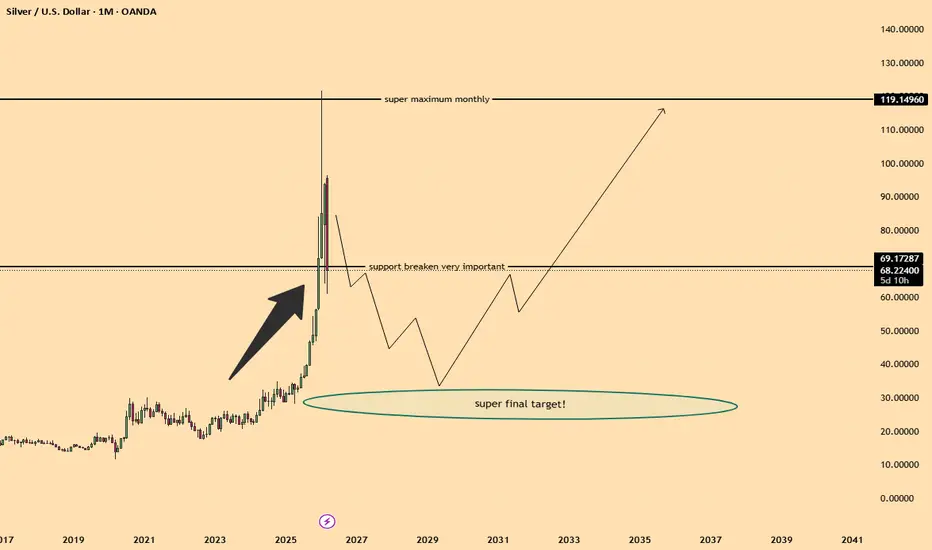
What Happened and Why Did It Drop So Much?
Silver experienced a spectacular rally during 2025 and early 2026, driven by strong investment demand, expectations of lower interest rates, safe-haven buying, and a structural supply deficit (industrial demand — especially from solar energy, electric vehicles, and electronics — consistently exceeded mine production).It reached an all-time high near $122 per ounce in late January 2026. However, in the following weeks (especially late January through March 2026), a sharp and violent correction occurred:Main causes of the drop:Increased margin requirements (margin hikes) on futures contracts: This forced many leveraged traders and speculators to sell positions quickly to meet margin calls. High leverage turned a small initial decline into a cascade of liquidations that accelerated the fall.
Strengthening of the US dollar: A stronger dollar makes silver (priced in USD) more expensive for international buyers, reducing demand.
Shift in interest rate expectations: Concerns grew about more persistent inflation (partly fueled by high oil prices and geopolitical tensions). Markets began pricing in fewer rate cuts — or even higher rates for longer — which reduces the appeal of non-yielding assets like silver.
Profit-taking and exit of speculative money: After such a rapid and powerful rise (over 300% from the lows in 2025), many institutional and retail investors decided to lock in gains. This was combined with outflows from silver-backed ETFs and leveraged positions.
Silver’s typical high volatility: Unlike gold (a purer safe-haven), silver has a significant industrial component (around 50-60% of demand). Any signal of economic slowdown or manufacturing weakness can amplify declines.
The decline was not gradual — it included days with double-digit drops and one of the worst single-day moves in decades, with massive liquidations where “everyone tried to exit at the same time.”How Much Did It Lose in Percentage?From the approximate peak of $122 down to levels around $68, silver lost roughly 44%.
At some points in March, monthly declines exceeded 26-27%, making this one of the fastest and deepest corrections in recent silver market history.
This extreme volatility is typical for silver: it rises much more aggressively than gold during bull markets, but it also falls with greater intensity during corrections.Next Possible ScenariosAnalysts see a wide range for silver in 2026 due to high uncertainty:Base case (most likely): Silver stabilizes in a $70–$90 average range for the year. The structural supply deficit remains (the market has been consuming more than it produces for several years), industrial demand (solar, EVs, AI) continues to grow, and it could get support if gold stays strong or if rates eventually ease. It may recover part of the losses if geopolitical tensions persist or if the global economy avoids a deep recession.
Bullish scenario: If the deficit continues, gold keeps rising, and investment demand as a safe haven increases, silver could retest $100–$120 or even break higher in spikes. Some optimistic forecasts see annual averages above $80–$100.
Bearish scenario: If the dollar strengthens further, rates stay high due to persistent inflation, or there is a significant industrial slowdown (lower demand for solar panels or manufacturing), silver could correct toward $55–$65 or even lower during panic selling. Additional 20-40% drops would not be unusual for such a volatile metal.
Overall, the long-term fundamentals (deficit and green demand) remain positive, but the short term will be dominated by high volatility.Why Should We Be Cautious About Future Price Cuts?Silver is a highly speculative and volatile asset for several reasons:High sensitivity to leverage and market sentiment: Much of the price action happens in the paper market (futures), where leverage amplifies moves in both directions. A new round of margin hikes, a strong economic data release, or a stronger dollar can easily trigger another wave of forced selling.
Industrial component: If there are clear signs of global economic cooling (slower growth in China, Europe, or the US), industrial demand for silver can drop quickly, pressuring the price even if investment demand holds up.
Correlation with the dollar and real yields: When real interest rates rise or the dollar strengthens, precious metals usually suffer. Any hawkish surprise in monetary policy can generate new declines.
History of deep corrections: Even in long bull cycles, silver has seen drawdowns (drops from highs) of 30-70%. Buying at emotional peaks without proper risk management has caused large losses for many investors in the past (as seen in 2011).
Liquidity and collective panic: During periods of stress, silver can fall much faster than gold because its market is smaller and less liquid.
Precaution recommendation: This is not the time for heavy leverage or buying everything at once. It is wiser to use dollar-cost averaging, set clear stop-loss levels, diversify, and only hold the portion of your portfolio you are willing to see drop 30-50% temporarily without panic-selling. Long-term fundamentals may be solid, but the path to higher prices almost always includes strong and painful corrections.In summary: The drop from $122 to $68 was a classic correction after a parabolic rally fueled by speculation and leverage, combined with shifting macro expectations. The coming months will remain highly volatile. Caution and solid risk management are essential to avoid unnecessary losses in future price cuts.
Silver experienced a spectacular rally during 2025 and early 2026, driven by strong investment demand, expectations of lower interest rates, safe-haven buying, and a structural supply deficit (industrial demand — especially from solar energy, electric vehicles, and electronics — consistently exceeded mine production).It reached an all-time high near $122 per ounce in late January 2026. However, in the following weeks (especially late January through March 2026), a sharp and violent correction occurred:Main causes of the drop:Increased margin requirements (margin hikes) on futures contracts: This forced many leveraged traders and speculators to sell positions quickly to meet margin calls. High leverage turned a small initial decline into a cascade of liquidations that accelerated the fall.
Strengthening of the US dollar: A stronger dollar makes silver (priced in USD) more expensive for international buyers, reducing demand.
Shift in interest rate expectations: Concerns grew about more persistent inflation (partly fueled by high oil prices and geopolitical tensions). Markets began pricing in fewer rate cuts — or even higher rates for longer — which reduces the appeal of non-yielding assets like silver.
Profit-taking and exit of speculative money: After such a rapid and powerful rise (over 300% from the lows in 2025), many institutional and retail investors decided to lock in gains. This was combined with outflows from silver-backed ETFs and leveraged positions.
Silver’s typical high volatility: Unlike gold (a purer safe-haven), silver has a significant industrial component (around 50-60% of demand). Any signal of economic slowdown or manufacturing weakness can amplify declines.
The decline was not gradual — it included days with double-digit drops and one of the worst single-day moves in decades, with massive liquidations where “everyone tried to exit at the same time.”How Much Did It Lose in Percentage?From the approximate peak of $122 down to levels around $68, silver lost roughly 44%.
At some points in March, monthly declines exceeded 26-27%, making this one of the fastest and deepest corrections in recent silver market history.
This extreme volatility is typical for silver: it rises much more aggressively than gold during bull markets, but it also falls with greater intensity during corrections.Next Possible ScenariosAnalysts see a wide range for silver in 2026 due to high uncertainty:Base case (most likely): Silver stabilizes in a $70–$90 average range for the year. The structural supply deficit remains (the market has been consuming more than it produces for several years), industrial demand (solar, EVs, AI) continues to grow, and it could get support if gold stays strong or if rates eventually ease. It may recover part of the losses if geopolitical tensions persist or if the global economy avoids a deep recession.
Bullish scenario: If the deficit continues, gold keeps rising, and investment demand as a safe haven increases, silver could retest $100–$120 or even break higher in spikes. Some optimistic forecasts see annual averages above $80–$100.
Bearish scenario: If the dollar strengthens further, rates stay high due to persistent inflation, or there is a significant industrial slowdown (lower demand for solar panels or manufacturing), silver could correct toward $55–$65 or even lower during panic selling. Additional 20-40% drops would not be unusual for such a volatile metal.
Overall, the long-term fundamentals (deficit and green demand) remain positive, but the short term will be dominated by high volatility.Why Should We Be Cautious About Future Price Cuts?Silver is a highly speculative and volatile asset for several reasons:High sensitivity to leverage and market sentiment: Much of the price action happens in the paper market (futures), where leverage amplifies moves in both directions. A new round of margin hikes, a strong economic data release, or a stronger dollar can easily trigger another wave of forced selling.
Industrial component: If there are clear signs of global economic cooling (slower growth in China, Europe, or the US), industrial demand for silver can drop quickly, pressuring the price even if investment demand holds up.
Correlation with the dollar and real yields: When real interest rates rise or the dollar strengthens, precious metals usually suffer. Any hawkish surprise in monetary policy can generate new declines.
History of deep corrections: Even in long bull cycles, silver has seen drawdowns (drops from highs) of 30-70%. Buying at emotional peaks without proper risk management has caused large losses for many investors in the past (as seen in 2011).
Liquidity and collective panic: During periods of stress, silver can fall much faster than gold because its market is smaller and less liquid.
Precaution recommendation: This is not the time for heavy leverage or buying everything at once. It is wiser to use dollar-cost averaging, set clear stop-loss levels, diversify, and only hold the portion of your portfolio you are willing to see drop 30-50% temporarily without panic-selling. Long-term fundamentals may be solid, but the path to higher prices almost always includes strong and painful corrections.In summary: The drop from $122 to $68 was a classic correction after a parabolic rally fueled by speculation and leverage, combined with shifting macro expectations. The coming months will remain highly volatile. Caution and solid risk management are essential to avoid unnecessary losses in future price cuts.

Unete a mi proyecto de capitalizacion y disfruta de beneficios exclusivos! t.me/fundedrelay
相關出版品
免責聲明
這些資訊和出版物並非旨在提供,也不構成TradingView提供或認可的任何形式的財務、投資、交易或其他類型的建議或推薦。請閱讀使用條款以了解更多資訊。
Unete a mi proyecto de capitalizacion y disfruta de beneficios exclusivos! t.me/fundedrelay
相關出版品
免責聲明
這些資訊和出版物並非旨在提供,也不構成TradingView提供或認可的任何形式的財務、投資、交易或其他類型的建議或推薦。請閱讀使用條款以了解更多資訊。