
Many traders still think about a trade in the wrong order.
They decide the position size first and then try to adapt the Stop Loss around it.
A more disciplined approach is the opposite:
1. Define the trade idea
2. Define the invalidation level / Stop Loss
3. Decide how much capital you are willing to risk
4. Calculate the correct position size
In other words:
Risk first. Size second.
WHY RISK SHOULD COME FIRST
The amount you are willing to lose should be known before the trade is opened.
If you use the same fixed position size on every trade, your real exposure can change dramatically depending on the distance between your Entry and Stop Loss.
A tight Stop Loss may create a relatively small monetary risk.
The exact same position size with a much wider Stop Loss may expose several times more capital.
This means that two trades with the same lot size do not necessarily carry the same risk.
The same problem appears when switching between Forex, Gold, indices or crypto, because contract values and price movements are different.
Consistent position sizing starts with consistent risk.
WHY CONSISTENT RISK MATTERS
Risk management is not only about protecting the account.
It also makes trading performance easier to evaluate.
When risk is kept relatively consistent from one trade to another:
• Losses become easier to control
• Drawdown becomes more predictable
• Results can be compared more accurately
• Emotional position sizing is reduced
• Strategy expectancy becomes easier to measure
• The trader can evaluate whether the trading method itself actually has an edge
Expectancy does not come only from finding good entries.
It comes from the relationship between winners, losers and the amount risked on each trade.
If position size changes randomly, this relationship becomes much harder to measure.
A disciplined risk process makes your trading statistics more meaningful.
THE KEY PRINCIPLE
Your Stop Loss should be determined by the market structure.
Your position size should be determined by your risk.
Not the other way around.
EXAMPLE ON XAUUSD
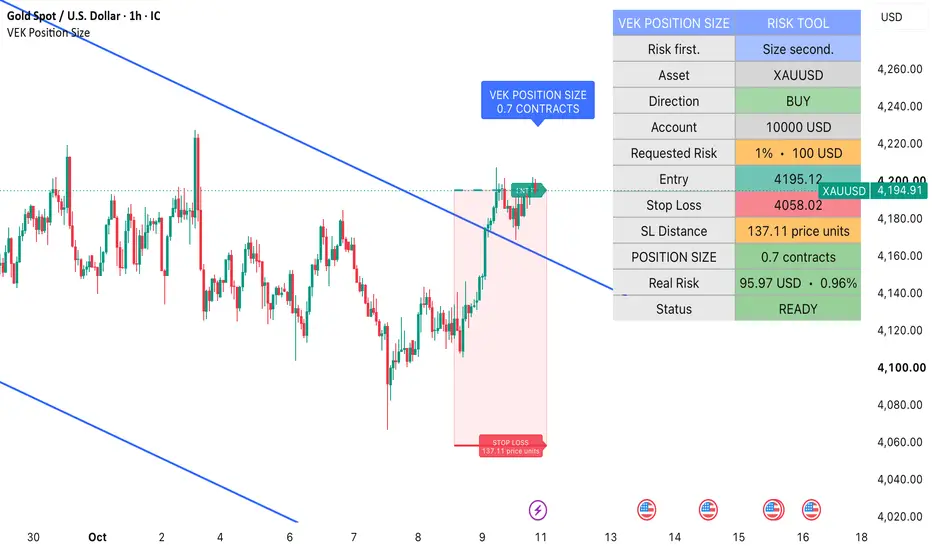
The chart above shows a simple example using XAUUSD.
Account size:
10,000 USD
Requested risk:
1%
Maximum planned risk:
100 USD
Entry:
4195.12
Stop Loss:
4058.02
Stop Loss distance:
137.11 price units
Once the Entry and Stop Loss are defined, the position size can be calculated from the amount of capital we are willing to risk.
In this example:
Position size:
0.7 contracts
Estimated real risk:
95.97 USD
Real risk:
0.96%
The objective is not to force the trade to exactly 100 USD of risk.
The objective is to select an executable position size that remains as close as possible to the planned risk without unnecessarily exceeding it.
USING VEK POSITION SIZE
VEK Position Size was designed to make this process faster and more visual.
Instead of calculating position size separately every time, the trader can place the Entry and Stop Loss directly on the chart.
The tool then uses:
• Account size
• Risk %
• Entry price
• Stop Loss price
• Stop Loss distance
• Instrument specifications
to calculate the corresponding executable position size and estimated real risk.
The purpose is simple:
Remove guesswork from position sizing and make risk visible before the trade is executed.
VEK Position Size does not generate BUY or SELL signals and does not choose the Stop Loss for the trader.
The trading idea remains yours.
The tool focuses only on translating your risk plan into a position size.
A BETTER ROUTINE BEFORE EVERY TRADE
Before entering a position:
• Identify your setup
• Define where the trade becomes invalid
• Place the Stop Loss at that level
• Decide the maximum percentage of capital you are willing to risk
• Calculate the corresponding position size
• Check the real monetary risk
• Only then consider executing the trade
This changes the question from:
“How big do I want this trade to be?”
to:
“How much am I willing to lose if this trade is wrong?”
That is a much more useful question.
FINAL THOUGHT
A good trade is not only a good entry.
It is a trade where the risk is known before execution and the position size is adapted to that risk.
Risk first.
Size second.
When risk becomes consistent, trading results become easier to control, compare and evaluate.
And that gives you a much clearer picture of your true trading expectancy.

VEK Pro Flow — Professional TradingView tools for trade planning & risk management.
VEK Trade Planner: whop.com/vek-pro-flow/vek-trade-planner/
Questions & support: support.vekproflow@gmail.com
VEK Trade Planner: whop.com/vek-pro-flow/vek-trade-planner/
Questions & support: support.vekproflow@gmail.com
免責聲明
這些資訊和出版物並非旨在提供,也不構成TradingView提供或認可的任何形式的財務、投資、交易或其他類型的建議或推薦。請閱讀使用條款以了解更多資訊。
VEK Pro Flow — Professional TradingView tools for trade planning & risk management.
VEK Trade Planner: whop.com/vek-pro-flow/vek-trade-planner/
Questions & support: support.vekproflow@gmail.com
VEK Trade Planner: whop.com/vek-pro-flow/vek-trade-planner/
Questions & support: support.vekproflow@gmail.com
免責聲明
這些資訊和出版物並非旨在提供,也不構成TradingView提供或認可的任何形式的財務、投資、交易或其他類型的建議或推薦。請閱讀使用條款以了解更多資訊。