OPEN-SOURCE SCRIPT
已更新 Adaptive Predictability Engine Entropy Gate, Regime Router
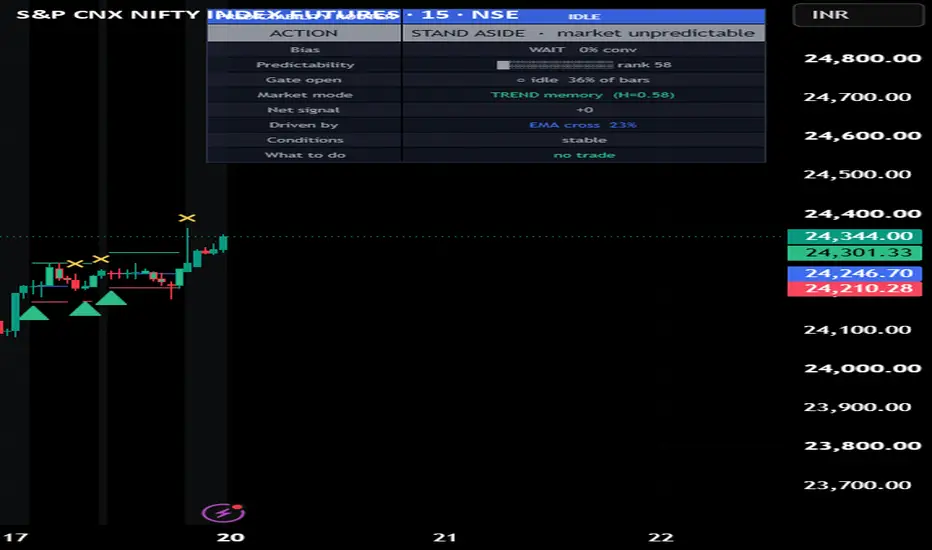
Adaptive Predictability Engine — Entropy Gate, Regime Router & Expert Committee
What it is
The Adaptive Predictability Engine is a governed decision framework, not another confluence average. It refuses to treat all market conditions as tradable. It applies a strict hierarchy: first it asks whether price is forecastable at all right now; if it is, it decides whether trend-style or reversion-style logic is appropriate; and only then does a small committee of transparent experts vote — with the committee continuously re-weighting itself toward whichever experts have been correct recently. When the market is unpredictable, the whole engine stands aside and shows nothing to trade.
It plots directly on price: long/short signals, the live entry/target/stop of the active trade, a plain-language dashboard, and an optional self-calibration panel that scores past signals in R-multiple expectancy (not just win rate).
Why these components are combined (mashup justification)
This is a deliberate, dependent stack — each layer conditions the next, so removing any one changes the layer below it. That is the difference between a governed engine and a bag of averaged indicators.
Predictability gate (permutation entropy + structure). Permutation entropy (Bandt–Pompe) measures the ordinal randomness of recent price across three time scales; this is blended with |Hurst − 0.5|, the distance of the market from a random walk, which is high for strong trends and strong mean-reversion. The blended predictability is percentile-ranked so the gate self-tunes per symbol and timeframe. If the tape is unpredictable, nothing downstream may fire. This is the master switch, and it is why the engine spends much of its time deliberately doing nothing.
Regime router (Hurst exponent). When structure exists, the Hurst exponent (generalized, via a structure-function slope) decides whether it is persistent (trend) or anti-persistent (mean-revert), and routes weight toward the appropriate family of experts rather than averaging trend and reversion logic together.
Expert committee (Hedge / multiplicative weights). Six deliberately diverse experts — price trend, volume-weighted price, order-flow delta, momentum exhaustion, volatility extreme, and range extreme — each cast a directional vote. Their weights update every bar by exponential regret (right experts gain influence, wrong ones lose it), with fixed-share regularization so no single expert can dominate and make the vote fragile.
Distribution-shift guard. If the recent return distribution moves materially versus a reference window, the engine freezes learning and cuts conviction until conditions settle, so stale weights don't drive trades through a regime change.
The output is a single decision = the regret-weighted vote of only the currently-appropriate experts, gated to zero whenever the tape is unpredictable.
How to use it
Add it to any liquid symbol and timeframe. Defaults are tuned for index futures (e.g. NIFTY) but every input is adjustable, and the Data source group lets you repoint price and volume for any market.
Watch the dashboard headline: LONG / SHORT / WAIT / STAND ASIDE. When a signal fires, the engine draws the entry, ATR target, and ATR stop so the action is concrete.
Treat the shaded background as a hard "do not trade" — the engine has judged the tape unpredictable.
Open the Edge calibration (advanced) panel to see, per market memory, the past R-expectancy of the engine's own signals versus a direction-matched baseline. Positive expectancy means the sample was profitable before costs; this is descriptive of the past, not a forward guarantee.
Use the Ablation (research) toggles to switch each layer off and see, on your own data, whether it earns its place.
What makes it original
Most published tools average indicators and hope. This one inverts the approach by asking whether to act at all before what to do, using information-theoretic predictability (permutation entropy) as a master gate, a memory estimate (Hurst) as a router, and online regret-minimization (Hedge) to arbitrate a diverse expert set — with built-in R-expectancy self-calibration so users can judge it honestly rather than on a cherry-picked screenshot. The order-flow expert reads finest-available lower-timeframe signed volume with automatic fallback. The coupling and governance order are the contribution; the individual estimators are classical and credited below.
Concept credits
Permutation entropy — Bandt & Pompe. Hurst exponent / long-range dependence — H. E. Hurst; Mandelbrot. Hedge / multiplicative-weights online learning — Freund & Schapire; Littlestone & Warmuth; Vovk. Efficiency/structure framing — Kaufman. Triple-barrier labelling and R-multiple expectancy — M. López de Prado. Wilson score interval — E. B. Wilson. Synthesis, governance design, and implementation are the author's own.
Important disclaimer
Research and education only. Not financial advice, not a signal service, not a guarantee of future results. No indicator has an inherent edge. The calibration panel is a descriptive summary of past behaviour on the current chart — not a backtest and not a forward prediction. Always validate independently, apply realistic costs and slippage, and manage risk. You are solely responsible for your trading decisions.
What it is
The Adaptive Predictability Engine is a governed decision framework, not another confluence average. It refuses to treat all market conditions as tradable. It applies a strict hierarchy: first it asks whether price is forecastable at all right now; if it is, it decides whether trend-style or reversion-style logic is appropriate; and only then does a small committee of transparent experts vote — with the committee continuously re-weighting itself toward whichever experts have been correct recently. When the market is unpredictable, the whole engine stands aside and shows nothing to trade.
It plots directly on price: long/short signals, the live entry/target/stop of the active trade, a plain-language dashboard, and an optional self-calibration panel that scores past signals in R-multiple expectancy (not just win rate).
Why these components are combined (mashup justification)
This is a deliberate, dependent stack — each layer conditions the next, so removing any one changes the layer below it. That is the difference between a governed engine and a bag of averaged indicators.
Predictability gate (permutation entropy + structure). Permutation entropy (Bandt–Pompe) measures the ordinal randomness of recent price across three time scales; this is blended with |Hurst − 0.5|, the distance of the market from a random walk, which is high for strong trends and strong mean-reversion. The blended predictability is percentile-ranked so the gate self-tunes per symbol and timeframe. If the tape is unpredictable, nothing downstream may fire. This is the master switch, and it is why the engine spends much of its time deliberately doing nothing.
Regime router (Hurst exponent). When structure exists, the Hurst exponent (generalized, via a structure-function slope) decides whether it is persistent (trend) or anti-persistent (mean-revert), and routes weight toward the appropriate family of experts rather than averaging trend and reversion logic together.
Expert committee (Hedge / multiplicative weights). Six deliberately diverse experts — price trend, volume-weighted price, order-flow delta, momentum exhaustion, volatility extreme, and range extreme — each cast a directional vote. Their weights update every bar by exponential regret (right experts gain influence, wrong ones lose it), with fixed-share regularization so no single expert can dominate and make the vote fragile.
Distribution-shift guard. If the recent return distribution moves materially versus a reference window, the engine freezes learning and cuts conviction until conditions settle, so stale weights don't drive trades through a regime change.
The output is a single decision = the regret-weighted vote of only the currently-appropriate experts, gated to zero whenever the tape is unpredictable.
How to use it
Add it to any liquid symbol and timeframe. Defaults are tuned for index futures (e.g. NIFTY) but every input is adjustable, and the Data source group lets you repoint price and volume for any market.
Watch the dashboard headline: LONG / SHORT / WAIT / STAND ASIDE. When a signal fires, the engine draws the entry, ATR target, and ATR stop so the action is concrete.
Treat the shaded background as a hard "do not trade" — the engine has judged the tape unpredictable.
Open the Edge calibration (advanced) panel to see, per market memory, the past R-expectancy of the engine's own signals versus a direction-matched baseline. Positive expectancy means the sample was profitable before costs; this is descriptive of the past, not a forward guarantee.
Use the Ablation (research) toggles to switch each layer off and see, on your own data, whether it earns its place.
What makes it original
Most published tools average indicators and hope. This one inverts the approach by asking whether to act at all before what to do, using information-theoretic predictability (permutation entropy) as a master gate, a memory estimate (Hurst) as a router, and online regret-minimization (Hedge) to arbitrate a diverse expert set — with built-in R-expectancy self-calibration so users can judge it honestly rather than on a cherry-picked screenshot. The order-flow expert reads finest-available lower-timeframe signed volume with automatic fallback. The coupling and governance order are the contribution; the individual estimators are classical and credited below.
Concept credits
Permutation entropy — Bandt & Pompe. Hurst exponent / long-range dependence — H. E. Hurst; Mandelbrot. Hedge / multiplicative-weights online learning — Freund & Schapire; Littlestone & Warmuth; Vovk. Efficiency/structure framing — Kaufman. Triple-barrier labelling and R-multiple expectancy — M. López de Prado. Wilson score interval — E. B. Wilson. Synthesis, governance design, and implementation are the author's own.
Important disclaimer
Research and education only. Not financial advice, not a signal service, not a guarantee of future results. No indicator has an inherent edge. The calibration panel is a descriptive summary of past behaviour on the current chart — not a backtest and not a forward prediction. Always validate independently, apply realistic costs and slippage, and manage risk. You are solely responsible for your trading decisions.
發行說明
Minor update發行說明
v1.1 — Cost model + finishing pass (no engine change)- Added a cost model to the R-expectancy panel: a new "Round-trip cost (R)" input and a NetR column
(NetR = ExpR − cost, per Trend / Revert / All). The panel already reported average-R expectancy;
it now also shows what survives trading costs — NetR>0 = profitable after costs. This is a
descriptive, past-only read; it does not change when the engine trades.
- Added a Data Window (EXP_) export bus so the committee vote, gate state, predictability and the
gross/net expectancy (EXP_ExpR / EXP_NetR) can feed other scripts via input.source().
- Added the MPL-2.0 licence header.
- No change to the entropy gate, Hurst router, expert committee, signals or panels — everyday
behaviour is identical.
Descriptive research tooling, past-only R-expectancy, not investment advice.
開源腳本
秉持TradingView一貫精神,這個腳本的創作者將其設為開源,以便交易者檢視並驗證其功能。向作者致敬!您可以免費使用此腳本,但請注意,重新發佈代碼需遵守我們的社群規範。

免責聲明
這些資訊和出版物並非旨在提供,也不構成TradingView提供或認可的任何形式的財務、投資、交易或其他類型的建議或推薦。請閱讀使用條款以了解更多資訊。
開源腳本
秉持TradingView一貫精神,這個腳本的創作者將其設為開源,以便交易者檢視並驗證其功能。向作者致敬!您可以免費使用此腳本,但請注意,重新發佈代碼需遵守我們的社群規範。
免責聲明
這些資訊和出版物並非旨在提供,也不構成TradingView提供或認可的任何形式的財務、投資、交易或其他類型的建議或推薦。請閱讀使用條款以了解更多資訊。