Execution Signals v9
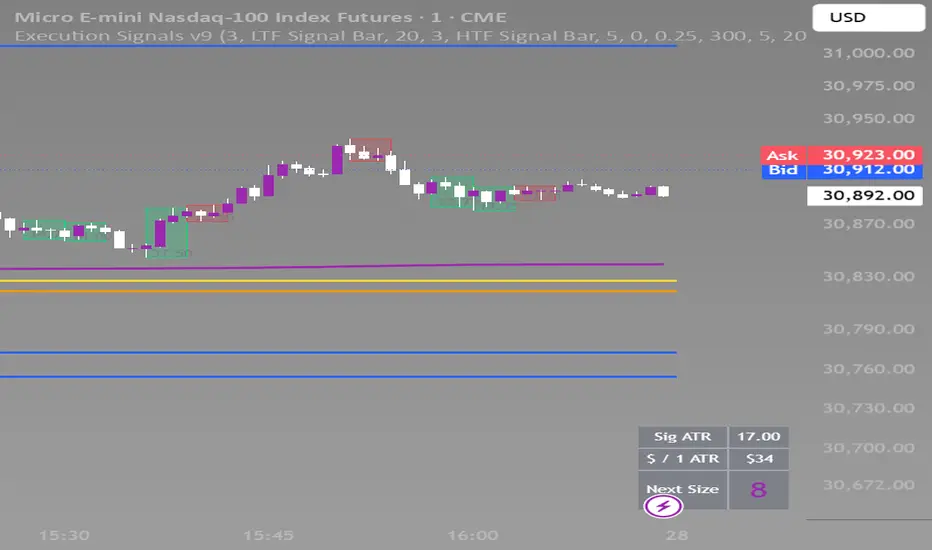
A mechanical price action breakout strategy for intraday futures. Signals form on a higher timeframe; execution happens on the chart timeframe (multi-timeframe / MTF). Built and tested primarily on index futures (NQ/MNQ/ES/MES), but works on any symbol with valid point value and tick data.
SIGNALS (detected on the last completed signal-timeframe bar)
- Failure to Go High — price exceeds the prior signal-TF bar's high but closes back at or below it, leaving an upper wick (a trapped breakout)
- Failure to Go Low — the mirror on the downside
- Inside Bar — the full range held within the prior signal-TF bar (compression)
Each pattern can be toggled independently. Includes a gap guard: if the underlying signal-TF data skips more than ~1.5× the signal period (a data gap or session break), that pair of bars isn't compared, so a gap can't masquerade as a signal.
EXECUTION MODES (choose one)
- Break of Signal Bar — enter the instant chart-TF price closes beyond the signal bar's high or low. Whichever side breaks first wins; the other side is void.
- LTF Signal Bar (nested) — the same HTF break only sets a directional bias (expires after a set number of chart-TF bars). The strategy then waits for a failure bar or inside bar on the chart timeframe itself — optionally required to match the bias direction — and enters on THAT bar's own break, which has its own shorter expiry.
STOP & TARGET
Stop placement is configurable: prior chart-TF bar, prior two bars, the HTF signal bar's own wick, or (in nested mode) the LTF signal bar's wick — with a minimum stop distance floor in points regardless of model. An optional max-risk-per-trade cap (points) rejects any setup whose stop is wider than that, rather than resizing it. Take profit is an R-multiple of the actual stop distance.
POSITION SIZING
Per trade, not daily-paced. Contracts are sized so that a 1-ATR (signal timeframe) favorable move nets roughly a target dollar amount you set, computed fresh at the moment of entry — floor(target ÷ (signal-TF ATR × point value)), capped at a configurable max contract count. That cap is also enforced independently at the platform level. A small on-chart table shows the live signal-TF ATR, dollar value of 1 ATR at one contract, and the size that would be used right now.
OPTIONAL DIRECTIONAL BIAS
Off by default. When enabled: trading above the prior RTH session's high restricts entries to longs only, below the prior low to shorts only; inside the prior day's range is either neutral (both directions allowed) or blocked entirely, per a toggle.
SESSION
RTH for level-building purposes: 9:30 AM–4:15 PM ET. Trading window: 6:00 PM ET through 3:59 PM ET the next session; all positions force-closed at 3:59 PM ET; no new entries 3:59–6:00 PM ET.
ON-CHART TOOLS
- Signal boxes over each qualifying bar (colored by type), with an optional range label
- Position boxes — every trade marked with its risk (red) and reward (green) zones, frozen on chart after the trade closes
- Day-Set Levels — deployed once per session like pivots: the prior RTH session's high/low (yellow), plus a master list of levels from synthetic hourly-bucket color flips within RTH (blue), invalidated

免責聲明
這些資訊和出版物並非旨在提供,也不構成TradingView提供或認可的任何形式的財務、投資、交易或其他類型的建議或推薦。請閱讀使用條款以了解更多資訊。
免責聲明
這些資訊和出版物並非旨在提供,也不構成TradingView提供或認可的任何形式的財務、投資、交易或其他類型的建議或推薦。請閱讀使用條款以了解更多資訊。