已更新
Unicorn Model
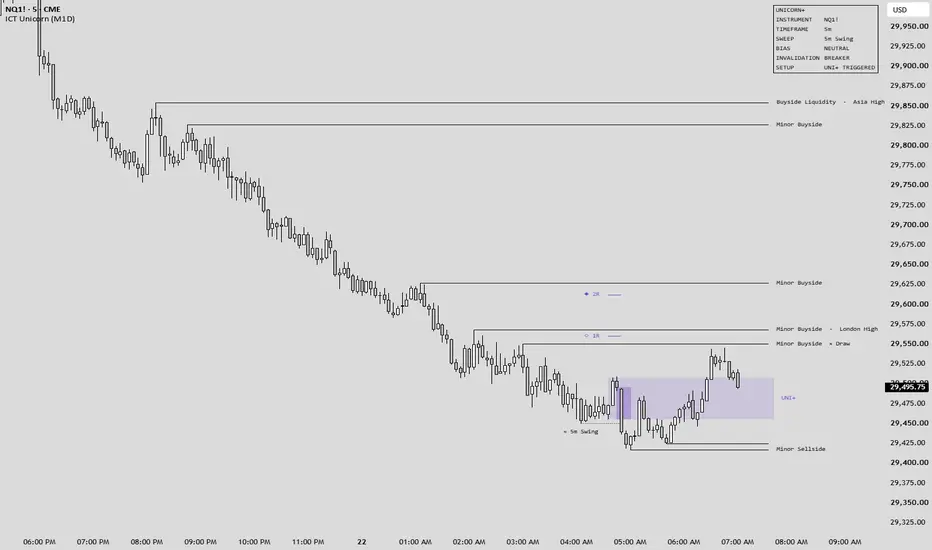
Unicorn Model
Finds the ICT Unicorn and frames its context. A Unicorn forms where a displacement leaves a Breaker behind and the Fair Value Gap that displacement traded through inverts onto it — the same-direction Inversion FVG overlapping the Breaker is what confirms it. Two arrays reinforcing each other at one price, which ICT teaches as a tight, high-probability zone. This tool detects that overlap, marks the Breaker that qualifies, always shows the inversion FVG that makes it one, tracks the liquidity that engineered it, and keeps the HTF bias and the draw on a clean dashboard. It maps structure. It does not fire trades.
The sequence it looks for
The Unicorn is a confluence, not a standalone trigger. Bullish below; bearish mirrors.
Because the Unicorn is only as good as its narrative, bias is first-class: qualification is gated to the HTF read by default, and the dashboard keeps the read, the raid and the draw in front of you.
These are established Inner Circle Trader concepts — the Fair Value Gap, the Breaker, market structure shift, liquidity, the Midnight Open and premium/discount. This script is an original implementation of them, and what makes it its own thing is that it resolves the Breaker and the Inversion FVG that confirms it into a single zone rather than plotting each array in isolation.
What it draws
The Unicorn. When a live same-direction IFVG overlaps a Breaker, that box is relabelled Unicorn + or Unicorn -, drawn in purple or magenta with a distinct dashed border so the setup reads at a glance against the solid-bordered arrays around it. It is confirmed once and holds — it does not flicker bar to bar — and the confirming IFVG is kept alive with it. The two live and die together, so a Unicorn always shows the inversion that makes it one.
The ingredients. Drawn faintly beneath: FVGs in blue for bullish and red for bearish, Breakers in a neutral black, each tagged with the chart timeframe. A gap that sits inside the Unicorn or its inversion hides its own box, so the zone is never buried under the ingredient it is built from. Everything invalidates by candle body only — a wick through a zone never counts. A plain FVG inverts the moment one body closes through it; the Breaker and the inversion take a configurable number of body closes to retire, two by default.
The inversion. When a body closes through an FVG it does not vanish, it inverts — flipping polarity to deliver from the other side. The same-direction inversion overlapping a Breaker is what confirms the Unicorn. It is shaded orange, carries no label because orange reads as IFVG on its own, and sits behind the Unicorn so the zone stays in front.
Liquidity. Swing highs are buyside, swing lows are sellside, plus prior-day and prior-week levels as external-range reference, each anchored to the candle that formed it. The outermost live swing each side is tagged Buyside or Sellside Liquidity; inner swings carry Minor tags; prior-period levels keep a dated one. A level that is also an Asia, London or New York session extreme carries that tag too. Every level is removed the instant it is taken — no dotted stub, no lingering line — and an un-taken level that price trends a full range past without returning also clears. Tags that share a price merge into one rather than stacking.
Midnight Open. The 00:00 New York open, a core daily reference and a bias input. Below it leans bullish, above it leans bearish.
The draw. The target the setup delivers toward. It stays hidden until a Unicorn has set up AND its setup-side liquidity has been swept; only then is the opposing draw tagged on that level. That ordering is deliberate — the marker can never read as a standalone entry signal.
Dashboard
HTF bias, bullish or bearish or mixed, auto or manual. Whether a Unicorn is live and which way, falling back to the last one's direction rather than a bare dash. Which side of liquidity was most recently raided. The current draw with its price. Prior-day high and low, tracked even when the lines are hidden. Price against the Midnight Open. And where price sits in the dealing range, discount or premium against the equilibrium.
Reading it in practice
Trade with the dashboard bias. A Unicorn marks the Breaker whose overlapping inversion FVG makes it one; the orange IFVG shows the imbalance it sits within. ICT guidance waits for price to tap the FVG side, places the stop beyond the combined Breaker and FVG extreme — whichever is furthest — and targets the engineered liquidity the draw tag names. A gap left open below a bullish Unicorn range is intended: it shows intent and speed, and is not meant to be filled.
Method and repainting
All detection evaluates on closed bars. Swings, the structure break, the Breaker flip, the FVGs, the inversion and the Unicorn overlap are confirmed on candle close, never intrabar. Once a Unicorn is confirmed it is locked — it does not re-evaluate or flip state bar to bar — and invalidation counts only confirmed body closes, so an in-progress candle, wick included, never removes it. The Midnight Open fixes on its forming bar, and every level anchors to the candle that formed it.
Live zones and levels extend to the right edge for readability. That projection is cosmetic and changes no confirmed level, tap or raid.
Settings
Session timezone, right-side offset and label sizes. Bias mode and whether Unicorns are gated to it. Pivot strength. Liquidity display, per-side level caps, prior day and week levels with their lookbacks, and the raid-relevance window. Session tagging and the three session windows. FVG minimum height and displacement size, both in ATR, the declutter, the cap on live gaps, the framing IFVG, and how many body closes retire a zone. Unicorn colours. Dashboard position, including middle right, and text size.
Analytics only
This is a decision-support tool for discretionary ICT study. It maps zones, structure and context. It contains no alerts and no buy or sell signals, and it does not tell you when to enter or exit. The draw marker is a text label that appears only after a Unicorn has set up and liquidity has been swept, pointing at a liquidity target — not a trade instruction.
Disclaimer
This is a decision-support tool for discretionary ICT trading. It is not financial advice, and no market's past behaviour is indicative of future results.
Finds the ICT Unicorn and frames its context. A Unicorn forms where a displacement leaves a Breaker behind and the Fair Value Gap that displacement traded through inverts onto it — the same-direction Inversion FVG overlapping the Breaker is what confirms it. Two arrays reinforcing each other at one price, which ICT teaches as a tight, high-probability zone. This tool detects that overlap, marks the Breaker that qualifies, always shows the inversion FVG that makes it one, tracks the liquidity that engineered it, and keeps the HTF bias and the draw on a clean dashboard. It maps structure. It does not fire trades.
The sequence it looks for
The Unicorn is a confluence, not a standalone trigger. Bullish below; bearish mirrors.
- Liquidity is taken — price sweeps a sellside low, engineering the reversal.
- A swing is broken — displacement closes through the last swing high. The candles immediately before that leg are left behind as an order block, and it becomes a Breaker only once price later closes back through it, the block failing and flipping exactly as an FVG inverts into an IFVG.
- The FVG inverts onto the Breaker — a candle body closes through the gap, so it fails and flips polarity into an Inversion FVG. A Breaker that a same-direction IFVG overlaps IS the Unicorn; with no overlapping IFVG it stays a plain Breaker.
- Bias frames it — the model needs a clear higher-timeframe read, so a bullish Unicorn shows in a bullish or discount context and a bearish one in premium.
- The draw — engineered liquidity in the direction of bias is the target the setup delivers toward.
Because the Unicorn is only as good as its narrative, bias is first-class: qualification is gated to the HTF read by default, and the dashboard keeps the read, the raid and the draw in front of you.
These are established Inner Circle Trader concepts — the Fair Value Gap, the Breaker, market structure shift, liquidity, the Midnight Open and premium/discount. This script is an original implementation of them, and what makes it its own thing is that it resolves the Breaker and the Inversion FVG that confirms it into a single zone rather than plotting each array in isolation.
What it draws
The Unicorn. When a live same-direction IFVG overlaps a Breaker, that box is relabelled Unicorn + or Unicorn -, drawn in purple or magenta with a distinct dashed border so the setup reads at a glance against the solid-bordered arrays around it. It is confirmed once and holds — it does not flicker bar to bar — and the confirming IFVG is kept alive with it. The two live and die together, so a Unicorn always shows the inversion that makes it one.
The ingredients. Drawn faintly beneath: FVGs in blue for bullish and red for bearish, Breakers in a neutral black, each tagged with the chart timeframe. A gap that sits inside the Unicorn or its inversion hides its own box, so the zone is never buried under the ingredient it is built from. Everything invalidates by candle body only — a wick through a zone never counts. A plain FVG inverts the moment one body closes through it; the Breaker and the inversion take a configurable number of body closes to retire, two by default.
The inversion. When a body closes through an FVG it does not vanish, it inverts — flipping polarity to deliver from the other side. The same-direction inversion overlapping a Breaker is what confirms the Unicorn. It is shaded orange, carries no label because orange reads as IFVG on its own, and sits behind the Unicorn so the zone stays in front.
Liquidity. Swing highs are buyside, swing lows are sellside, plus prior-day and prior-week levels as external-range reference, each anchored to the candle that formed it. The outermost live swing each side is tagged Buyside or Sellside Liquidity; inner swings carry Minor tags; prior-period levels keep a dated one. A level that is also an Asia, London or New York session extreme carries that tag too. Every level is removed the instant it is taken — no dotted stub, no lingering line — and an un-taken level that price trends a full range past without returning also clears. Tags that share a price merge into one rather than stacking.
Midnight Open. The 00:00 New York open, a core daily reference and a bias input. Below it leans bullish, above it leans bearish.
The draw. The target the setup delivers toward. It stays hidden until a Unicorn has set up AND its setup-side liquidity has been swept; only then is the opposing draw tagged on that level. That ordering is deliberate — the marker can never read as a standalone entry signal.
Dashboard
HTF bias, bullish or bearish or mixed, auto or manual. Whether a Unicorn is live and which way, falling back to the last one's direction rather than a bare dash. Which side of liquidity was most recently raided. The current draw with its price. Prior-day high and low, tracked even when the lines are hidden. Price against the Midnight Open. And where price sits in the dealing range, discount or premium against the equilibrium.
Reading it in practice
Trade with the dashboard bias. A Unicorn marks the Breaker whose overlapping inversion FVG makes it one; the orange IFVG shows the imbalance it sits within. ICT guidance waits for price to tap the FVG side, places the stop beyond the combined Breaker and FVG extreme — whichever is furthest — and targets the engineered liquidity the draw tag names. A gap left open below a bullish Unicorn range is intended: it shows intent and speed, and is not meant to be filled.
Method and repainting
All detection evaluates on closed bars. Swings, the structure break, the Breaker flip, the FVGs, the inversion and the Unicorn overlap are confirmed on candle close, never intrabar. Once a Unicorn is confirmed it is locked — it does not re-evaluate or flip state bar to bar — and invalidation counts only confirmed body closes, so an in-progress candle, wick included, never removes it. The Midnight Open fixes on its forming bar, and every level anchors to the candle that formed it.
Live zones and levels extend to the right edge for readability. That projection is cosmetic and changes no confirmed level, tap or raid.
Settings
Session timezone, right-side offset and label sizes. Bias mode and whether Unicorns are gated to it. Pivot strength. Liquidity display, per-side level caps, prior day and week levels with their lookbacks, and the raid-relevance window. Session tagging and the three session windows. FVG minimum height and displacement size, both in ATR, the declutter, the cap on live gaps, the framing IFVG, and how many body closes retire a zone. Unicorn colours. Dashboard position, including middle right, and text size.
Analytics only
This is a decision-support tool for discretionary ICT study. It maps zones, structure and context. It contains no alerts and no buy or sell signals, and it does not tell you when to enter or exit. The draw marker is a text label that appears only after a Unicorn has set up and liquidity has been swept, pointing at a liquidity target — not a trade instruction.
Disclaimer
This is a decision-support tool for discretionary ICT trading. It is not financial advice, and no market's past behaviour is indicative of future results.
發行說明
Volume imbalances are part of the gapA volume imbalance is a two-candle body gap that a wick still trades through. When one sits on either side of the gap candle, the BISI or SIBI now widens to that body edge, so one zone carries the whole region. On by default: Absorb Volume Imbalances into gaps.
Suspension blocks
Three candles in the same direction, each opening beyond the previous close, have a volume imbalance on both sides of the middle candle. That leg is now drawn as one zone from the first candle's close to the last candle's open and labelled SB + or SB -. It takes the place of the gap on that leg. On by default: Detect Suspension Blocks.
A cleaner dashboard
The panel now reads like the rest of the suite: the name on top, then INSTRUMENT, TIMEFRAME and HTF BIAS, then only the rows that have something to say. Black text, one thin frame, no fill.
Liquidity labels on the right
Every buyside and sellside label, and the 12am Open, now sits just past the right end of its line, on the line's price, the same as 2022 Model+. Label size defaults to small.
發行說明
Gaps reach the full body gapAny body gap on either side of the gap candle now widens the BISI or SIBI to that body edge, whether a wick trades through it or the wicks gap too. Before, a body gap with no wick across it was missed and the zone stopped at the wick. On a weekly chart this is the difference between a zone ending at the prior high and one reaching the prior close. Same rule as the rest of the suite.
發行說明
Optional rally-away test for the order block"Order block rally-away (x block height, ICT 2 to 3; 0 = off)" in the new Order Blocks group, last in the settings so your saved settings stay in place. Above 0, the block only registers when the displacement close has travelled that many block heights beyond the run of candles that made it. The block already blends the whole same-colour run. Default 0 = off.
Table text follows the chart
The dashboard text and frame are white on a dark chart and black on a light one. Still no background.
發行說明
Timeframe tags keep their countA 3 day, 2 week or 3 month chart was tagged D, W or MN like a single period. They now read D3, W2 and MN3. The model, zones and settings are unchanged.
發行說明
Cleaner lookZone fills are lighter. Zone names now sit on each zone's centre line, ending at its right edge, with a small ▲ / ▼ / ◆ mark, so they stay clear of the level names beside price. The dashboard reads Sweep, Bias, Unicorn and Draw first, in a plain black frame. Use Reset settings to pick up the lighter fills.
發行說明
*Small label bug corrected 發行說明
The Unicorn now runs as a modelEvery confirmed Unicorn becomes a setup. Entry is the zone's near edge and invalidation its far edge (or the extreme of the raid, set under Model → Invalidation), and 1R and 2R are measured off that distance. A setup triggers on the first closed candle after the Unicorn that trades into the zone and closes back out of it, then runs to 2R or its invalidation; a candle that touches both counts as invalidated. A retest window and a session filter are in the Model settings.
New Minimal display, on by default
Minimal draws the model alone: each Unicorn zone labelled UNI+ or UNI-, with its overlap with the inversion gap shaded darker inside, the 1R and 2R marks at the zone's left edge, the liquidity it swept as a dotted line tagged with what it was (Swing, PDL, Asia Low), and the next Breaker still waiting for its gap, labelled BRK + or BRK -. Bullish zones are purple and bearish zones black. The full map is one setting away under Display → Full.
Liquidity shown as the targets
Live buyside and sellside liquidity and the prior day and week highs and lows stay on in Minimal as the places a setup delivers to. Each line is removed the moment it is taken, and the one being delivered to carries × Draw.
A raid is required by default
A Unicorn with no liquidity taken behind it within the Raid Relevance Window is drawn faint and never triggers. Turn off Model → Require a raid first to treat every Unicorn as a setup.
New panel and alerts
The panel reads the instrument, the timeframe, the last sweep, the bias, the invalidation in use and where the latest setup stands. Four new alerts fire on bar close: UNI+ formed, UNI- formed, UNI+ triggered and UNI- triggered. Breakers and Unicorns in the Full view are now labelled BRK + / BRK - and UNI+ / UNI-.
發行說明
Tidier sourceRemoved a leftover internal version line from the source. Nothing on the chart changes.

免責聲明
這些資訊和出版物並非旨在提供,也不構成TradingView提供或認可的任何形式的財務、投資、交易或其他類型的建議或推薦。請閱讀使用條款以了解更多資訊。