2SD Bands Tracker with Multi-Anchor VWAP & Cross-Market Mapping
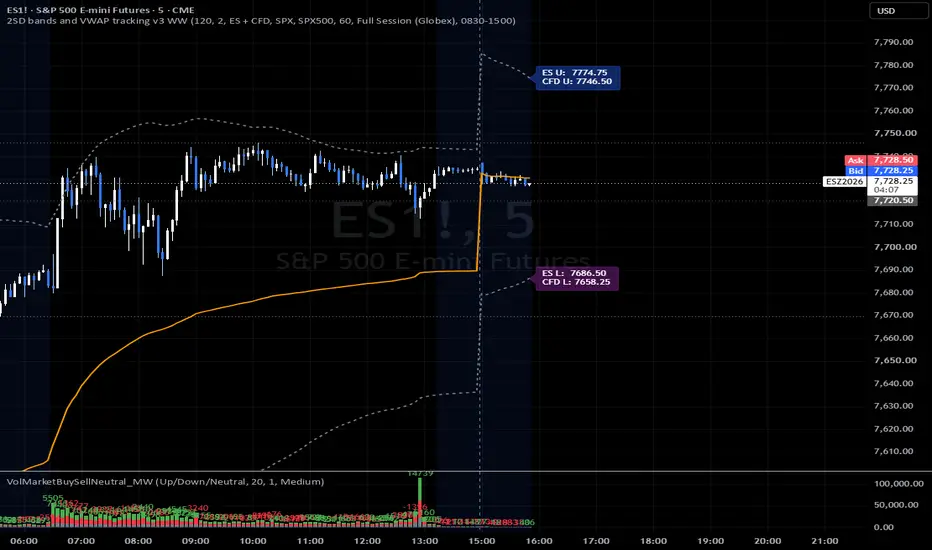
2SD Bands Tracker with Multi-Anchor VWAP and Cross-Market Mapping [ES / SPX / CFD]
### Overview & Market Philosophy
The 2SD Bands Tracker with Multi-Anchor VWAP and Cross-Market Mapping is an intraday value area and volatility tracking tool built on Auction Market Theory (Jim Dalton framework). VWAP functions as an institutional Point of Control (POC) or fair value anchor, while standard deviation bands define the structural boundaries of the market value area.
Empirical market research indicates that approximately 86% to 90% of intraday price action remains contained within ±2 standard deviations (±2σ) of session VWAP. This indicator calculates these containment levels in real time and solves a critical workflow challenge for index futures and options traders: deriving real-time equivalent SPX Cash and SPX CFD price targets directly while charting E-mini S&P 500 (ES) futures.
---
### Key Technical Features & Calculation Logic
1. Multi-Anchor VWAP Engine
Select between three distinct anchoring modes to fit your trading workflow:
- Full Session (Globex): Anchors at the CME Globex session reopen (5:00 PM CT) utilizing Pine Script's built-in ta.vwap() calculation.
- RTH Only (Cash Session): Performs a custom volume-weighted accumulation that dynamically resets at the US Cash Market open (08:30 CT / 09:30 ET).
- Continuous (No Reset): Accumulates volume-weighted price across all historical dataset bars without resetting, ideal for higher-timeframe trend analysis.
2. Dynamic Volatility Bands (±2σ)
Standard deviation bands are calculated around the selected active VWAP anchor using an adjustable lookback length (stdevLength = 50) and multiplier (mult = 2.0):
- Upper Band = VWAP + (Multiplier * StDev)
- Lower Band = VWAP - (Multiplier * StDev)
3. Cross-Market Basis Conversion (ES -> SPX & CFD)
For options traders charting ES futures, cash index strikes differ due to the futures basis spread. Using request.security(), the indicator fetches live reference price data for SPX Cash (SPX) and SPX CFD (FOREXCOM:SPXUSD). It applies a real-time basis adjustment formula to derive target levels on reference feeds:
- Reference Target = Price_ES - (Close_ES - Close_Ref)
4. Clean Right-Margin Floating Label UX
Anchors floating labels to the rightmost bar at upper and lower band coordinates. Label code executes strictly on barstate.islast with explicit reference tracking and deletion before recreation to ensure clean memory usage and avoid chart performance degradation.
---
### Inputs & Customization Guide
- Std Dev Lookback (stdevLength): Lookback period for standard deviation volatility calculation (Default: 50).
- Std Dev Multiplier (mult): Multiplier for band width (Default: 2.0).
- VWAP Anchor Mode: Choose between Full Session (Globex), RTH Only (Cash), or Continuous (No Reset).
- Cash Session (Exchange Time): Session string for RTH anchor resets, defined strictly in CME exchange time (Default: 0930-1600).
- Label Shows: Select display levels (ES Only, SPX Only, CFD Only, ES + SPX, ES + CFD, ES + SPX + CFD).
- Reference Symbols: Ticker inputs for SPX Cash (default SPX) and SPX CFD (default FOREXCOM:SPXUSD).
- Visuals & Transparency: Base color pickers for upper (+2σ) and lower (-2σ) labels, VWAP line, and band lines, with adjustable background transparency (0-100).
---
### How to Setup & Best Practices
1. Apply the indicator to an intraday futures chart (e.g., ES1!, ES, MES).
2. Pin to Scale: Because this overlay indicator defaults to unpinned scaling on new applications, open the indicator's three-dots menu on your chart and select Pin to scale -> Pin to right scale so bands and labels align accurately with price action.
3. Intraday Scope: Band calculations and floating labels operate on intraday timeframes (timeframe.isintraday).
### Overview & Market Philosophy
The 2SD Bands Tracker with Multi-Anchor VWAP and Cross-Market Mapping is an intraday value area and volatility tracking tool built on Auction Market Theory (Jim Dalton framework). VWAP functions as an institutional Point of Control (POC) or fair value anchor, while standard deviation bands define the structural boundaries of the market value area.
Empirical market research indicates that approximately 86% to 90% of intraday price action remains contained within ±2 standard deviations (±2σ) of session VWAP. This indicator calculates these containment levels in real time and solves a critical workflow challenge for index futures and options traders: deriving real-time equivalent SPX Cash and SPX CFD price targets directly while charting E-mini S&P 500 (ES) futures.
---
### Key Technical Features & Calculation Logic
1. Multi-Anchor VWAP Engine
Select between three distinct anchoring modes to fit your trading workflow:
- Full Session (Globex): Anchors at the CME Globex session reopen (5:00 PM CT) utilizing Pine Script's built-in ta.vwap() calculation.
- RTH Only (Cash Session): Performs a custom volume-weighted accumulation that dynamically resets at the US Cash Market open (08:30 CT / 09:30 ET).
- Continuous (No Reset): Accumulates volume-weighted price across all historical dataset bars without resetting, ideal for higher-timeframe trend analysis.
2. Dynamic Volatility Bands (±2σ)
Standard deviation bands are calculated around the selected active VWAP anchor using an adjustable lookback length (stdevLength = 50) and multiplier (mult = 2.0):
- Upper Band = VWAP + (Multiplier * StDev)
- Lower Band = VWAP - (Multiplier * StDev)
3. Cross-Market Basis Conversion (ES -> SPX & CFD)
For options traders charting ES futures, cash index strikes differ due to the futures basis spread. Using request.security(), the indicator fetches live reference price data for SPX Cash (SPX) and SPX CFD (FOREXCOM:SPXUSD). It applies a real-time basis adjustment formula to derive target levels on reference feeds:
- Reference Target = Price_ES - (Close_ES - Close_Ref)
4. Clean Right-Margin Floating Label UX
Anchors floating labels to the rightmost bar at upper and lower band coordinates. Label code executes strictly on barstate.islast with explicit reference tracking and deletion before recreation to ensure clean memory usage and avoid chart performance degradation.
---
### Inputs & Customization Guide
- Std Dev Lookback (stdevLength): Lookback period for standard deviation volatility calculation (Default: 50).
- Std Dev Multiplier (mult): Multiplier for band width (Default: 2.0).
- VWAP Anchor Mode: Choose between Full Session (Globex), RTH Only (Cash), or Continuous (No Reset).
- Cash Session (Exchange Time): Session string for RTH anchor resets, defined strictly in CME exchange time (Default: 0930-1600).
- Label Shows: Select display levels (ES Only, SPX Only, CFD Only, ES + SPX, ES + CFD, ES + SPX + CFD).
- Reference Symbols: Ticker inputs for SPX Cash (default SPX) and SPX CFD (default FOREXCOM:SPXUSD).
- Visuals & Transparency: Base color pickers for upper (+2σ) and lower (-2σ) labels, VWAP line, and band lines, with adjustable background transparency (0-100).
---
### How to Setup & Best Practices
1. Apply the indicator to an intraday futures chart (e.g., ES1!, ES, MES).
2. Pin to Scale: Because this overlay indicator defaults to unpinned scaling on new applications, open the indicator's three-dots menu on your chart and select Pin to scale -> Pin to right scale so bands and labels align accurately with price action.
3. Intraday Scope: Band calculations and floating labels operate on intraday timeframes (timeframe.isintraday).

免責聲明
這些資訊和出版物並非旨在提供,也不構成TradingView提供或認可的任何形式的財務、投資、交易或其他類型的建議或推薦。請閱讀使用條款以了解更多資訊。
免責聲明
這些資訊和出版物並非旨在提供,也不構成TradingView提供或認可的任何形式的財務、投資、交易或其他類型的建議或推薦。請閱讀使用條款以了解更多資訊。