已更新
Overnight Bias: Net Long/Short with Percent
Overnight bias can assist with NY session gap fades or gap and go trading once the NY session is open.
Some general gap rules are:
1. Gap Direction Aligned with Overnight Bias
Rule: If the NY session gaps up and the overnight bias is Net Long (e.g., >60% of bars above the overnight open), favor longs.
Confirmation: Look for price to hold above overnight open or VWAP.
Invalidation: If price re-enters the overnight range, reassess.
2. Gap Opposing Overnight Bias (Contrarian Setup)
Rule: If the NY opens opposite the overnight bias, expect potential gap fill or reversal.
Trade Bias: Look for retracement back toward the overnight open or VWAP.
Example: Overnight was Net Long, but NY gaps down → wait for reclaim of VWAP to go long, else fade strength.
3. Gap Into Prior Day Value Area (VAH to VAL)
Rule: If the NY session gaps into the prior day value area:
It implies mean reversion behavior.
Expect price to rotate toward the POC (point of control).
Trade Bias: Fade toward POC if overnight bias is balanced or opposite the gap direction.
4. Gap Outside Prior Day Value Area
Rule: A gap above VAH or below VAL suggests potential breakout or new trend day.
Trade Bias: If overnight bias aligns (e.g., gap above VAH + Net Long overnight), consider trend continuation.
Invalidation: If price breaks back inside the prior day value area, watch for failed breakout → fade trade possible.
5. Gap Above Prior Day High / Below Prior Day Low
Rule: This is a true breakout gap.
Above Prior High + Net Long Bias: Look for continuation.
Below Prior Low + Net Short Bias: Look for sell pressure continuation.
Trade Bias: Use pullbacks to the prior high/low or overnight open for continuation setups.
6. Gap Within Prior Day Range
Rule: If the NY open is within the prior day’s high and low, expect chop or balanced conditions.
Trade Bias: Use overnight VWAP and prior POC as decision zones. Be cautious unless a breakout occurs.
7. Failed Gap and Re-entry into Prior Day Range
Rule: If price gaps above prior high but re-enters the prior range, it's a failed breakout.
Trade Bias: Look for a fade back to VAH or POC.
Confirmation: Watch for breakdown below overnight VWAP or failure to hold overnight open.
8. Gap + Overnight VWAP Divergence
Rule: If price gaps opposite the direction of VWAP (e.g., VWAP rising, gap down), wait for confirmation.
Trade Bias: Be cautious with early trades. Bias may flip if VWAP is reclaimed.
9. Gap + Overnight Open Test
Rule: If price opens with a gap and then retests the overnight open, that level becomes a decision zone.
Trade Bias:
Hold above = trend continuation.
Rejection = gap fill or reversal.
10. Unfilled Gap = Trend Bias
Rule: If the gap remains unfilled for the first 30–60 minutes, it increases the odds of a trend day.
Trade Bias: Trade pullbacks in the direction of the gap and overnight bias.
Should anyone have suggestion to add please do so.
發行說明
I have added price magnitude to the Overnight Bias which adds a second dimension to the overnight bias. Anyone can modify the script and good luck traders.發行說明
Overnight Bias: Professional Sentiment & Gap Execution FrameworkOverview
The New York Session (RTH) does not start with a clean slate. It inherits "inventory" and "bias" from overnight participants. This indicator quantifies that bias by measuring Time Dominance and Price Magnitude relative to the Overnight Open (the "Line in the Sand").
This tool is specifically designed for Gap Traders who need to know if a morning gap is likely to "Fill" (Mean Reversion) or "Go" (Trend Continuation).
The Decision Matrix: 10 Rules for Gap Trading
By combining the Overnight Bias (Net Long/Short) with the NY Opening Gap, traders can apply the following discretionary rules:
I. Alignment & Continuation
Alignment Bias: If NY gaps up and Bias is Net Long (>60% bars above open), favor Longs. Look for price to hold the Overnight Open or VWAP.
Breakout Gaps: A gap outside the Prior Day Range (Above High/Below Low) combined with an aligned Overnight Bias suggests a high-probability Trend Day.
Value Area Breakouts: Gapping outside the Prior Day Value Area (VAH/VAL) with aligned bias suggests new price discovery. Use pullbacks to VAH/VAL as entries.
The Unfilled Gap: If a gap remains unfilled for the first 30–60 minutes, the odds of a trend day increase. Trade pullbacks in the direction of the gap.
II. Reversal & Mean Reversion
Opposing Bias (The Trap): If NY gaps opposite to the Bias (e.g., Net Long overnight but Gaps Down), expect a potential Gap Fill back toward the Overnight Open or VWAP.
Re-entry (Failed Breakout): If price gaps above the Prior Day High but re-enters that range, it is a failed breakout. Look for a fade back to the POC (Point of Control).
Value Area Rotation: Gapping into the Prior Day Value Area suggests mean reversion. Expect a rotation toward the POC, especially if Bias is balanced.
VWAP Divergence: If price gaps opposite the direction of the VWAP slope, exercise caution. A reclaim of VWAP often flips the daily bias.
III. Balance & Range Trading
Inside Range Gaps: If the NY Open is within the Prior Day Range, expect chop. Use the Overnight VWAP and Prior POC as your primary decision zones.
The Anchor Test: A retest of the Overnight Open is a critical decision point. Holding above confirms trend; rejection suggests a reversal/gap fill.
Indicator Components
Time Bias: Percentage of the session spent above/below the anchor. High Time Bias = High Conviction.
Price Mag (Magnitude): The maximum % extension. High Mag + Low Time Bias = Volatile Stop Run.
Overnight Open (Orange Line): The institutional "Mean" for the overnight session.
Timezone-Safe: Automatically anchors to the NY Session (17:00–08:30 ET) regardless of your local chart settings.
Strategic Note
This indicator is most powerful when used alongside a Volume Profile to identify where the Prior Day Value Area (VAH/VAL) and POC are located. When the Overnight Bias confirms a departure from "Value," the probability of a high-momentum move increases significantly.
How to Install
Add the script to your chart.
Ensure your chart session is set to Electronic Trading Hours (ETH) to see the overnight data.
Use the Top Right Dashboard to monitor the "Net Bias" shifting in real-time before the 9:30 AM bell.
發行說明
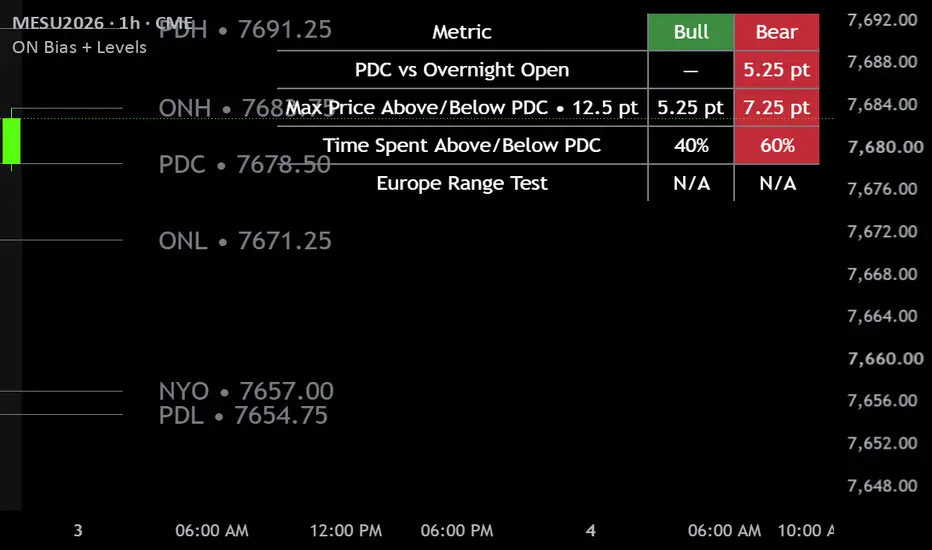
## Major Update — Overnight Bias: Professional Edition V1.0This release is a major redesign of the original Overnight Bias indicator. The purpose remains the same: provide objective overnight market context for the upcoming New York RTH session.
### What Changed
The original version measured the percentage of chart bars above/below the **Overnight Open** and maximum price extension from that same reference.
Professional Edition V1.0 now uses the **Prior RTH Close (PDC)** as the primary overnight inventory reference.
The updated framework measures:
* **Overnight Gap:** Actual Overnight Open relative to PDC.
* **Price Excursion:** Maximum price movement above and below PDC.
* **Time Acceptance:** Elapsed time spent above and below PDC rather than simply counting chart bars.
* **Overnight Range:** Developing/completed ONH-to-ONL range.
* **European Range Test:** Whether London subsequently tests the European High, Low, or both.
The Gap, Time Acceptance and Price Excursion measurements use adjustable thresholds before receiving Bull/Bear highlighting. This helps prevent small differences from automatically being treated as meaningful directional bias.
### Key Price Levels
The indicator now includes:
**PDH • PDL • PDC • ONH • ONL • NY Open**
Four optional custom price levels are also available.
The level system uses timestamp-based coordinates (`xloc.bar_time`) rather than `bar_index`, improving consistency across chart timeframes and TradingView Bar Replay.
### Developing vs Completed Overnight
The overnight calculation begins at **17:00 New York time** and develops throughout the overnight session.
At the **09:30 NY RTH open**, the completed overnight measurements are frozen and remain displayed during RTH. This allows NY price action to be compared with the overnight condition that existed before the open.
When the next overnight session begins, a new measurement cycle starts.
Because Pine Script executes on available chart bars, the last completed values remain visible while the market is closed. For example, Friday's completed information remains displayed through the weekend until new Sunday evening market data begins the next overnight session. This behavior is intentional and is consistent in live data and Bar Replay.
### Dashboard
The dashboard uses a compact:
**Metric | Bull | Bear**
format and displays:
* PDC vs Overnight Open
* Maximum Price Above/Below PDC
* Time Spent Above/Below PDC
* European Range Test
Green and red backgrounds identify measurements that satisfy their applicable Bull/Bear threshold or range-test condition. A neutral cell means the threshold has not been satisfied.
The dashboard is intended to show whether the individual overnight measurements are aligned, mixed, or neutral. It is **not a buy/sell signal**.
### Important Note for Existing Users
Values in this version will differ from previous versions because the underlying methodology has changed.
**Previous version:**
Bar counts and price magnitude relative to the Overnight Open.
**Professional Edition V1.0:**
Elapsed Time Acceptance and maximum Price Excursion relative to PDC, with the actual Overnight Open retained separately for gap measurement.
The new values therefore should not be directly compared with results from earlier versions.
### European/London Context
The European Range Test records whether London trades at or beyond the preceding European High or Low.
It is a **test**, not a liquidity-sweep or rejection signal. No reversal or close back inside the range is required.
### Naming Note
Earlier versions did not use a separate Pine `shorttitle` in the same manner as this version.
The updated indicator uses:
**Full title:** Overnight Bias: Professional Edition V1.0
**Chart short title:** ON Bias + Levels
The shorter name may therefore appear in the TradingView chart status line. This is only a display-name change and remains an update to the original Overnight Bias publication.
### Intended Use
Overnight Bias is a **market-context tool**, not a standalone trading system.
It is designed to help answer:
**Where did overnight trading begin relative to PDC?**
**Where did price spend more directional time?**
**How far did price explore in each direction?**
**What important prior-session and overnight levels surround price?**
**Did London test either side of the preceding European range?**
Agreement among several measurements can describe a more directionally consistent overnight condition, while disagreement can identify mixed conditions.
Neither predicts what the NY session must do next.
For futures such as ES/MES, use a chart containing Electronic Trading Hours so the required overnight data is available.
The source remains open for traders who wish to study, modify, or adapt the framework to their own trading process.

免責聲明
這些資訊和出版物並非旨在提供,也不構成TradingView提供或認可的任何形式的財務、投資、交易或其他類型的建議或推薦。請閱讀使用條款以了解更多資訊。
免責聲明
這些資訊和出版物並非旨在提供,也不構成TradingView提供或認可的任何形式的財務、投資、交易或其他類型的建議或推薦。請閱讀使用條款以了解更多資訊。