Synapse Quantum v1.0 | Multi-Confluence Entry Engine Strategy
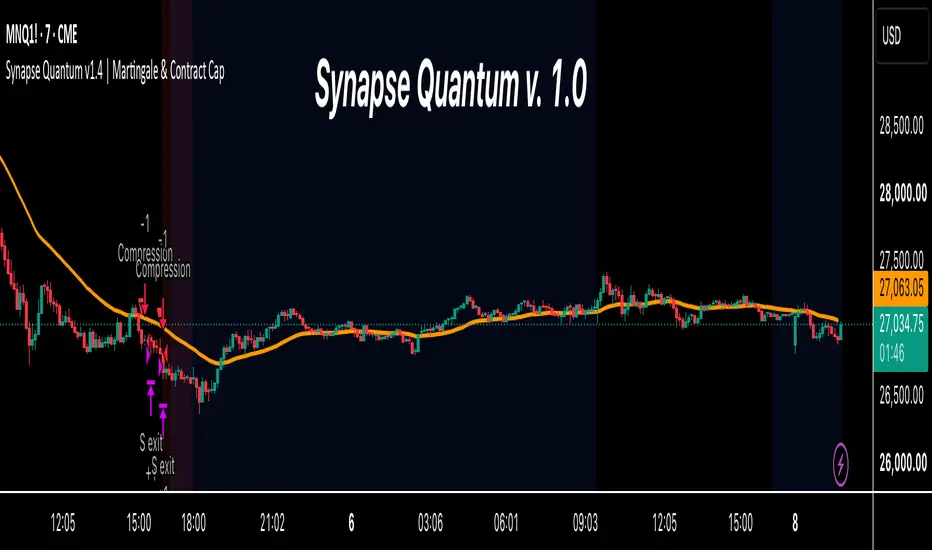
SYNAPSE QUANTUM v1.0
MULTI-ENGINE ENTRY STRATEGY
Overnight MNQ Futures | 7-Minute Chart
Recommended Baseline Settings & Historical Performance
STRATEGY OVERVIEW
Synapse Quantum is an advanced, multi-engine, market-adaptive futures trading strategy designed to identify high-probability trading opportunities through a combination of market geometry, volatility analysis, price equilibrium, momentum, and independent entry methodologies.
Unlike traditional trading strategies that rely on a single indicator, crossover, or directional signal, Synapse Quantum combines seven independently configurable entry engines into one coordinated trading system. Each engine interprets price behavior differently, allowing the strategy to recognize opportunities across multiple market environments.
The strategy is specifically designed and configured for Micro E-mini Nasdaq-100 (MNQ) futures using 7-minute candles. It operates during the overnight trading session, beginning at 6:00 PM Eastern and continuing until 4:40 PM the following trading day.
Synapse Quantum is designed to pursue consistent, controlled profitability through intelligent entry selection, adaptive market analysis, configurable position sizing, and comprehensive daily risk-management safeguards.
Its recommended baseline configuration uses three active entry engines, a starting position of one MNQ contract, a maximum position of two MNQ contracts, a $250 daily profit target, and a $400 daily loss limit.
The strategy's central philosophy is simple: different market conditions create different opportunities, and no single entry methodology is ideal for every environment.
Rather than forcing one approach onto every market condition, Synapse Quantum attempts to identify opportunities through several complementary methods.
========================================
RECOMMENDED BASELINE SETTINGS
========================================
01 | MARKET GEOMETRY
Equilibrium EMA Length: 34
ATR Length: 11
Efficiency Length: 20
Trend Efficiency Minimum: 0.35
Range Efficiency Maximum: 0.10
ATR Baseline Length: 30
Compression Threshold: 0.82
Regime Requirement: Engine-specific (selected label partially obscured in screenshot)
These settings establish the strategy's underlying market-analysis framework. They help evaluate directional efficiency, volatility conditions, compression, and the relationship between price and its equilibrium.
02 | INDEPENDENT ENTRY ENGINES
Engine 1: Memory / Equilibrium Reclaim — ENABLED
Engine 2: Elastic Snapback — ENABLED
Engine 3: Compression Breakout — ENABLED
Engine 4: EMA Crossover — DISABLED
Engine 5: EMA Pullback Continuation — DISABLED
Engine 6: Bollinger Band Reversion — DISABLED
Engine 7: Bollinger Squeeze Breakout — DISABLED
ADDITIONAL ENGINE SETTINGS
Memory Pullback Proximity: 0.10 ATR
Snapback Stretch: 1.50 ATR
Channel Breakout Lookback: 12
Fast EMA: 12
Slow EMA: 21
EMA Pullback Proximity: 0.25 ATR
Bollinger Length: 20
Bollinger Deviation: 2.0
Bollinger Squeeze Baseline Length: 50
BB Squeeze Width / Average: 0.75
Opposite Signals on Same Bar: Skip
The three active engines are intentionally different.
The Memory / Equilibrium Reclaim engine seeks opportunities involving price returning to and reclaiming important equilibrium levels.
The Elastic Snapback engine looks for price becoming stretched relative to its normal volatility and potentially reversing toward equilibrium.
The Compression Breakout engine attempts to recognize periods of compressed volatility followed by directional expansion.
Together, these three approaches allow the strategy to participate in different types of price behavior without relying exclusively on trend-following or mean-reversion signals.
03 | OPTIONAL ENTRY FILTERS
Require Fast/Slow EMA Alignment: OFF
Require Slow EMA Slope Alignment: OFF
Require Price Above/Below Slow EMA: OFF
Require Minimum ATR: ON
Minimum ATR: 10 Points
Require ATR Expansion: OFF
ATR / ATR Baseline Minimum: 0.70
Require RSI Directional Confirmation: OFF
RSI Length: 14
RSI Minimum for Longs: 52
RSI Maximum for Shorts: 48
Require Candle Pressure Confirmation: ON
Pressure EMA Smoothing: 3
Require Relative Volume: OFF
Volume Average Length: 20
Relative Volume Minimum: 1.15
Require Completed Higher-Timeframe EMA Bias: ON
Higher Timeframe: 2 Hours
Require Supertrend Direction: OFF
Supertrend ATR Multiplier: 2.0
Supertrend ATR Length: 10
Allow Longs: ON
Allow Shorts: ON
These filters provide an additional layer of flexibility.
The recommended configuration prioritizes minimum volatility, candle pressure confirmation, and completed higher-timeframe directional bias.
Other filters remain available but disabled, allowing the entry engines to operate without excessive restrictions.
04 | STOPS, TARGETS & EXIT MANAGEMENT
Initial Stop Units: ATR
Initial Stop Distance: 1.50 ATR
Target Units: Points
Target Distance: 100 Points
Exit Management: Static Bracket (appears selected in screenshot)
Trail Arms After Favorable R: 0.80
ATR Trailing Distance: 1.50
Chandelier Distance: 2.0 ATR
Additional Breakeven: OFF
Breakeven Activation: 1.0 R
Breakeven Offset: 1 Tick
Exit on Opposing Qualified Setup: OFF
Exit Trend Trades When Efficiency Fails: OFF
Maximum Bars in Trade: 0 (Unlimited)
Require Minimum Configured Reward/Risk: OFF
Minimum R:R: 1.0
The baseline configuration uses an ATR-based initial stop, allowing stop distance to adapt to prevailing volatility.
The 100-point profit target represents a theoretical gross profit of $200 for one MNQ contract or $400 for two MNQ contracts, before commissions and slippage.
Additional exit-management methods are available for experimentation, including trailing stops, Chandelier-based management, breakeven protection, and signal-based exits.
05 | MARTINGALE & POSITION SIZING
Enable Loss-Based Martingale Sizing: ON
Starting Contracts: 1 MNQ
Multiplier After Each Loss: 2
Maximum Contracts (Hard Cap): 2 MNQ
Maximum Consecutive Sizing Steps: 3
Reset to Starting Size After Winning Trade: ON
Reset Losing Streak at New Overnight Session: ON
Show Next Order Size in Data Window: ON
One of Synapse Quantum's distinctive features is its configurable loss-recovery position sizing.
The strategy begins with one MNQ contract. Following a losing trade, it can increase the next position to two MNQ contracts.
Unlike an unrestricted Martingale system, Synapse Quantum imposes a hard two-contract maximum, preventing additional exponential increases.
After a winning trade, the position size resets to one contract.
The losing streak also resets at the beginning of each new overnight session.
This structure is intended to provide a limited opportunity to recover previous losses while preventing uncontrolled position escalation.
However, increasing position size after a loss also increases exposure during unfavorable market conditions. The contract cap limits position size but does not eliminate the risks associated with Martingale recovery.
06 | OVERNIGHT SESSION & DAILY SAFEGUARDS
Timezone: America/New_York
Entry Window: 6:00 PM to 4:40 PM
Restrict Entries to Session: ON
Sunday Overnight: ON
Monday Overnight: ON
Tuesday Overnight: ON
Wednesday Overnight: ON
Thursday Overnight: ON
Maximum Entries Per Session: 0 (Unlimited)
Bars Between Entries: 2
Enable Daily Profit Lockout: ON
Daily Profit Target: $250
Enable Daily Loss Lockout: ON
Daily Loss Limit: $400
Flatten on Daily Threshold: ON
Standing Daily Stop/Target Price Guards: ON
Avoid New Entries Near Daily Profit Target: ON
Minimum Dollars Remaining for Entry: $30
Flatten at Entry Window End: ON
These safeguards are particularly important for overnight trading.
The strategy is designed to stop trading after reaching its configured daily profit target or loss threshold.
Standing protective price guards are intended to provide faster reactions to threshold crossings rather than relying exclusively on completed 7-minute candles.
The strategy also avoids opening new positions when the remaining distance to the daily profit target is less than $30.
At the end of the trading window, open positions are configured to flatten.
These features are intended to improve discipline, reduce unnecessary exposure, and make the strategy more suitable for systematic overnight execution.
Actual losses can exceed configured thresholds because of slippage, market gaps, order latency, or execution differences.
07 | VISUALS & DIAGNOSTICS
Show EMAs: OFF
Show Bollinger Bands: OFF
Show Equilibrium: ON
Show Engine Signals: ON
Show Diagnostics in Data Window: OFF
Show Next Order Size in Data Window: ON
This configuration provides a relatively clean chart while preserving visibility into equilibrium levels, entry signals, and upcoming position sizing.
========================================
HISTORICAL BACKTEST PERFORMANCE
========================================
BACKTEST PERIOD
November 13, 2025 – November 5, 2026
Instrument: MNQ Futures
Chart Timeframe: 7 Minutes
Trading Style: Overnight Multi-Engine Strategy
HISTORICAL PERFORMANCE SUMMARY
Total Net Profit: +$10,592.50
Profit Factor: 1.63
Total Completed Trades: 318
Winning Trades: 152
Losing Trades: 166
Winning Trade Percentage: 47.8%
Gross Winning P&L: +$27,466.50
Gross Losing P&L: -$16,874.00
Average Net Profit Per Trade: +$33.31
Largest Winning Trade: +$397.00
Largest Losing Trade: -$311.00
Maximum Closed-Trade Drawdown: -$1,290.00
Total Overnight Sessions With Closed Trades: 198
Profitable Overnight Sessions: 109
Losing Overnight Sessions: 89
Profitable Session Percentage: 55.1%
Average Profit Per Active Overnight Session: +$53.50
The maximum closed-trade drawdown does not include unrealized intratrade drawdown.
These historical results are encouraging because the strategy generated positive net profitability despite winning fewer than half of its individual trades.
Its 1.63 profit factor indicates that historical gross profits were approximately 63% greater than historical gross losses.
This suggests that the combination of trade selection, profit targets, stop management, and position sizing produced a positive expectancy over the tested period.
========================================
MONTHLY BACKTEST RESULTS
========================================
November 2025: +$62.50 (Partial Month)
December 2025: +$365.00
January 2026: +$62.00
February 2026: +$1,342.00
March 2026: +$324.50
April 2026: +$382.00
May 2026: +$163.50
June 2026: +$1,456.50
July 2026: +$1,398.50
August 2026: +$969.00
September 2026: +$2,403.50
October 2026: +$1,539.00
November 2026: +$124.50 (Partial Month)
TOTAL HISTORICAL NET PROFIT: +$10,592.50
One particularly encouraging characteristic of this backtest is that every calendar month represented finished profitable.
September 2026 was the strongest month, generating $2,403.50.
June, July, and October also produced more than $1,300 each.
Although some months generated relatively modest profits, the backtest demonstrated positive monthly performance throughout the represented period.
These results are historical and do not guarantee that future months will be profitable.
========================================
ENTRY ENGINE PERFORMANCE BREAKDOWN
========================================
Compression Breakout: 251 Entries
Elastic Snapback: 58 Entries
Memory / Equilibrium Reclaim: 9 Entries
Total Entries: 318
Approximately 79% of the strategy's historical entries originated from the Compression Breakout engine.
This is an interesting finding because it indicates that the current baseline configuration relies heavily on identifying volatility compression followed by directional price movement.
The Elastic Snapback engine contributed additional opportunities, while the Memory / Equilibrium Reclaim engine was comparatively selective.
Although the strategy contains seven independent engines, the current configuration demonstrates that it does not require all seven engines to be active to generate a substantial number of trading opportunities.
Future testing could evaluate each engine independently to determine its individual profitability, drawdown characteristics, and contribution to the combined strategy.
========================================
WHAT MAKES SYNAPSE QUANTUM UNIQUE?
========================================
1. MULTIPLE INDEPENDENT ENTRY ENGINES
Synapse Quantum does not depend on one trading signal or one market condition.
Its seven available entry engines allow it to approach the market through several different methodologies, including equilibrium recovery, volatility expansion, price reversals, EMA-based continuation, and Bollinger Band behavior.
This gives the strategy greater flexibility than a conventional single-indicator trading system.
2. MARKET-GEOMETRY ANALYSIS
The strategy uses equilibrium, ATR, efficiency measurements, and volatility compression to evaluate how price is behaving.
Rather than simply asking whether price is moving up or down, Synapse Quantum attempts to identify the type of market environment in which a potential trade is developing.
3. MARKET-ADAPTIVE ENTRY SELECTION
Different entry engines can recognize different types of opportunities.
For example, a compression breakout setup is fundamentally different from an elastic snapback reversal.
Combining these approaches allows the strategy to search for opportunities across changing market conditions.
4. HIGHER-TIMEFRAME DIRECTIONAL CONTEXT
The recommended configuration incorporates completed two-hour EMA information while executing on 7-minute candles.
This provides a broader directional perspective without sacrificing the responsiveness of a shorter trading timeframe.
When implemented correctly, using completed higher-timeframe values also helps reduce repainting and lookahead concerns.
5. CUSTOMIZABLE CONFLUENCE FILTERS
The strategy provides numerous optional filters, including EMA alignment, EMA slope, ATR expansion, RSI confirmation, candle pressure, relative volume, and Supertrend direction.
These filters can be enabled individually, allowing traders to experiment with different combinations without redesigning the underlying entry engines.
6. LIMITED MARTINGALE RECOVERY
The strategy includes configurable loss-based position sizing with a strict maximum contract cap.
The recommended baseline increases from one MNQ contract to two after a loss but does not permit unlimited position growth.
This creates a defined maximum position size while retaining a limited recovery mechanism.
7. COMPREHENSIVE DAILY SAFEGUARDS
Synapse Quantum incorporates daily profit and loss thresholds, standing protective price guards, session restrictions, entry spacing, profit-target proximity restrictions, and session-end flattening.
These features are intended to help prevent excessive trading and maintain consistent risk-management rules.
8. DESIGNED FOR OVERNIGHT MNQ TRADING
The strategy is configured specifically for the overnight MNQ futures market on 7-minute candles.
This timeframe provides a balance between responsiveness and signal filtering.
The system is intended to identify opportunities throughout the evening, overnight, and following trading day while respecting the configured session boundaries.
========================================
WHY SYNAPSE QUANTUM COULD BE PROFITABLE
========================================
The strategy's potential profitability comes from several complementary design principles.
First, its independent entry engines allow it to recognize opportunities that might be missed by strategies relying on a single signal.
Second, the combination of volatility analysis, equilibrium measurements, and candle pressure confirmation helps establish more specific conditions for trade entry.
Third, the higher-timeframe directional filter provides additional market context.
Fourth, ATR-based stops adapt to changing volatility rather than using one fixed stop distance in every market condition.
Fifth, daily profit and loss thresholds are designed to limit trading after predetermined objectives have been reached.
Finally, the limited Martingale feature allows controlled increases in contract size following losses, while the hard contract cap prevents unlimited escalation.
The historical backtest supports the possibility that these features can work together to produce positive results.
Over approximately one year, Synapse Quantum generated more than $10,500 in historical net profit, a profit factor of 1.63, and positive results in every represented calendar month.
The system also demonstrated that profitability does not necessarily require an extremely high individual trade win rate.
However, historical profitability does not establish that the strategy will perform similarly in live trading. Its performance should be validated with realistic transaction costs, slippage, out-of-sample testing, and forward execution.
========================================
INTENDED APPLICATIONS
========================================
Synapse Quantum is designed for traders seeking a customizable, rules-based approach to MNQ futures.
Potential applications include:
- Overnight automated futures trading.
- TradingView strategy backtesting.
- Paper trading and forward testing.
- Prop firm evaluation research.
- Systematic futures trading with defined daily thresholds.
- Multi-engine entry experimentation.
- Volatility and market-regime research.
- Development of alternative entry and exit configurations.
The strategy can potentially be integrated into automated execution workflows using TradingView alerts and compatible third-party execution services.
Before live deployment, alert behavior, position synchronization, order sizing, protective orders, and actual brokerage fills should be thoroughly verified.
========================================
FUTURE DEVELOPMENT & OPTIMIZATION
========================================
Synapse Quantum provides a flexible foundation for continued strategy development.
Potential improvements include more detailed entry-engine performance reporting, adaptive risk allocation, enhanced trade-quality scoring, volatility-sensitive profit targets, additional market-regime filters, and improved intrabar execution safeguards.
One particularly valuable area of future research is determining whether the three active engines perform better together than individually.
Another is examining whether the limited Martingale feature improves risk-adjusted performance or simply increases exposure following losing trades.
Additional testing across different market conditions, contract periods, and out-of-sample datasets would help determine how robust the baseline configuration is.
========================================
FINAL STRATEGY SUMMARY
========================================
Synapse Quantum v1.0 is a multi-engine, market-adaptive futures trading strategy designed specifically for overnight MNQ trading on 7-minute candles.
Its defining characteristic is the combination of independent entry methodologies, market-geometry analysis, configurable technical confirmations, volatility-adaptive risk management, and comprehensive daily trading safeguards.
The recommended baseline uses three active entry engines, a 34-period equilibrium EMA, an 11-period ATR, a completed two-hour EMA directional filter, candle pressure confirmation, and a minimum ATR requirement of 10 points.
The strategy begins with one MNQ contract, permits limited loss-based sizing up to two contracts, and operates with a $250 daily profit target and $400 daily loss threshold.
Its historical backtest produced approximately $10,592.50 in net profit across 318 completed trades, with a 47.8% win rate and a 1.63 profit factor.
All represented calendar months finished profitable, providing an encouraging preliminary indication of historical consistency.
The strategy's greatest potential advantage is its ability to combine different approaches to price behavior within one coordinated trading framework.
Rather than relying on a single indicator or one narrow market condition, Synapse Quantum attempts to recognize different opportunities as market behavior changes.
Its ultimate objective is to identify repeatable trading opportunities while keeping position sizing, daily exposure, and trading activity within clearly defined boundaries.
Synapse Quantum is intended to be a flexible, systematic trading framework that can be refined through ongoing backtesting, forward testing, and realistic execution analysis.
IMPORTANT DISCLAIMER
All performance figures represent historical simulated backtest results, not guaranteed future returns. Actual trading results may differ because of commissions, slippage, liquidity, intrabar price movement, order execution, and market conditions. Daily loss limits and protective orders do not guarantee a maximum realized loss. Martingale position sizing increases risk following losses and requires particular caution.
MULTI-ENGINE ENTRY STRATEGY
Overnight MNQ Futures | 7-Minute Chart
Recommended Baseline Settings & Historical Performance
STRATEGY OVERVIEW
Synapse Quantum is an advanced, multi-engine, market-adaptive futures trading strategy designed to identify high-probability trading opportunities through a combination of market geometry, volatility analysis, price equilibrium, momentum, and independent entry methodologies.
Unlike traditional trading strategies that rely on a single indicator, crossover, or directional signal, Synapse Quantum combines seven independently configurable entry engines into one coordinated trading system. Each engine interprets price behavior differently, allowing the strategy to recognize opportunities across multiple market environments.
The strategy is specifically designed and configured for Micro E-mini Nasdaq-100 (MNQ) futures using 7-minute candles. It operates during the overnight trading session, beginning at 6:00 PM Eastern and continuing until 4:40 PM the following trading day.
Synapse Quantum is designed to pursue consistent, controlled profitability through intelligent entry selection, adaptive market analysis, configurable position sizing, and comprehensive daily risk-management safeguards.
Its recommended baseline configuration uses three active entry engines, a starting position of one MNQ contract, a maximum position of two MNQ contracts, a $250 daily profit target, and a $400 daily loss limit.
The strategy's central philosophy is simple: different market conditions create different opportunities, and no single entry methodology is ideal for every environment.
Rather than forcing one approach onto every market condition, Synapse Quantum attempts to identify opportunities through several complementary methods.
========================================
RECOMMENDED BASELINE SETTINGS
========================================
01 | MARKET GEOMETRY
Equilibrium EMA Length: 34
ATR Length: 11
Efficiency Length: 20
Trend Efficiency Minimum: 0.35
Range Efficiency Maximum: 0.10
ATR Baseline Length: 30
Compression Threshold: 0.82
Regime Requirement: Engine-specific (selected label partially obscured in screenshot)
These settings establish the strategy's underlying market-analysis framework. They help evaluate directional efficiency, volatility conditions, compression, and the relationship between price and its equilibrium.
02 | INDEPENDENT ENTRY ENGINES
Engine 1: Memory / Equilibrium Reclaim — ENABLED
Engine 2: Elastic Snapback — ENABLED
Engine 3: Compression Breakout — ENABLED
Engine 4: EMA Crossover — DISABLED
Engine 5: EMA Pullback Continuation — DISABLED
Engine 6: Bollinger Band Reversion — DISABLED
Engine 7: Bollinger Squeeze Breakout — DISABLED
ADDITIONAL ENGINE SETTINGS
Memory Pullback Proximity: 0.10 ATR
Snapback Stretch: 1.50 ATR
Channel Breakout Lookback: 12
Fast EMA: 12
Slow EMA: 21
EMA Pullback Proximity: 0.25 ATR
Bollinger Length: 20
Bollinger Deviation: 2.0
Bollinger Squeeze Baseline Length: 50
BB Squeeze Width / Average: 0.75
Opposite Signals on Same Bar: Skip
The three active engines are intentionally different.
The Memory / Equilibrium Reclaim engine seeks opportunities involving price returning to and reclaiming important equilibrium levels.
The Elastic Snapback engine looks for price becoming stretched relative to its normal volatility and potentially reversing toward equilibrium.
The Compression Breakout engine attempts to recognize periods of compressed volatility followed by directional expansion.
Together, these three approaches allow the strategy to participate in different types of price behavior without relying exclusively on trend-following or mean-reversion signals.
03 | OPTIONAL ENTRY FILTERS
Require Fast/Slow EMA Alignment: OFF
Require Slow EMA Slope Alignment: OFF
Require Price Above/Below Slow EMA: OFF
Require Minimum ATR: ON
Minimum ATR: 10 Points
Require ATR Expansion: OFF
ATR / ATR Baseline Minimum: 0.70
Require RSI Directional Confirmation: OFF
RSI Length: 14
RSI Minimum for Longs: 52
RSI Maximum for Shorts: 48
Require Candle Pressure Confirmation: ON
Pressure EMA Smoothing: 3
Require Relative Volume: OFF
Volume Average Length: 20
Relative Volume Minimum: 1.15
Require Completed Higher-Timeframe EMA Bias: ON
Higher Timeframe: 2 Hours
Require Supertrend Direction: OFF
Supertrend ATR Multiplier: 2.0
Supertrend ATR Length: 10
Allow Longs: ON
Allow Shorts: ON
These filters provide an additional layer of flexibility.
The recommended configuration prioritizes minimum volatility, candle pressure confirmation, and completed higher-timeframe directional bias.
Other filters remain available but disabled, allowing the entry engines to operate without excessive restrictions.
04 | STOPS, TARGETS & EXIT MANAGEMENT
Initial Stop Units: ATR
Initial Stop Distance: 1.50 ATR
Target Units: Points
Target Distance: 100 Points
Exit Management: Static Bracket (appears selected in screenshot)
Trail Arms After Favorable R: 0.80
ATR Trailing Distance: 1.50
Chandelier Distance: 2.0 ATR
Additional Breakeven: OFF
Breakeven Activation: 1.0 R
Breakeven Offset: 1 Tick
Exit on Opposing Qualified Setup: OFF
Exit Trend Trades When Efficiency Fails: OFF
Maximum Bars in Trade: 0 (Unlimited)
Require Minimum Configured Reward/Risk: OFF
Minimum R:R: 1.0
The baseline configuration uses an ATR-based initial stop, allowing stop distance to adapt to prevailing volatility.
The 100-point profit target represents a theoretical gross profit of $200 for one MNQ contract or $400 for two MNQ contracts, before commissions and slippage.
Additional exit-management methods are available for experimentation, including trailing stops, Chandelier-based management, breakeven protection, and signal-based exits.
05 | MARTINGALE & POSITION SIZING
Enable Loss-Based Martingale Sizing: ON
Starting Contracts: 1 MNQ
Multiplier After Each Loss: 2
Maximum Contracts (Hard Cap): 2 MNQ
Maximum Consecutive Sizing Steps: 3
Reset to Starting Size After Winning Trade: ON
Reset Losing Streak at New Overnight Session: ON
Show Next Order Size in Data Window: ON
One of Synapse Quantum's distinctive features is its configurable loss-recovery position sizing.
The strategy begins with one MNQ contract. Following a losing trade, it can increase the next position to two MNQ contracts.
Unlike an unrestricted Martingale system, Synapse Quantum imposes a hard two-contract maximum, preventing additional exponential increases.
After a winning trade, the position size resets to one contract.
The losing streak also resets at the beginning of each new overnight session.
This structure is intended to provide a limited opportunity to recover previous losses while preventing uncontrolled position escalation.
However, increasing position size after a loss also increases exposure during unfavorable market conditions. The contract cap limits position size but does not eliminate the risks associated with Martingale recovery.
06 | OVERNIGHT SESSION & DAILY SAFEGUARDS
Timezone: America/New_York
Entry Window: 6:00 PM to 4:40 PM
Restrict Entries to Session: ON
Sunday Overnight: ON
Monday Overnight: ON
Tuesday Overnight: ON
Wednesday Overnight: ON
Thursday Overnight: ON
Maximum Entries Per Session: 0 (Unlimited)
Bars Between Entries: 2
Enable Daily Profit Lockout: ON
Daily Profit Target: $250
Enable Daily Loss Lockout: ON
Daily Loss Limit: $400
Flatten on Daily Threshold: ON
Standing Daily Stop/Target Price Guards: ON
Avoid New Entries Near Daily Profit Target: ON
Minimum Dollars Remaining for Entry: $30
Flatten at Entry Window End: ON
These safeguards are particularly important for overnight trading.
The strategy is designed to stop trading after reaching its configured daily profit target or loss threshold.
Standing protective price guards are intended to provide faster reactions to threshold crossings rather than relying exclusively on completed 7-minute candles.
The strategy also avoids opening new positions when the remaining distance to the daily profit target is less than $30.
At the end of the trading window, open positions are configured to flatten.
These features are intended to improve discipline, reduce unnecessary exposure, and make the strategy more suitable for systematic overnight execution.
Actual losses can exceed configured thresholds because of slippage, market gaps, order latency, or execution differences.
07 | VISUALS & DIAGNOSTICS
Show EMAs: OFF
Show Bollinger Bands: OFF
Show Equilibrium: ON
Show Engine Signals: ON
Show Diagnostics in Data Window: OFF
Show Next Order Size in Data Window: ON
This configuration provides a relatively clean chart while preserving visibility into equilibrium levels, entry signals, and upcoming position sizing.
========================================
HISTORICAL BACKTEST PERFORMANCE
========================================
BACKTEST PERIOD
November 13, 2025 – November 5, 2026
Instrument: MNQ Futures
Chart Timeframe: 7 Minutes
Trading Style: Overnight Multi-Engine Strategy
HISTORICAL PERFORMANCE SUMMARY
Total Net Profit: +$10,592.50
Profit Factor: 1.63
Total Completed Trades: 318
Winning Trades: 152
Losing Trades: 166
Winning Trade Percentage: 47.8%
Gross Winning P&L: +$27,466.50
Gross Losing P&L: -$16,874.00
Average Net Profit Per Trade: +$33.31
Largest Winning Trade: +$397.00
Largest Losing Trade: -$311.00
Maximum Closed-Trade Drawdown: -$1,290.00
Total Overnight Sessions With Closed Trades: 198
Profitable Overnight Sessions: 109
Losing Overnight Sessions: 89
Profitable Session Percentage: 55.1%
Average Profit Per Active Overnight Session: +$53.50
The maximum closed-trade drawdown does not include unrealized intratrade drawdown.
These historical results are encouraging because the strategy generated positive net profitability despite winning fewer than half of its individual trades.
Its 1.63 profit factor indicates that historical gross profits were approximately 63% greater than historical gross losses.
This suggests that the combination of trade selection, profit targets, stop management, and position sizing produced a positive expectancy over the tested period.
========================================
MONTHLY BACKTEST RESULTS
========================================
November 2025: +$62.50 (Partial Month)
December 2025: +$365.00
January 2026: +$62.00
February 2026: +$1,342.00
March 2026: +$324.50
April 2026: +$382.00
May 2026: +$163.50
June 2026: +$1,456.50
July 2026: +$1,398.50
August 2026: +$969.00
September 2026: +$2,403.50
October 2026: +$1,539.00
November 2026: +$124.50 (Partial Month)
TOTAL HISTORICAL NET PROFIT: +$10,592.50
One particularly encouraging characteristic of this backtest is that every calendar month represented finished profitable.
September 2026 was the strongest month, generating $2,403.50.
June, July, and October also produced more than $1,300 each.
Although some months generated relatively modest profits, the backtest demonstrated positive monthly performance throughout the represented period.
These results are historical and do not guarantee that future months will be profitable.
========================================
ENTRY ENGINE PERFORMANCE BREAKDOWN
========================================
Compression Breakout: 251 Entries
Elastic Snapback: 58 Entries
Memory / Equilibrium Reclaim: 9 Entries
Total Entries: 318
Approximately 79% of the strategy's historical entries originated from the Compression Breakout engine.
This is an interesting finding because it indicates that the current baseline configuration relies heavily on identifying volatility compression followed by directional price movement.
The Elastic Snapback engine contributed additional opportunities, while the Memory / Equilibrium Reclaim engine was comparatively selective.
Although the strategy contains seven independent engines, the current configuration demonstrates that it does not require all seven engines to be active to generate a substantial number of trading opportunities.
Future testing could evaluate each engine independently to determine its individual profitability, drawdown characteristics, and contribution to the combined strategy.
========================================
WHAT MAKES SYNAPSE QUANTUM UNIQUE?
========================================
1. MULTIPLE INDEPENDENT ENTRY ENGINES
Synapse Quantum does not depend on one trading signal or one market condition.
Its seven available entry engines allow it to approach the market through several different methodologies, including equilibrium recovery, volatility expansion, price reversals, EMA-based continuation, and Bollinger Band behavior.
This gives the strategy greater flexibility than a conventional single-indicator trading system.
2. MARKET-GEOMETRY ANALYSIS
The strategy uses equilibrium, ATR, efficiency measurements, and volatility compression to evaluate how price is behaving.
Rather than simply asking whether price is moving up or down, Synapse Quantum attempts to identify the type of market environment in which a potential trade is developing.
3. MARKET-ADAPTIVE ENTRY SELECTION
Different entry engines can recognize different types of opportunities.
For example, a compression breakout setup is fundamentally different from an elastic snapback reversal.
Combining these approaches allows the strategy to search for opportunities across changing market conditions.
4. HIGHER-TIMEFRAME DIRECTIONAL CONTEXT
The recommended configuration incorporates completed two-hour EMA information while executing on 7-minute candles.
This provides a broader directional perspective without sacrificing the responsiveness of a shorter trading timeframe.
When implemented correctly, using completed higher-timeframe values also helps reduce repainting and lookahead concerns.
5. CUSTOMIZABLE CONFLUENCE FILTERS
The strategy provides numerous optional filters, including EMA alignment, EMA slope, ATR expansion, RSI confirmation, candle pressure, relative volume, and Supertrend direction.
These filters can be enabled individually, allowing traders to experiment with different combinations without redesigning the underlying entry engines.
6. LIMITED MARTINGALE RECOVERY
The strategy includes configurable loss-based position sizing with a strict maximum contract cap.
The recommended baseline increases from one MNQ contract to two after a loss but does not permit unlimited position growth.
This creates a defined maximum position size while retaining a limited recovery mechanism.
7. COMPREHENSIVE DAILY SAFEGUARDS
Synapse Quantum incorporates daily profit and loss thresholds, standing protective price guards, session restrictions, entry spacing, profit-target proximity restrictions, and session-end flattening.
These features are intended to help prevent excessive trading and maintain consistent risk-management rules.
8. DESIGNED FOR OVERNIGHT MNQ TRADING
The strategy is configured specifically for the overnight MNQ futures market on 7-minute candles.
This timeframe provides a balance between responsiveness and signal filtering.
The system is intended to identify opportunities throughout the evening, overnight, and following trading day while respecting the configured session boundaries.
========================================
WHY SYNAPSE QUANTUM COULD BE PROFITABLE
========================================
The strategy's potential profitability comes from several complementary design principles.
First, its independent entry engines allow it to recognize opportunities that might be missed by strategies relying on a single signal.
Second, the combination of volatility analysis, equilibrium measurements, and candle pressure confirmation helps establish more specific conditions for trade entry.
Third, the higher-timeframe directional filter provides additional market context.
Fourth, ATR-based stops adapt to changing volatility rather than using one fixed stop distance in every market condition.
Fifth, daily profit and loss thresholds are designed to limit trading after predetermined objectives have been reached.
Finally, the limited Martingale feature allows controlled increases in contract size following losses, while the hard contract cap prevents unlimited escalation.
The historical backtest supports the possibility that these features can work together to produce positive results.
Over approximately one year, Synapse Quantum generated more than $10,500 in historical net profit, a profit factor of 1.63, and positive results in every represented calendar month.
The system also demonstrated that profitability does not necessarily require an extremely high individual trade win rate.
However, historical profitability does not establish that the strategy will perform similarly in live trading. Its performance should be validated with realistic transaction costs, slippage, out-of-sample testing, and forward execution.
========================================
INTENDED APPLICATIONS
========================================
Synapse Quantum is designed for traders seeking a customizable, rules-based approach to MNQ futures.
Potential applications include:
- Overnight automated futures trading.
- TradingView strategy backtesting.
- Paper trading and forward testing.
- Prop firm evaluation research.
- Systematic futures trading with defined daily thresholds.
- Multi-engine entry experimentation.
- Volatility and market-regime research.
- Development of alternative entry and exit configurations.
The strategy can potentially be integrated into automated execution workflows using TradingView alerts and compatible third-party execution services.
Before live deployment, alert behavior, position synchronization, order sizing, protective orders, and actual brokerage fills should be thoroughly verified.
========================================
FUTURE DEVELOPMENT & OPTIMIZATION
========================================
Synapse Quantum provides a flexible foundation for continued strategy development.
Potential improvements include more detailed entry-engine performance reporting, adaptive risk allocation, enhanced trade-quality scoring, volatility-sensitive profit targets, additional market-regime filters, and improved intrabar execution safeguards.
One particularly valuable area of future research is determining whether the three active engines perform better together than individually.
Another is examining whether the limited Martingale feature improves risk-adjusted performance or simply increases exposure following losing trades.
Additional testing across different market conditions, contract periods, and out-of-sample datasets would help determine how robust the baseline configuration is.
========================================
FINAL STRATEGY SUMMARY
========================================
Synapse Quantum v1.0 is a multi-engine, market-adaptive futures trading strategy designed specifically for overnight MNQ trading on 7-minute candles.
Its defining characteristic is the combination of independent entry methodologies, market-geometry analysis, configurable technical confirmations, volatility-adaptive risk management, and comprehensive daily trading safeguards.
The recommended baseline uses three active entry engines, a 34-period equilibrium EMA, an 11-period ATR, a completed two-hour EMA directional filter, candle pressure confirmation, and a minimum ATR requirement of 10 points.
The strategy begins with one MNQ contract, permits limited loss-based sizing up to two contracts, and operates with a $250 daily profit target and $400 daily loss threshold.
Its historical backtest produced approximately $10,592.50 in net profit across 318 completed trades, with a 47.8% win rate and a 1.63 profit factor.
All represented calendar months finished profitable, providing an encouraging preliminary indication of historical consistency.
The strategy's greatest potential advantage is its ability to combine different approaches to price behavior within one coordinated trading framework.
Rather than relying on a single indicator or one narrow market condition, Synapse Quantum attempts to recognize different opportunities as market behavior changes.
Its ultimate objective is to identify repeatable trading opportunities while keeping position sizing, daily exposure, and trading activity within clearly defined boundaries.
Synapse Quantum is intended to be a flexible, systematic trading framework that can be refined through ongoing backtesting, forward testing, and realistic execution analysis.
IMPORTANT DISCLAIMER
All performance figures represent historical simulated backtest results, not guaranteed future returns. Actual trading results may differ because of commissions, slippage, liquidity, intrabar price movement, order execution, and market conditions. Daily loss limits and protective orders do not guarantee a maximum realized loss. Martingale position sizing increases risk following losses and requires particular caution.

免責聲明
這些資訊和出版物並非旨在提供,也不構成TradingView提供或認可的任何形式的財務、投資、交易或其他類型的建議或推薦。請閱讀使用條款以了解更多資訊。
免責聲明
這些資訊和出版物並非旨在提供,也不構成TradingView提供或認可的任何形式的財務、投資、交易或其他類型的建議或推薦。請閱讀使用條款以了解更多資訊。