
Synthesized Investment Thesis for Albany International (AIN): A High-Risk, Speculative Short
The collective analysis paints a picture of a mature industrial company experiencing fundamental deterioration, making its stock a candidate for underperformance. When combined with the specific technical levels provided, it forms a high-conviction, yet high-risk, speculative short thesis.
Core Fundamental Weaknesses (The "Why" to Avoid or Short):
Chronic Growth Stagnation: With annualized revenue growth of only 4.3% over five years and a mere 2.5% over the last two, Albany operates in a state of near-zero organic expansion. This falls significantly below the benchmark for a quality industrial company and suggests it is losing relevance or pricing power in its core markets (paper machine clothing, aerospace composites).
Eroding Profitability and Capital Efficiency: The metrics here are alarmingly consistent:
Plummeting Free Cash Flow Margin: A 9.9 percentage point contraction over five years, down to 8%, indicates the business is consuming increasing amounts of capital just to maintain operations, leaving less true cash profit for shareholders.
Declining Return on Invested Capital (ROIC): A falling ROIC from an already low base is a critical red flag. It signals that management's recent investments and strategic bets—whether in new products, capacity, or acquisitions—are failing to generate adequate returns. This creates a vicious cycle of value destruction.
Unjustified Valuation Relative to Trajectory: Despite a recent decline, a forward P/E of 17.7x-20.3x is not "cheap" for a company with stagnating sales and declining returns on capital. It prices in stability or a turnaround that the fundamentals do not support. The consensus price target implying a -4.1% return reflects analyst skepticism about near-term upside.
Integrated Technical & Risk Management Parameters (The "How" to Execute):
This is where the thesis moves from a qualitative "avoid" to a quantitative "speculative short" strategy.
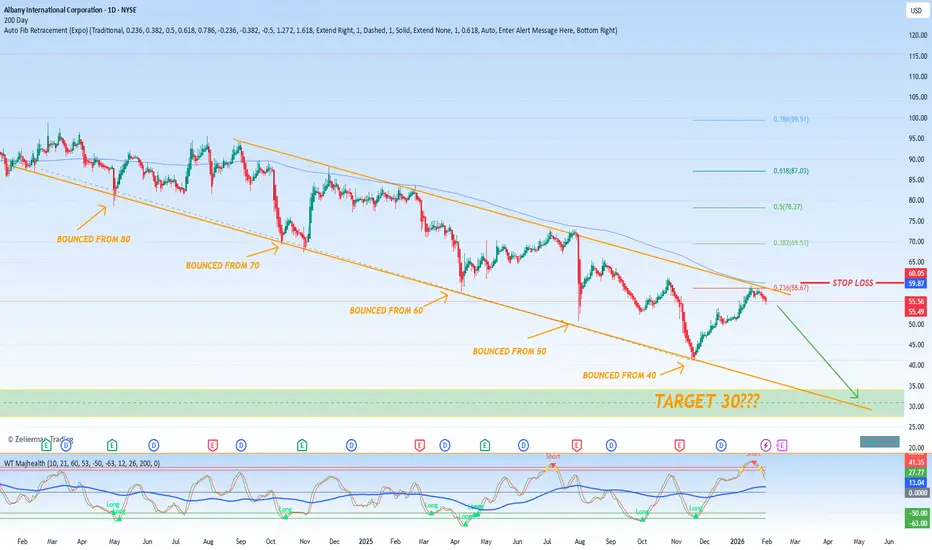
Entry & Initial Stop-Loss: A short position would be considered at or near the current level (~$57.60). The provided stop-loss at $60.00 is critical. This level acts as a definitive risk-management point. A sustained break above $60 would invalidate the immediate bearish structure and suggest the stock has found a floor, necessitating an exit to cap losses.
Profit-Taking Target & Chart Evidence: The ambitious take-profit target of $30.00 implies a potential decline of nearly 50% from current levels. The rationale for this target is based on observed technical behavior: "bounces from the bottom going down in 10s." This suggests a long-term, stair-step decline where the stock finds temporary support at round-number increments (e.g., $50, $40), experiences a brief bounce, and then breaks down to the next decade level. A fall to $30 would represent a breakdown from the $40 support level, potentially targeting lows not seen in years.
Final Integrated Judgment:
Albany International (AIN) presents a compelling case for a high-risk, actively managed short position rather than a passive hold.
The Fundamentals provide the rationale: Sluggish growth, collapsing cash flow margins, and poor capital allocation create a backdrop where multiple compression (a lower P/E ratio) is likely, especially if earnings begin to contract.
The Technicals provide the roadmap and risk controls: The pattern of declining decade-level supports justifies a low price target, while the strict stop-loss at $60.00 defines and limits the trade's risk.
Critical Caution: This is a speculative trade predicated on the continuation of a severe downtrend. The stop-loss must be respected. Any fundamental catalyst—such as a major new aerospace contract, a successful restructuring, or a takeover rumor—could swiftly reverse the price action and trigger the stop. Therefore, position sizing must be conservative.
In summary, the integrated view suggests selling or shorting AIN with a strategic profit target of $30.00, while employing a disciplined stop-loss at $60.00 to carefully manage the significant risk that the long-term decline may be interrupted by a sharp counter-trend rally.
The collective analysis paints a picture of a mature industrial company experiencing fundamental deterioration, making its stock a candidate for underperformance. When combined with the specific technical levels provided, it forms a high-conviction, yet high-risk, speculative short thesis.
Core Fundamental Weaknesses (The "Why" to Avoid or Short):
Chronic Growth Stagnation: With annualized revenue growth of only 4.3% over five years and a mere 2.5% over the last two, Albany operates in a state of near-zero organic expansion. This falls significantly below the benchmark for a quality industrial company and suggests it is losing relevance or pricing power in its core markets (paper machine clothing, aerospace composites).
Eroding Profitability and Capital Efficiency: The metrics here are alarmingly consistent:
Plummeting Free Cash Flow Margin: A 9.9 percentage point contraction over five years, down to 8%, indicates the business is consuming increasing amounts of capital just to maintain operations, leaving less true cash profit for shareholders.
Declining Return on Invested Capital (ROIC): A falling ROIC from an already low base is a critical red flag. It signals that management's recent investments and strategic bets—whether in new products, capacity, or acquisitions—are failing to generate adequate returns. This creates a vicious cycle of value destruction.
Unjustified Valuation Relative to Trajectory: Despite a recent decline, a forward P/E of 17.7x-20.3x is not "cheap" for a company with stagnating sales and declining returns on capital. It prices in stability or a turnaround that the fundamentals do not support. The consensus price target implying a -4.1% return reflects analyst skepticism about near-term upside.
Integrated Technical & Risk Management Parameters (The "How" to Execute):
This is where the thesis moves from a qualitative "avoid" to a quantitative "speculative short" strategy.
Entry & Initial Stop-Loss: A short position would be considered at or near the current level (~$57.60). The provided stop-loss at $60.00 is critical. This level acts as a definitive risk-management point. A sustained break above $60 would invalidate the immediate bearish structure and suggest the stock has found a floor, necessitating an exit to cap losses.
Profit-Taking Target & Chart Evidence: The ambitious take-profit target of $30.00 implies a potential decline of nearly 50% from current levels. The rationale for this target is based on observed technical behavior: "bounces from the bottom going down in 10s." This suggests a long-term, stair-step decline where the stock finds temporary support at round-number increments (e.g., $50, $40), experiences a brief bounce, and then breaks down to the next decade level. A fall to $30 would represent a breakdown from the $40 support level, potentially targeting lows not seen in years.
Final Integrated Judgment:
Albany International (AIN) presents a compelling case for a high-risk, actively managed short position rather than a passive hold.
The Fundamentals provide the rationale: Sluggish growth, collapsing cash flow margins, and poor capital allocation create a backdrop where multiple compression (a lower P/E ratio) is likely, especially if earnings begin to contract.
The Technicals provide the roadmap and risk controls: The pattern of declining decade-level supports justifies a low price target, while the strict stop-loss at $60.00 defines and limits the trade's risk.
Critical Caution: This is a speculative trade predicated on the continuation of a severe downtrend. The stop-loss must be respected. Any fundamental catalyst—such as a major new aerospace contract, a successful restructuring, or a takeover rumor—could swiftly reverse the price action and trigger the stop. Therefore, position sizing must be conservative.
In summary, the integrated view suggests selling or shorting AIN with a strategic profit target of $30.00, while employing a disciplined stop-loss at $60.00 to carefully manage the significant risk that the long-term decline may be interrupted by a sharp counter-trend rally.

Thông báo miễn trừ trách nhiệm
Thông tin và các ấn phẩm này không nhằm mục đích, và không cấu thành, lời khuyên hoặc khuyến nghị về tài chính, đầu tư, giao dịch hay các loại khác do TradingView cung cấp hoặc xác nhận. Đọc thêm tại Điều khoản Sử dụng.
Thông báo miễn trừ trách nhiệm
Thông tin và các ấn phẩm này không nhằm mục đích, và không cấu thành, lời khuyên hoặc khuyến nghị về tài chính, đầu tư, giao dịch hay các loại khác do TradingView cung cấp hoặc xác nhận. Đọc thêm tại Điều khoản Sử dụng.