
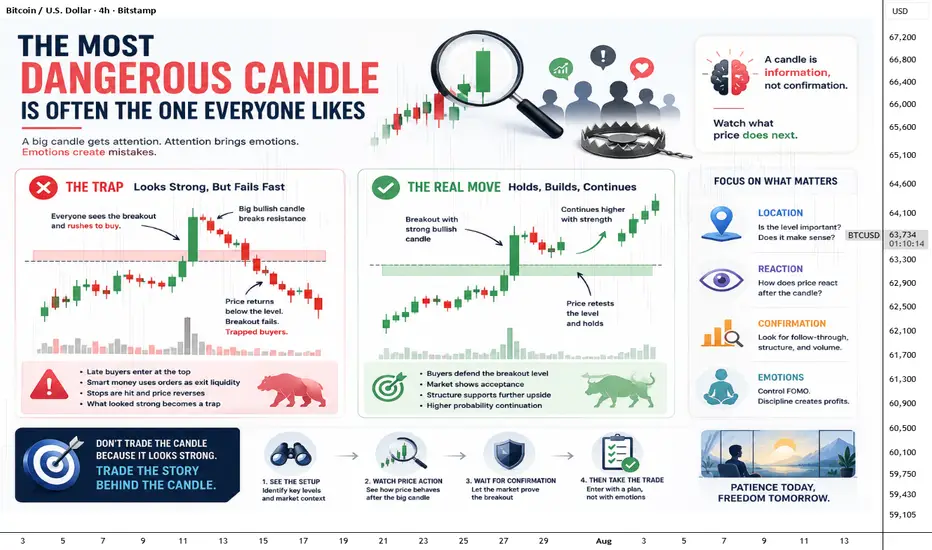
A large bullish or bearish candle is one of the most attractive things on a chart. When traders see a strong green candle breaking a resistance level, the immediate thought is often, “The trend has started.” When a large red candle breaks support, many immediately expect further downside. The candle looks powerful, clean and convincing. But sometimes, that is exactly what makes it dangerous.
The problem is not the candle itself. The problem is what happens after everyone notices it. A strong candle attracts attention because it shows urgency. Traders who were waiting for confirmation enter late, breakout traders jump in, and traders who were on the opposite side may rush to exit. This sudden increase in participation can push price even further, making the move look stronger than it really is.
A Strong Candle Can Hide Weak Positioning
Imagine a stock has been moving sideways for several days. Suddenly, a huge green candle breaks above the range. The candle closes near its high, volume increases and everything looks bullish.
A trader who sees this for the first time may think the safest decision is to buy immediately.
But there is an important question to ask:
Who is buying at this point?
Some traders may have bought much earlier near the bottom of the range. They are already sitting on profits. New buyers, however, are entering after price has already moved significantly.
This creates an interesting situation. The candle may represent genuine buying, but it may also become the point where late buyers enter just before existing holders start taking profits.
That is why a strong candle should not automatically be treated as a signal to enter.
The Candle Is Information, Not Confirmation
One of the biggest mistakes traders make is treating one candle as a complete story.
A candle only tells us what happened during a particular period. It does not tell us what will happen next.
A large breakout candle tells us that buyers were aggressive during that period. It does not guarantee that buyers will remain aggressive afterward.
The next few candles are often more important.
If price breaks resistance and continues holding above it, the breakout becomes more convincing. But if price quickly falls back below the breakout level, the meaning of that original candle changes completely.
What looked like strength may have been a trap.
The Real Danger Comes From Chasing
There is nothing wrong with buying a breakout. The danger comes from buying simply because the candle looks impressive.
This is where emotions take over.
A trader sees price moving quickly and feels that waiting means missing the opportunity. The candle becomes bigger, the fear of missing out becomes stronger, and the trader enters without thinking about where the trade is invalidated.
Ironically, the stronger the candle looks, the more tempting it can be to chase.
Good trading is often about doing the opposite: when everyone is excited, slow down and examine the structure.
Ask where price was before the candle appeared. Ask whether the breakout is happening from an important level. Ask whether the candle is closing outside the range or merely pushing through it temporarily.
These questions are more useful than simply asking whether the candle is bullish or bearish.
Watch What Happens After the Candle
The candle itself is not the final signal. The reaction after it is often more valuable.
Suppose a stock produces a massive bullish candle above resistance. Instead of buying immediately, watch what happens next.
If price pulls back slightly, holds the breakout area and then starts moving higher again, the market is showing that buyers are willing to defend the new level.
But if price quickly falls back into the previous range, the breakout deserves much more suspicion.
The same logic works on the downside.
A huge red candle breaking support may look extremely bearish. But if price immediately recovers and closes back above the broken support, the breakdown may have simply collected stop-loss orders before reversing.
This is why the candle after the big candle can sometimes tell you more than the big candle itself.
Look at the Location, Not Just the Candle
A large candle in the middle of nowhere is not the same as a large candle appearing at an important market structure.
This is one of the simplest ways to improve candle analysis.
A huge bullish candle after a long decline and near a major support zone has a different meaning from a huge bullish candle that appears after price has already rallied sharply into resistance.
The shape may be almost identical.
The context is completely different.
Instead of asking:
“Is this a strong candle?”
Ask:
“Where did this strong candle appear?”
That small change in thinking can prevent many impulsive trades.
Sometimes the Best Trade Is the Second Move
You do not have to catch the first move.
This is something many traders struggle to accept.
Markets give multiple opportunities. If a huge candle breaks a level, you can wait for the market to prove whether that breakout is genuine.
Sometimes price will retest the broken level. Sometimes it will form a small consolidation above it. Sometimes it will completely reject the breakout.
Waiting may mean entering at a slightly higher or lower price than the first candle, but you may gain something much more valuable: **better information**.
The goal is not to enter as early as possible.
The goal is to enter when the probability and risk make sense.
The Lesson:
A powerful candle deserves attention, but it does not automatically deserve a trade.
The most dangerous candle can sometimes be the one that looks perfect because it creates the strongest emotional reaction. Everyone sees it. Everyone talks about it. Everyone wants to participate.
That is exactly when a trader should stop and ask what the market is actually doing.
A candle is only one piece of information. Its location, the preceding structure, volume, follow-through and reaction around the breakout level all matter.
The market does not reward the trader who reacts fastest to every impressive candle. It rewards the trader who understands why that candle appeared and what price does next.
The problem is not the candle itself. The problem is what happens after everyone notices it. A strong candle attracts attention because it shows urgency. Traders who were waiting for confirmation enter late, breakout traders jump in, and traders who were on the opposite side may rush to exit. This sudden increase in participation can push price even further, making the move look stronger than it really is.
A Strong Candle Can Hide Weak Positioning
Imagine a stock has been moving sideways for several days. Suddenly, a huge green candle breaks above the range. The candle closes near its high, volume increases and everything looks bullish.
A trader who sees this for the first time may think the safest decision is to buy immediately.
But there is an important question to ask:
Who is buying at this point?
Some traders may have bought much earlier near the bottom of the range. They are already sitting on profits. New buyers, however, are entering after price has already moved significantly.
This creates an interesting situation. The candle may represent genuine buying, but it may also become the point where late buyers enter just before existing holders start taking profits.
That is why a strong candle should not automatically be treated as a signal to enter.
The Candle Is Information, Not Confirmation
One of the biggest mistakes traders make is treating one candle as a complete story.
A candle only tells us what happened during a particular period. It does not tell us what will happen next.
A large breakout candle tells us that buyers were aggressive during that period. It does not guarantee that buyers will remain aggressive afterward.
The next few candles are often more important.
If price breaks resistance and continues holding above it, the breakout becomes more convincing. But if price quickly falls back below the breakout level, the meaning of that original candle changes completely.
What looked like strength may have been a trap.
The Real Danger Comes From Chasing
There is nothing wrong with buying a breakout. The danger comes from buying simply because the candle looks impressive.
This is where emotions take over.
A trader sees price moving quickly and feels that waiting means missing the opportunity. The candle becomes bigger, the fear of missing out becomes stronger, and the trader enters without thinking about where the trade is invalidated.
Ironically, the stronger the candle looks, the more tempting it can be to chase.
Good trading is often about doing the opposite: when everyone is excited, slow down and examine the structure.
Ask where price was before the candle appeared. Ask whether the breakout is happening from an important level. Ask whether the candle is closing outside the range or merely pushing through it temporarily.
These questions are more useful than simply asking whether the candle is bullish or bearish.
Watch What Happens After the Candle
The candle itself is not the final signal. The reaction after it is often more valuable.
Suppose a stock produces a massive bullish candle above resistance. Instead of buying immediately, watch what happens next.
If price pulls back slightly, holds the breakout area and then starts moving higher again, the market is showing that buyers are willing to defend the new level.
But if price quickly falls back into the previous range, the breakout deserves much more suspicion.
The same logic works on the downside.
A huge red candle breaking support may look extremely bearish. But if price immediately recovers and closes back above the broken support, the breakdown may have simply collected stop-loss orders before reversing.
This is why the candle after the big candle can sometimes tell you more than the big candle itself.
Look at the Location, Not Just the Candle
A large candle in the middle of nowhere is not the same as a large candle appearing at an important market structure.
This is one of the simplest ways to improve candle analysis.
A huge bullish candle after a long decline and near a major support zone has a different meaning from a huge bullish candle that appears after price has already rallied sharply into resistance.
The shape may be almost identical.
The context is completely different.
Instead of asking:
“Is this a strong candle?”
Ask:
“Where did this strong candle appear?”
That small change in thinking can prevent many impulsive trades.
Sometimes the Best Trade Is the Second Move
You do not have to catch the first move.
This is something many traders struggle to accept.
Markets give multiple opportunities. If a huge candle breaks a level, you can wait for the market to prove whether that breakout is genuine.
Sometimes price will retest the broken level. Sometimes it will form a small consolidation above it. Sometimes it will completely reject the breakout.
Waiting may mean entering at a slightly higher or lower price than the first candle, but you may gain something much more valuable: **better information**.
The goal is not to enter as early as possible.
The goal is to enter when the probability and risk make sense.
The Lesson:
A powerful candle deserves attention, but it does not automatically deserve a trade.
The most dangerous candle can sometimes be the one that looks perfect because it creates the strongest emotional reaction. Everyone sees it. Everyone talks about it. Everyone wants to participate.
That is exactly when a trader should stop and ask what the market is actually doing.
A candle is only one piece of information. Its location, the preceding structure, volume, follow-through and reaction around the breakout level all matter.
Don't trade the candle because it looks strong. Trade the story behind the candle.
The market does not reward the trader who reacts fastest to every impressive candle. It rewards the trader who understands why that candle appeared and what price does next.

Bài đăng liên quan
Thông báo miễn trừ trách nhiệm
Thông tin và các ấn phẩm này không nhằm mục đích, và không cấu thành, lời khuyên hoặc khuyến nghị về tài chính, đầu tư, giao dịch hay các loại khác do TradingView cung cấp hoặc xác nhận. Đọc thêm tại Điều khoản Sử dụng.
Bài đăng liên quan
Thông báo miễn trừ trách nhiệm
Thông tin và các ấn phẩm này không nhằm mục đích, và không cấu thành, lời khuyên hoặc khuyến nghị về tài chính, đầu tư, giao dịch hay các loại khác do TradingView cung cấp hoặc xác nhận. Đọc thêm tại Điều khoản Sử dụng.